Búsquedas
Searching for strings
Advanced queries using boolean operations, parentheses, or field specific lookup can be used to find the strings you want.
Cuando no se define ningún campo, la búsqueda se efectúa en las cadenas de origen, de destino y de contexto.
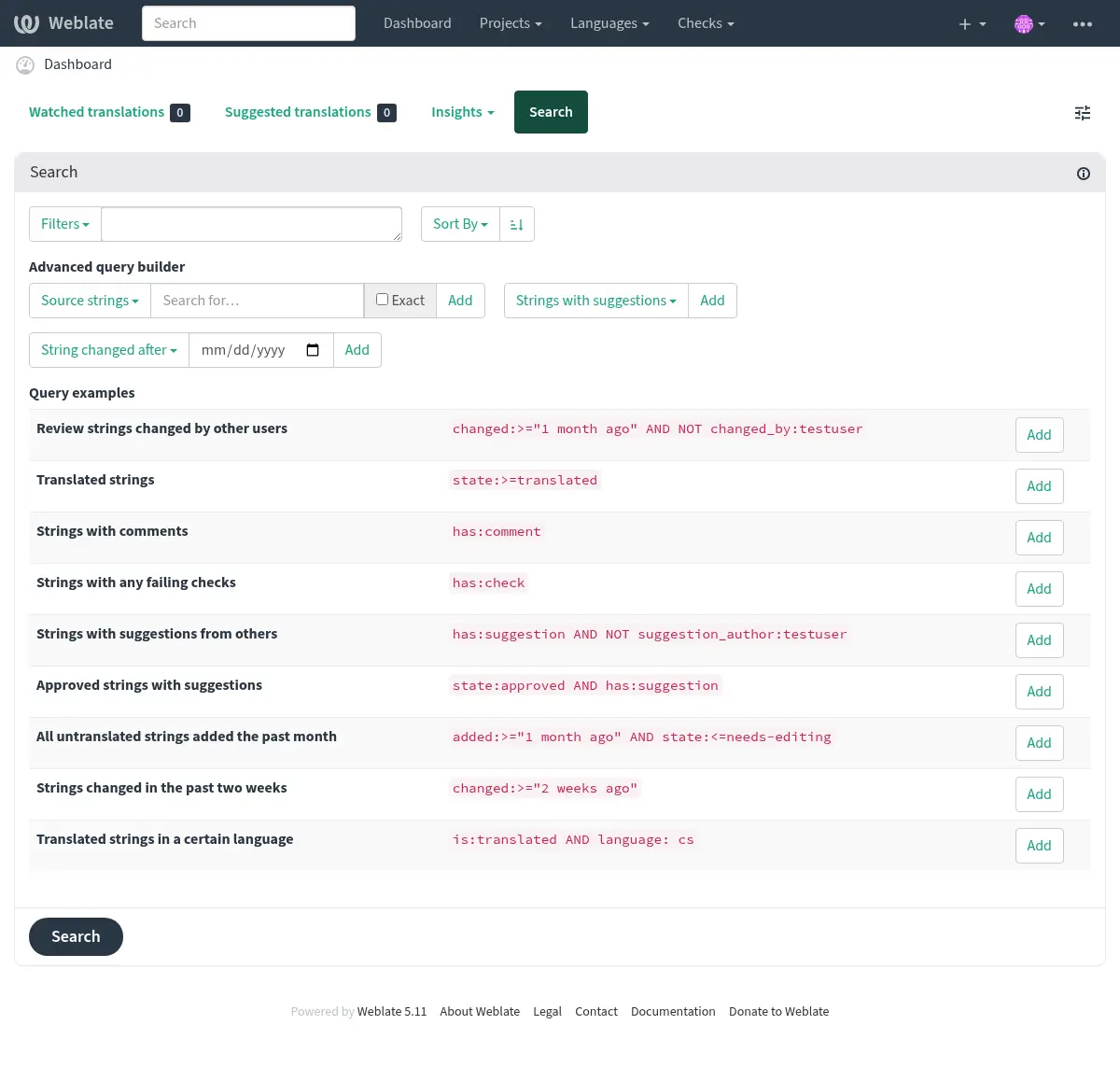
Búsqueda sencilla
Any phrase typed into the search box is split into words. Strings containing all
of them are shown. To look for an exact phrase, put «the searchphrase» into
quotes (both single (') and double (") quotes will work): "this is a quoted
string" or 'another quoted string'.
Campos
source:TEXTBúsqueda insensible a mayúsculas y minúsculas de la cadena de origen.
target:TEXTTarget string case-insensitive search.
context:TEXTContext string case-insensitive search.
key:TEXTKey string case-insensitive search.
note:TEXTCadena de origen descripción búsqueda insensible a mayúsculas y minúsculas.
location:TEXTLocation string case-insensitive search.
priority:NUMBERString priority.
id:NUMBERString unique identifier.
position:NUMBERString position in the translation file.
added:DATETIMEMarca de tiempo de cuando la cadena fue añadida a Weblate.
state:TEXTSearch for string states (
approved,translated,needs-editing,empty,read-only).This field also supports Operadores de campo, so searching for completed strings can be performed as
state:>=translated, searching for strings needing translation asstate:<translated.source_state:TEXTSearch for source string states, see above for more info.
pending:BOOLEANString pending for flushing to VCS.
has:TEXTSearch for string having attributes -
plural,context,suggestion,comment,check,dismissed-check,translation,variant,screenshot,flags,explanation,glossary,note,label.is:TEXTFilters string on a condition:
read-onlyorreadonlyRead-only strings, same as
state:read-only.approvedApproved strings, same as
state:approved.needs-editingorfuzzyNeeding editing strings, same as
state:needs-editing.translatedTranslated strings, same as
state:>translated.untranslatedUntranslated strings, same as
state:<translated.pendingPending strings not yet committed to the file (see Consignas diferidas).
language:TEXTString target language.
component:TEXTComponent slug or name case-insensitive search, see «Slug» del componente and Nombre de componente.
project:TEXTProject slug, see «Slug» del URL.
path:TEXTPath to the object to limit searching inside component, category, project, or translation.
changed_by:TEXTString was changed by author with given username.
changed:DATETIMEEl contenido de la cadena se modificó en la fecha, admite Operadores de campo.
change_time:DATETIMELa cadena se modificó el día , admite Operadores de campo, a diferencia de
changedesto incluye eventos que no cambian el contenido y puede aplicar filtros de acciones personalizados usandochange_action.change_action:TEXTFiltros de acciones de cambio, útiles junto con
change_time. Acepta el nombre en inglés de la acción de cambio, ya sea entre comillas y con espacios o en minúsculas y espacios reemplazados por un guion. Consulte Searching for changes para ver ejemplos.source_changed:DATETIMELa cadena de origen se modificó el día , admite Operadores de campo.
check:TEXTString has failing check, see Comprobaciones y correcciones for check identifiers.
dismissed_check:TEXTString has dismissed check, see Comprobaciones y correcciones for check identifiers.
comment:TEXTSearch in user comments.
resolved_comment:TEXTBuscar en comentarios resueltos.
comment_author:TEXTFilter by comment author.
suggestion:TEXTSearch in suggestions.
suggestion_author:TEXTFilter by suggestion author.
explanation:TEXTBuscar en las explicaciones.
label:TEXTBuscar en las etiquetas.
screenshot:TEXTBuscar en capturas de pantalla.
Operadores booleanos
You can combine lookups using AND, OR, NOT and parentheses to
form complex queries.
The NOT operator has higher precedence than the AND operator; the
AND operator has higher precedence than the OR operator. You can add
parenthesis to define a precedence of your own.
Omitting the operator will make the query behave like the AND operator was
used.
|
Parenthesized expression to clearly show the precedence. |
|
The |
|
Query using an implicit |
Operadores de campo
Puede especificar operadores, rangos o búsquedas parciales para búsquedas de fecha o numéricas:
state:>=translatedState is
translatedor better (approved).changed:2019Changed in year 2019.
changed:[2019-03-01 to 2019-04-01]Cambiado entre dos fechas determinadas.
position:[10 to 100]Strings with position between 10 and 100 (inclusive).
Operadores exactos
You can do an exact match query on different string fields using = operator. For example, to
search for all source strings exactly matching hello world, use: source:="hello world".
For searching single word expressions, you can skip quotes. For example, to search for all source strings
matching hello, you can use: source:=hello.
Searching for changes
Added in version 4.4.
La búsqueda de eventos históricos puede realizarse mediante los operadores change_action y change_time.
Por ejemplo, la búsqueda de cadenas marcadas para edición en 2018 puede introducirse como change_time:2018 AND change_action:marked-for-edit o change_time:2018 AND change_action: "Marcado para edición".
Expresiones regulares
Anywhere text is accepted you can also specify a regular expression as r"regexp".
For example, to search for all source strings which contain any digit between 2
and 5, use source:r"[2-5]".
Consejo
Las expresiones regulares son evaluadas por el backend de la base de datos y pueden utilizar diferentes extensiones, por favor consulte la documentación de la base de datos para más detalles.
PostgreSQL Regular Expressions Details (this is the default database engine for Weblate)
Consultas predefinidas
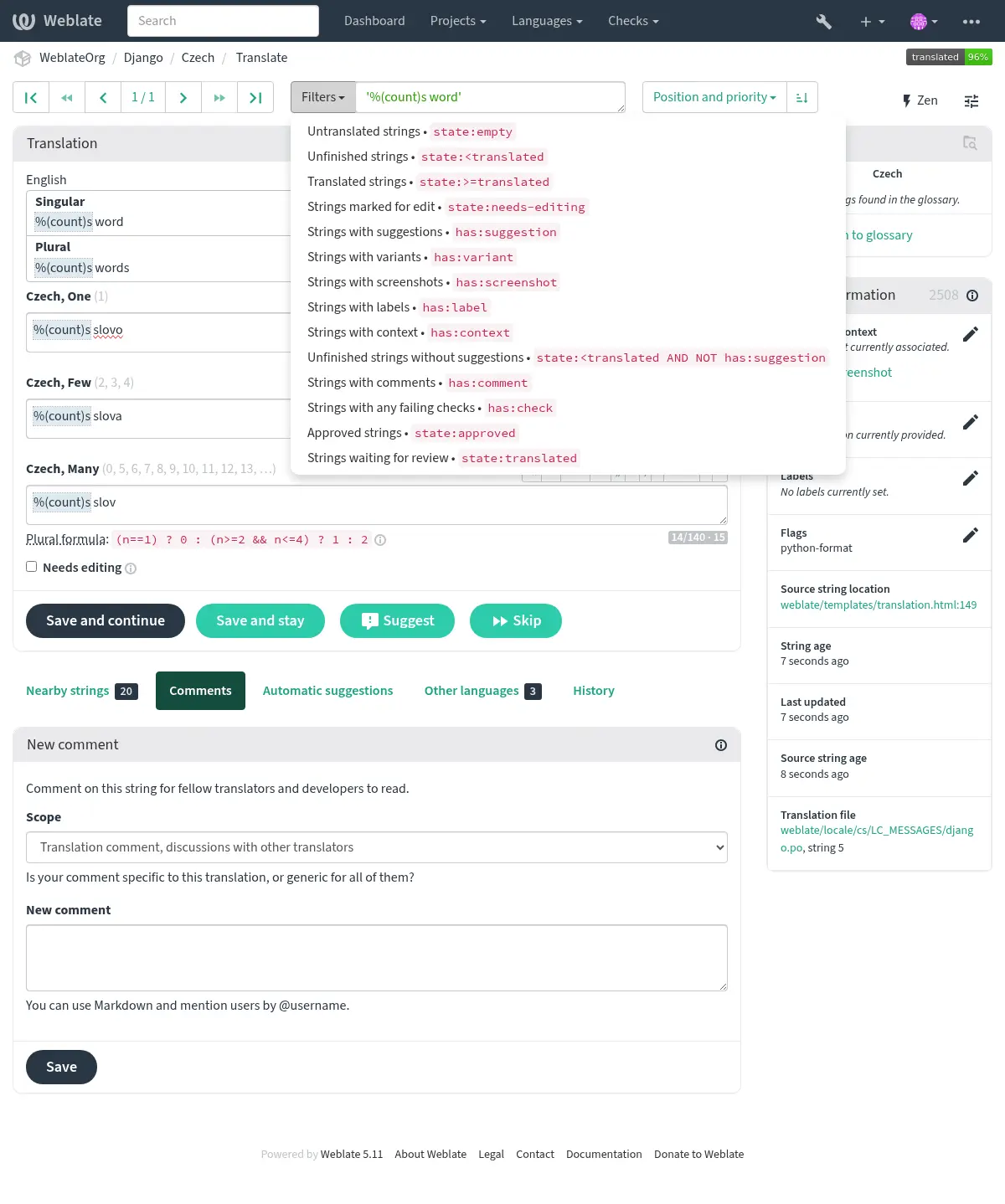
You can select out of predefined queries on the search page, this allows you to quickly access the most frequent searches:
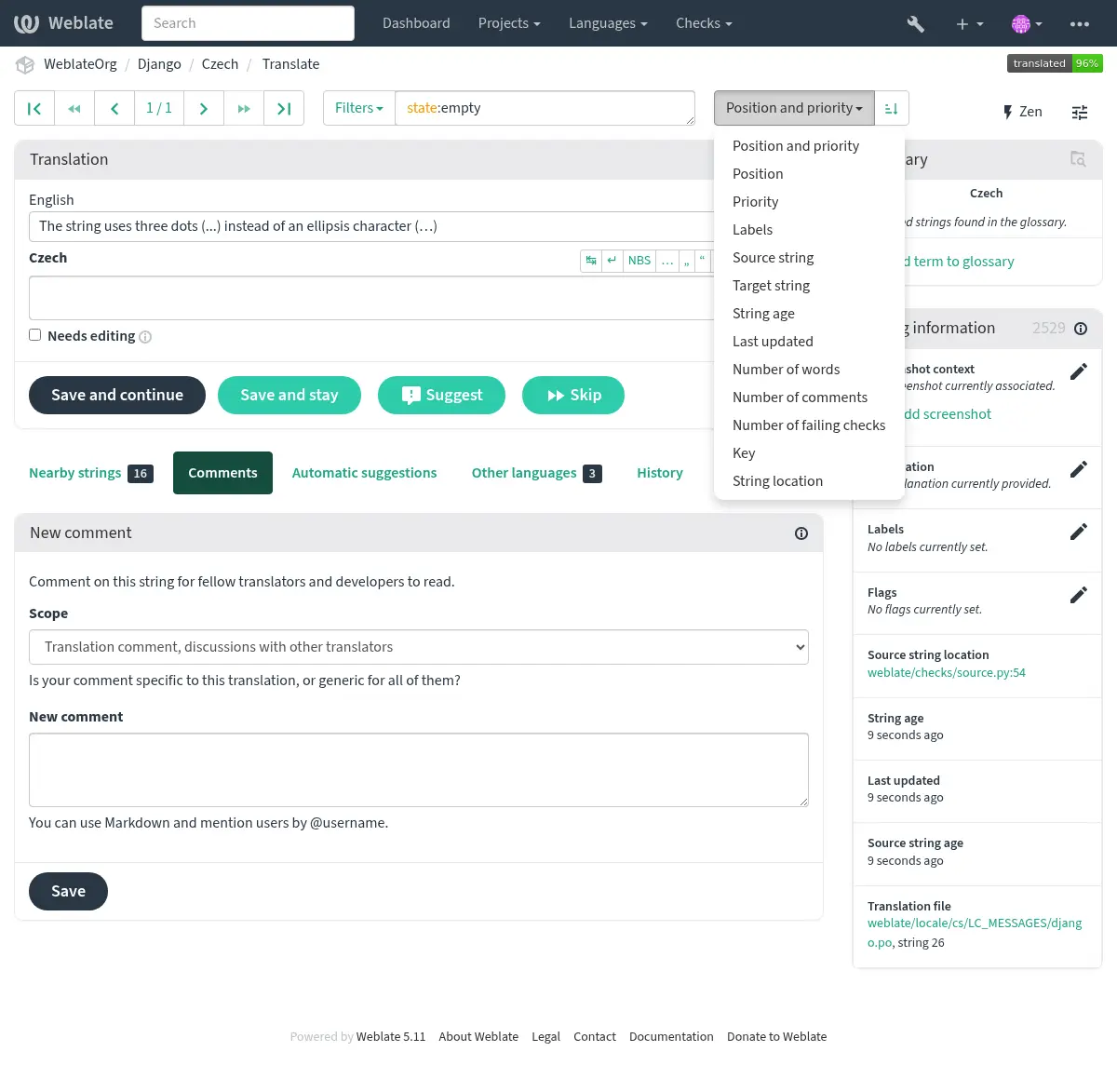
Ordenar los resultados
There are many options to order the strings according to your needs:
Searching for users
Added in version 4.18.
The user browsing has similar search abilities:
username:TEXTSearch in usernames.
full_name:TEXTSearch in full names.
language:TEXTUser configured translation language (see Idiomas traducidos).
joined:DATETIMEEl contenido de la cadena se modificó en la fecha, admite Operadores de campo.
translates:TEXTUser has contributed to a given language.
You might want to limit contribution time by
change_time, for examplechange_time:>"90 days ago".contributes:TEXTUser has contributed to a given project or component.
You might want to limit contribution time by
change_time, for examplechange_time:>"90 days ago".change_time:DATETIMESame as in Searching for strings.
change_action:TEXTSame as in Searching for strings.
Additional lookups are available in the Interfaz de administración:
is:botSearch for bots (used for project scoped tokens).
is:activeSearch for active users.
email:TEXTSearch by e-mail.
Valores difusos para los campos FECHA Y HORA
En lugar de utilizar valores DATETIME como DD-MM-AAAA, se puede utilizar una cadena que contenga adverbios de tiempo como «ayer», «el mes pasado» y «hace 2 días» como valores en los campos DATETIME.
Ejemplos:
changed:>="2 weeks ago"Devuelve cadenas que se modificaron hace 2 semanas desde la fecha y hora actuales.
changed:>=yesterdayDevuelve cadenas que se modificaron a partir de ayer.