Wyszukiwanie
Searching for strings
Advanced queries using boolean operations, parentheses, or field specific lookup can be used to find the strings you want.
When no field is defined, the lookup happens on source, target, and context strings.
Proste wyszukiwanie
Any phrase typed into the search box is split into words. Strings containing all
of them are shown. To look for an exact phrase, put „the searchphrase” into
quotes (both single (') and double (") quotes will work): "this is a quoted
string" or 'another quoted string'.
Pola
source:TEXTWyszukiwanie bez rozróżniania wielkości liter w ciągu źródłowym.
target:TEXTTarget string case-insensitive search.
context:TEXTContext string case-insensitive search.
key:TEXTKey string case-insensitive search.
note:TEXTWyszukiwanie bez rozróżniania wielkości liter w opisie ciągu źródłowego.
location:TEXTLocation string case-insensitive search.
priority:NUMBERPriorytet ciągu.
id:NUMBERUnikalny identyfikator ciągu tekstowego.
position:NUMBERPozycja ciągu tekstowego w pliku tłumaczenia.
added:DATETIMETimestamp for when the string was added to Weblate.
state:TEXTSearch for string states (
approved,translated,needs-editing,empty,read-only).This field also supports Operatory pól, so searching for completed strings can be performed as
state:>=translated, searching for strings needing translation asstate:<translated.pending:BOOLEANString pending for flushing to VCS.
has:TEXTSearch for string having attributes -
plural,context,suggestion,comment,check,dismissed-check,translation,variant,screenshot,flags,explanation,glossary,note,label.is:TEXTFilters string on a condition:
read-onlyorreadonlyRead-only strings, same as
state:read-only.approvedApproved strings, same as
state:approved.needs-editingorfuzzyNeeding editing strings, same as
state:needs-editing.translatedTranslated strings, same as
state:>translated.untranslated:Untranslated strings, same as
state:<translated.pendingPending strings not yet committed to the file (see Leniwe zatwierdzenia).
language:TEXTDocelowy język ciągu.
component:TEXTComponent slug or name case-insensitive search, see Końcówka adresu URL komponentu and Nazwa komponentu.
project:TEXTProject slug, see Końcówka adresu URL.
path:TEXTPath to the object to limit searching inside component, category, project, or translation.
changed_by:TEXTString was changed by author with given username.
changed:DATETIMEString content was changed on date, supports Operatory pól.
change_time:DATETIMEString was changed on date, supports Operatory pól, unlike
changedthis includes event which don’t change content and you can apply custom action filtering usingchange_action.change_action:TEXTFilters on change action, useful together with
change_time. Accepts English name of the change action, either quoted and with spaces or lowercase and spaces replaced by a hyphen. See Wyszukiwanie zmian for examples.source_changed:DATETIMESource string was changed on date, supports Operatory pól.
check:TEXTString has failing check, see Kontrole i korekty for check identifiers.
dismissed_check:TEXTString has dismissed check, see Kontrole i korekty for check identifiers.
comment:TEXTSzukaj w komentarzach użytkowników.
resolved_comment:TEXTSzukaj w rozwiązanych komentarzach.
comment_author:TEXTFiltruj według autora komentarza.
suggestion:TEXTSzukaj w sugestiach.
suggestion_author:TEXTFiltruj według autora sugestii.
explanation:TEXTSzukaj w objaśnieniach.
label:TEXTSzukaj w etykietach.
screenshot:TEXTSzukaj w zrzutach ekranu.
Operatory logiczne
You can combine lookups using AND, OR, NOT and parentheses to
form complex queries. For example: state:translated AND (source:hello OR source:bar)
Operatory pól
You can specify operators, ranges or partial lookups for date or numeric searches:
state:>=translatedState is
translatedor better (approved).changed:2019Zmieniono w roku 2019.
changed:[2019-03-01 to 2019-04-01]Changed between two given dates.
position:[10 to 100]Strings with position between 10 and 100 (inclusive).
Dokładne operatory
You can do an exact match query on different string fields using = operator. For example, to
search for all source strings exactly matching hello world, use: source:="hello world".
For searching single word expressions, you can skip quotes. For example, to search for all source strings
matching hello, you can use: source:=hello.
Wyszukiwanie zmian
Added in version 4.4.
Searching for history events can be done using change_action and
change_time operators.
For example, searching for strings marked for edit in 2018 can be entered as
change_time:2018 AND change_action:marked-for-edit or
change_time:2018 AND change_action:"Marked for edit".
Wyrażenie regularne
Anywhere text is accepted you can also specify a regular expression as r"regexp".
For example, to search for all source strings which contain any digit between 2
and 5, use source:r"[2-5]".
Podpowiedź
The regular expressions are evaluated by the database backend and might use different extensions, please consult the database documentation below for more details.
PostgreSQL Regular Expressions Details (this is the default database engine for Weblate)
Wstępnie zdefiniowane zapytania
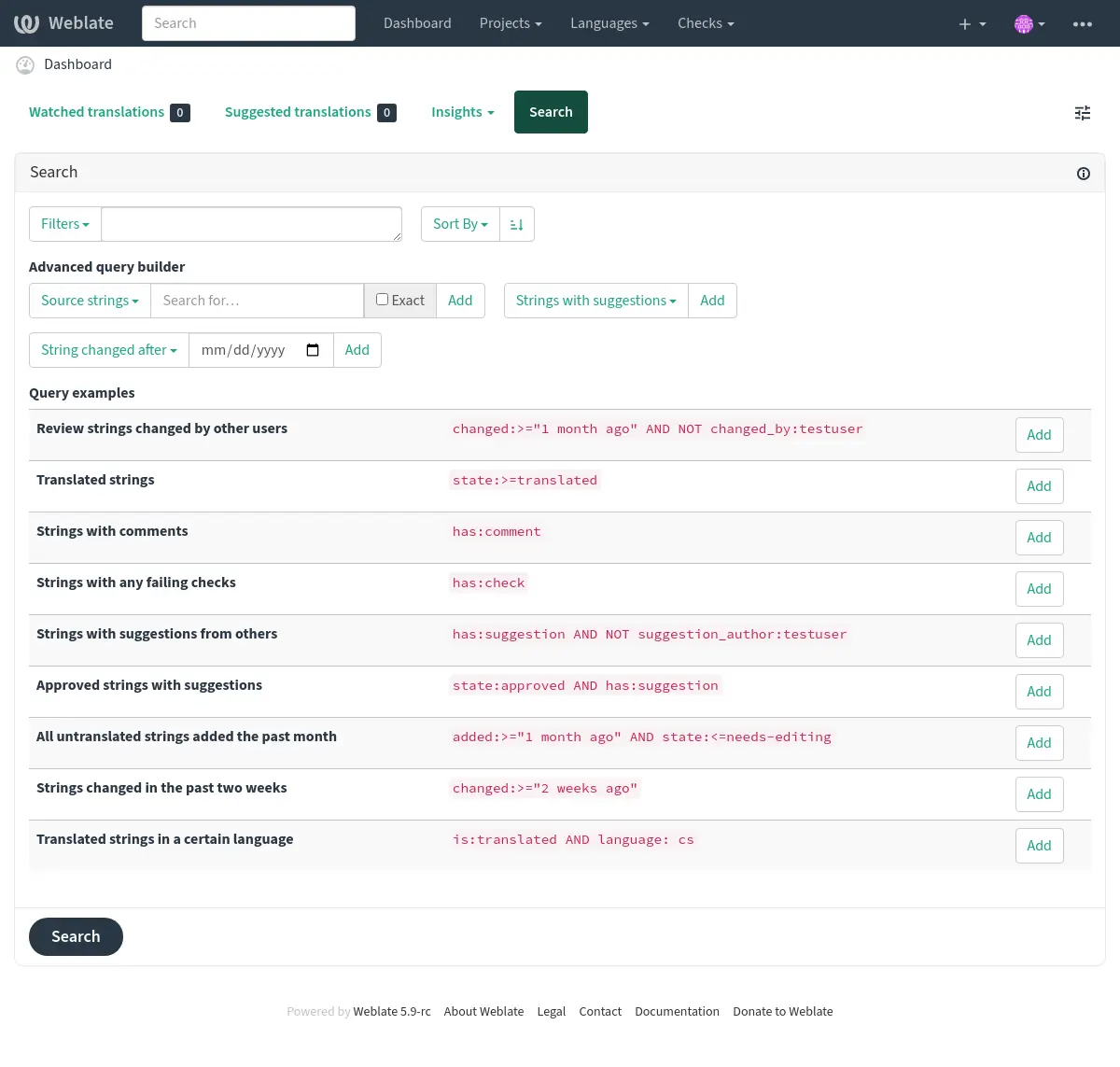
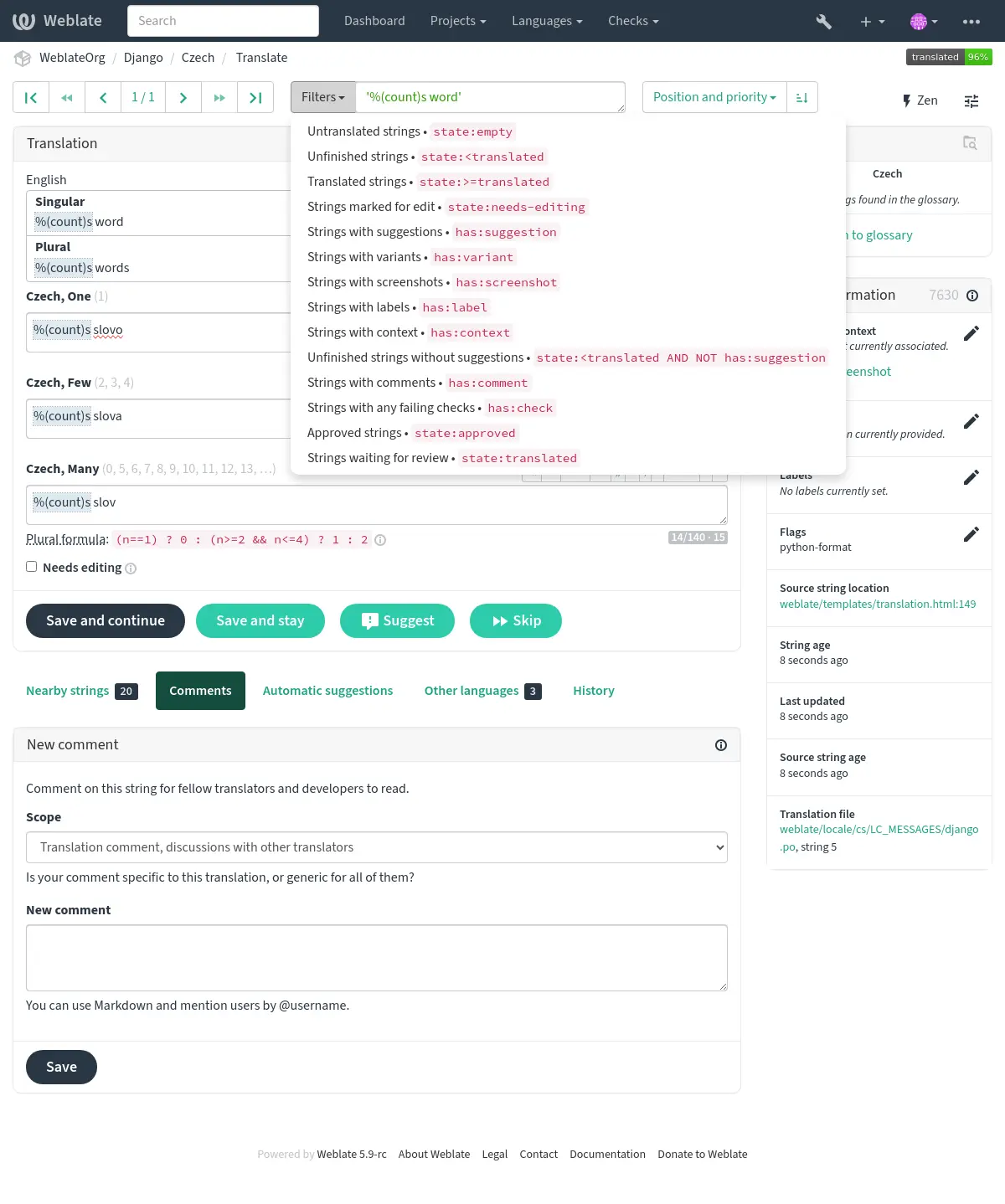
You can select out of predefined queries on the search page, this allows you to quickly access the most frequent searches:
Ordering the results
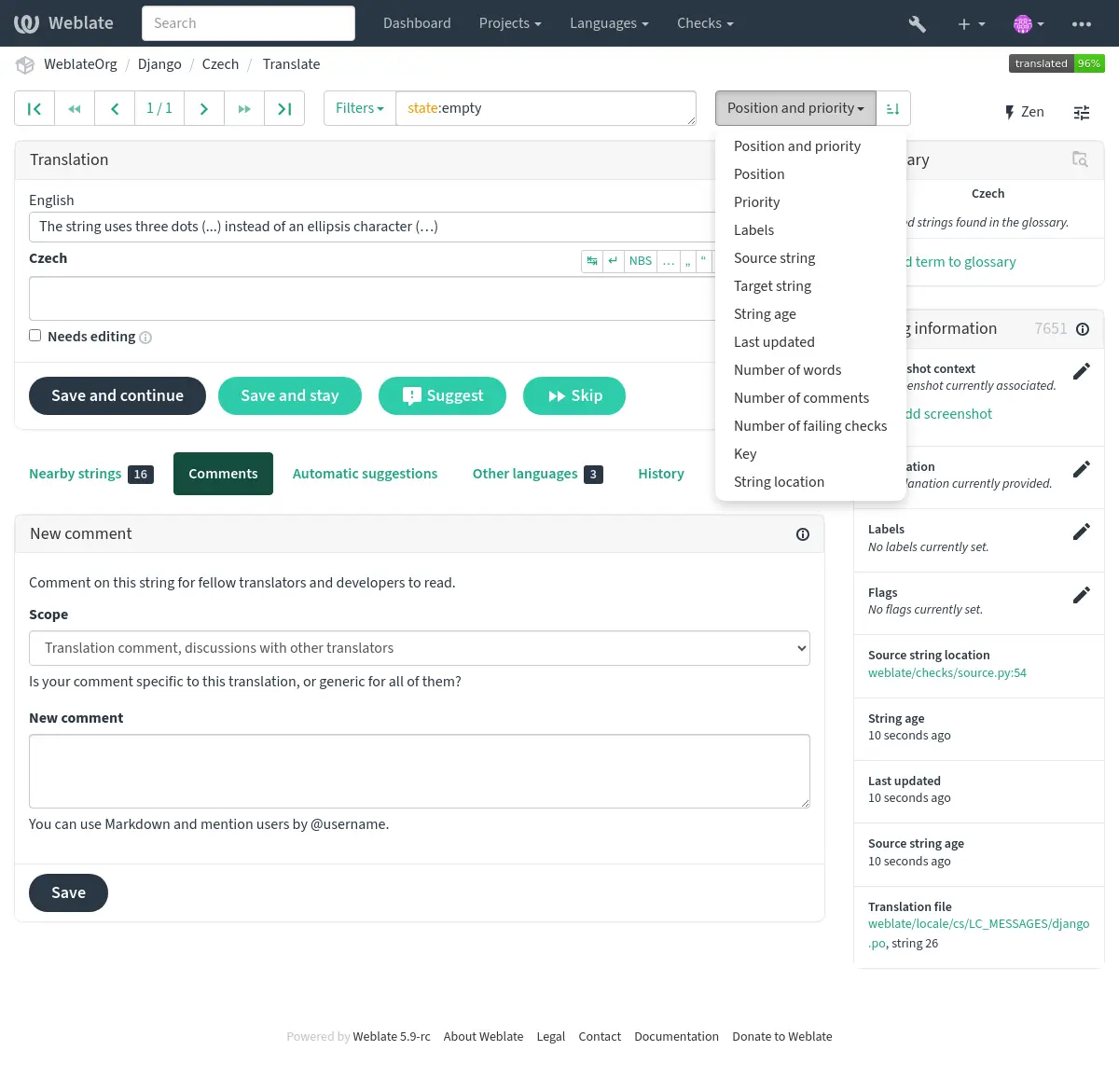
There are many options to order the strings according to your needs:
Searching for users
Added in version 4.18.
The user browsing has similar search abilities:
username:TEXTSearch in usernames.
full_name:TEXTSearch in full names.
language:TEXTUser configured translation language (see Tłumaczone języki).
joined:DATETIMEString content was changed on date, supports Operatory pól.
translates:TEXTUser has contributed to a given language in the past 90 days.
contributes:TEXTUser has contributed to a given project or component in the past 90 days.
change_time:DATETIMESame as in Searching for strings.
change_action:TEXTSame as in Searching for strings.
Additional lookups are available in the Interfejs zarządzania:
is:botSearch for bots (used for project scoped tokens).
is:activeWyszukaj aktywnych użytkowników.
email:TEXTSearch by e-mail.
Fuzzy values for DATETIME fields
Instead of using DATETIME values like MM-DD-YYYY, a string containing adverb
of time like yesterday, last month, and 2 days ago can be used as
values in the DATETIME fields.
Przykłady:
changed:>="2 weeks ago"Returns strings that are changed 2 weeks ago from the current date and time.
changed:>=yesterdayReturns strings that are changed starting yesterday.