Memorie de traducere
Weblate comes with a built-in translation memory consisting of:
Memorie de traducere importată manual (a se vedea Interfață utilizator).
Traduceri stocate automat efectuate în Weblate (în funcție de Translation-memory scopes).
A importat automat traducerile anterioare.
Content in the translation memory can be applied to strings in several ways:
User can accept suggestions from the Sugestii automate tab while editing the string.
The selected strings can be processed using Traducere automată from the Operations menu.
Traducere automată add-on can automatically apply changes to new and existing strings.
Pentru sfaturi de instalare, consultați Memorie de traducere Weblate, care este activat în mod implicit.
Translation-memory scopes
The translation-memory scopes ensure privacy for different projects and users. Sharing of translations is also available.
Memorie de traducere importată
Importing arbitrary translation memory data using the import_memory
command makes memory content available to all users and projects.
Per-user translation memory
Stochează automat toate traducerile utilizatorilor în memoria personală de traducere a fiecărui utilizator în parte.
The default value for new users is automatically adjusted based on the Autoclean translation memory configuration. If automatic cleanup is enabled, this is disabled by default to prevent reintroducing inconsistent translations.
Per-project translation memory
Toate traducerile din cadrul unui proiect sunt stocate automat într-o memorie de traducere a proiectului, disponibilă numai pentru acest proiect.
Stare memorie de traducere
Added in version 5.13.
Translation memory entries can have two different statuses: active and pending. Pending entries are included in suggestions, but with a quality penalty applied. If Autoclean translation memory is enabled, stale and obsolete entries with pending status are automatically removed when a translation is approved.
Autoclean translation memory
Added in version 5.13.
The translation memory is automatically cleaned up by removing obsolete and outdated entries.
In the Docker container this can be configured using WEBLATE_DEFAULT_AUTOCLEAN_TM.
Notă
Enabling automatic cleanup also changes the default for new user profiles to not contribute to personal translation memory. This prevents reintroducing inconsistent translations that were supposed to be cleaned up.
Vezi și
Managing the Translation Memory
Interfață utilizator
Personal translation memory management is available by clicking the user avatar in the top-right corner of the UI and selecting „Translation memory” from the dropdown menu. Entries attributed to the user are listed in scopes – total, for each respective project, component, or language contributed to, with options to download (as JSON, or TMX) or delete them.
In the basic user interface you can manage per-user and per-project translation memories. It can be used to download, wipe or import translation memory.
There are multiple options to download the translation memory of the whole instance.
Sugestie
Translation memories in various formats can be imported into Weblate, the TMX format is provided for interoperability with other tools. All supported formats are TMX, JSON, XLIFF, PO, CSV.
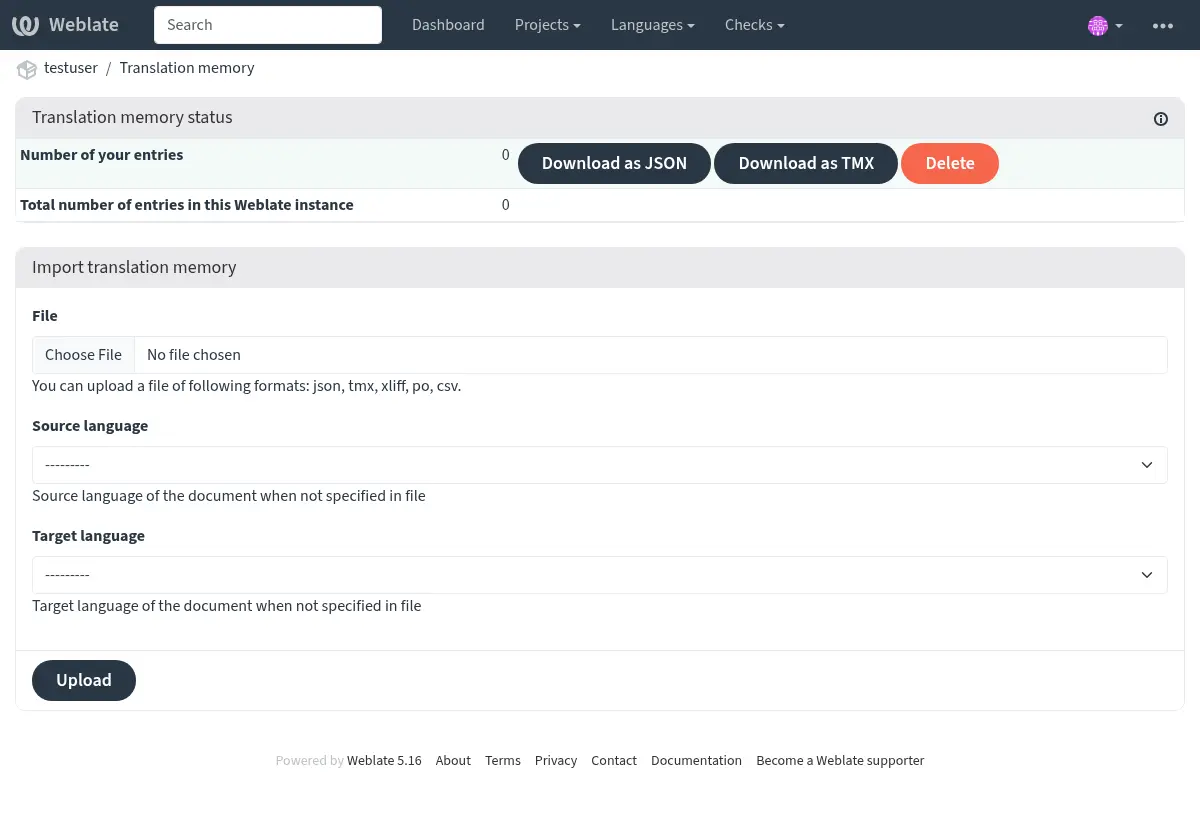
You can search for translations in the view built for this.
Admin interface
There is a platform-wide interface to manage the translation memory.
Added in version 4.12.
It has the same options as the user interface, but also allows rebuilding parts of or the entire translation memory. All old entries can be flushed and re-created from a component or project by selecting „Administration” from amidst the different tabs at the top of the screen, and then „Translation memory”.
Interfața de gestionare
Several management commands can manipulate translation memory content. These operate on the translation memory as a whole, unfiltered by scopes (unless requested by parameters):
dump_memoryExportă memoria în JSON
import_memoryImportă fișiere TMX sau JSON în memoria de traducere
cleanup_memoryRemoves all entries with pending status from the translation memory
Added in version 4.14.
The Weblate API covers the translation memory. This allows automated manipulation for different purposes, or based on events in the translation cycle.