Kontrole i korekty
The quality checks help catch common translator errors, ensuring the translation is in good shape. The checks can be ignored in case of false positives.
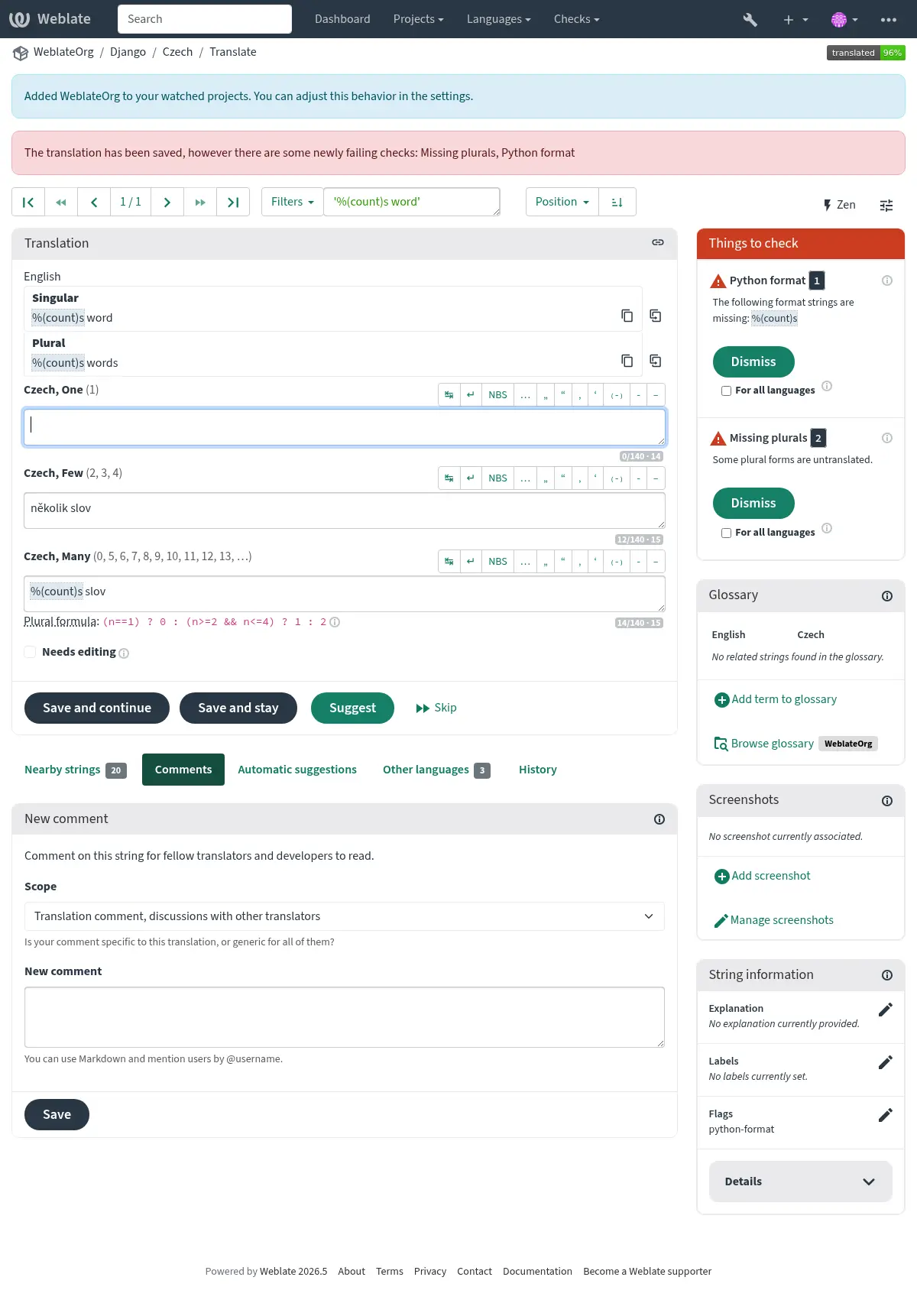
Once submitting a translation with a failing check, this is immediately shown to the user:
Automatyczne korekty
In addition to Kontrole jakości, Weblate can fix some common errors in translated strings automatically. Use it with caution to not have it add errors.
Zobacz także
Trailing ellipsis replacer
- Class name:
weblate.trans.autofixes.chars.ReplaceTrailingDotsWithEllipsis
Replace trailing dots (...) with an ellipsis (…) to make it consistent with the source string.
Zero-width space removal
- Class name:
weblate.trans.autofixes.chars.RemoveZeroSpace
Zero width space is typically not desired in the translation. This fix will remove it unless it is present in the source string as well.
Control characters removal
- Class name:
weblate.trans.autofixes.chars.RemoveControlChars
Removes control characters if the source does not contain any.
Devanagari danda
- Class name:
weblate.trans.autofixes.chars.DevanagariDanda
Replaces sentence full stop in Bangla by the Devanagari danda character (।).
Odstępy między czcionkami
- Class name:
weblate.trans.autofixes.chars.PunctuationSpacing
Dodane w wersji 5.3.
Ensures French uses correct punctuation spacing.
This fixup can be disabled via ignore-punctuation-spacing flag (which also
disables Odstępy między czcionkami).
Unsafe HTML cleanup
- Class name:
weblate.trans.autofixes.html.BleachHTML
Removes unsafe HTML markup from strings flagged as safe-html.
Zobacz także
Trailing and leading whitespace fixer
- Class name:
weblate.trans.autofixes.whitespace.SameBookendingWhitespace
Makes leading and trailing whitespace consistent with the source string. The
behavior can be fine-tuned using ignore-begin-space and
ignore-end-space flags to skip processing parts of the string.
Kontrole jakości
Weblate employs a wide range of quality checks on strings. The following section describes them all in further detail. There are also language specific checks. Please file a bug if anything is reported in error.
Zobacz także
Sprawdzanie tłumaczeń
Executed upon every translation change, helping translators maintain good quality translations.
Znaczniki BBCode
Zmienione w wersji 5.10: This checks no longer relies on unreliable automatic detection, it now needs to be turned on using the bbcode-text flag.
- Podsumowanie:
BBCode w tłumaczeniu nie pasuje do źródła.
- Zakres:
przetłumaczone ciągi
- Sprawdź klasę:
weblate.checks.markup.BBCodeCheck- Check identifier:
bbcode- Trigger:
This check needs to be enabled using a flag.
- Dostępna flaga:
bbcode-text- Flaga do zignorowania:
ignore-bbcode
BBCode represents simple markup, like for example highlighting important parts of a message in bold font, or italics.
This check ensures they are also found in translation.
Informacja
The method for detecting BBCode is currently quite simple so this check might produce false positives.
Kolejne zduplikowane wyrazy
Dodane w wersji 4.1.
- Podsumowanie:
Tekst zawiera to samo słowo dwa razy z rzędu.
- Zakres:
przetłumaczone ciągi
- Sprawdź klasę:
weblate.checks.duplicate.DuplicateCheck- Check identifier:
duplicate- Trigger:
This check is always enabled but can be ignored using a flag.
- Flaga do zignorowania:
ignore-duplicate
Checks that no consecutive duplicate words occur in a translation. This usually indicates a mistake in the translation.
Podpowiedź
This check includes language specific rules to avoid false positives. In case it triggers falsely in your case, let us know. See Zgłaszanie problemów w Weblate.
Nie jest zgodny z słownikiem
Dodane w wersji 4.5.
- Podsumowanie:
Tłumaczenie nie jest zgodne z terminami zdefiniowanymi w słowniku.
- Zakres:
przetłumaczone ciągi
- Sprawdź klasę:
weblate.checks.glossary.GlossaryCheck- Check identifier:
check_glossary- Trigger:
This check needs to be enabled using a flag.
- Dostępna flaga:
check-glossary- Flaga do zignorowania:
ignore-check-glossary
This check has to be turned on using check-glossary flag (see
Dostosowywanie zachowania za pomocą flag). Please consider following prior to enabling it:
It does exact string matching, the glossary is expected to contain terms in all variants.
Checking each string against glossary is expensive, it will slow down any operation in Weblate which involves running checks like importing strings or translating.
It also utilizes untranslatable glossary terms in Niezmienione tłumaczenie.
Podwójna spacja
- Podsumowanie:
Tłumaczenie zawiera podwójną spację.
- Zakres:
przetłumaczone ciągi
- Sprawdź klasę:
weblate.checks.chars.DoubleSpaceCheck- Check identifier:
double_space- Trigger:
This check is always enabled but can be ignored using a flag.
- Flaga do zignorowania:
ignore-double-space
Checks that double space is present in translation to avoid false positives on other space-related checks.
Check is false when double space is found in source meaning double space is intentional.
Części Fluent
Dodane w wersji 5.0.
- Podsumowanie:
Części Fluent powinny pasować.
- Zakres:
przetłumaczone ciągi
- Sprawdź klasę:
weblate.checks.fluent.parts.FluentPartsCheck- Check identifier:
fluent-parts- Trigger:
This check needs to be enabled using a flag.
- File formats automatically enabling this check:
- Dostępna flaga:
fluent-parts- Flaga do zignorowania:
ignore-fluent-parts
Each Fluent Message can have an optional value (the main text content), and optional attributes, each of which is a „part” of the Message. In Weblate, all these parts appear within the same block, using Fluent-like syntax to specify the attributes. For example:
This is the Message value
.title = This is the title attribute
.alt = This is the alt attribute
This check ensures that the translated Message also has a value if the source Message has one, or no value if the source has none. This also checks that the same attributes used in the source Message also appear in the translation, with no additions.
Informacja
This check is not applied to Fluent Terms since Terms always have a value, and Term attributes tend to be locale-specific (used for grammar rules, etc.), and are not expected to appear in all translations.
Zobacz także
Odnośniki Fluent
Dodane w wersji 5.0.
- Podsumowanie:
Odnośniki Fluent powinny pasować.
- Zakres:
przetłumaczone ciągi
- Sprawdź klasę:
weblate.checks.fluent.references.FluentReferencesCheck- Check identifier:
fluent-references- Trigger:
This check needs to be enabled using a flag.
- File formats automatically enabling this check:
- Dostępna flaga:
fluent-references- Flaga do zignorowania:
ignore-fluent-references
A Fluent Message or Term can reference another Message, Term, Attribute, or a variable. For example:
Here is a { message }, a { message.attribute } a { -term } and a { $variable }.
Within a function { NUMBER($num, minimumFractionDigits: 2) }
Generally, translated Messages or Terms are expected to contain the same references as the source, although not necessarily in the same order of appearance. So this check ensures that translations use the same references in their value as the source value, the same number of times, and with no additions. For Messages, this will also check that each Attribute in the translation uses the same references as the matching Attribute in the source.
When the source or translation contains Fluent Select Expressions, then each possible variant in the source must be matched with at least one variant in the translation with the same references, and vice versa.
Moreover, if a variable reference appears both in the Select Expression’s selector and within one of its variants, then all variants may also be considered as if they also contain that reference. The assumption being that the variant’s key may have made the reference redundant for that variant. For example:
{ $num ->
    [one] an apple
   *[other] { $num } apples
}
Here, for the purposes of this check, the [one] variant will also be
considered to contain the $num reference.
However, a reference within the Select Expression’s selector, which can only be a variable of a Term Attribute in Fluent’s syntax, will not by itself count as a required reference because they do not form the actual text content of the string that the end-user will see, and the presence of a Select Expression is considered locale-specific. For example:
{ -term.starts-with-vowel ->
    [yes] an { -term }
   *[no] a { -term }
}
Here a reference to -term.starts-with-vowel is not expected to appear in
translations, but a reference to -term is.
Wewnętrzny HTML tłumaczenia Fluent
Dodane w wersji 5.0.
- Podsumowanie:
Docelowy Fluent powinien być prawidłowym wewnętrznym kodem HTML, który pasuje.
- Zakres:
przetłumaczone ciągi
- Sprawdź klasę:
weblate.checks.fluent.inner_html.FluentTargetInnerHTMLCheck- Check identifier:
fluent-target-inner-html- Trigger:
This check needs to be enabled using a flag.
- File formats automatically enabling this check:
- Dostępna flaga:
fluent-target-inner-html- Flaga do zignorowania:
ignore-fluent-target-inner-html
This check will verify that the translated value of a Message or Term contains the same HTML elements as the source value.
First, if the source value fails the Wewnętrzny HTML źródła Fluent check, then this check will do nothing. Otherwise, the translated value will also be checked under the same conditions.
Second, the HTML elements found in the translated value will be compared against the HTML elements found in the source value. Two elements will match if they share the exact same tag name, the exact same attributes and values, and all their ancestors match in the same way. This check will ensure that all the elements in the source appear somewhere in the translation, with the same number of appearances, and with no additional elements added. When there are multiple elements in the value, they need not appear in the same order in the translation value.
When the source or translation contains Fluent Select Expressions, then each possible variant in the source must be matched with at least one variant in the translation with the same HTML elements, and vice versa.
When using Fluent in combination with the Fluent DOM package, this check will
ensure that the translation also includes any required data-l10n-name
elements that appear in the source, or any of the allowed inline elements like
<br>.
For example, the following source:
Source message <img data-l10n-name="icon"/> with icon
would match with:
Translated message <img data-l10n-name="icon"/> with icon
but not:
Translated message <img data-l10n-name="new-val"/> with icon
nor
Translated message <br data-l10n-name="icon"/> with no icon
Zobacz także
Składnia tłumaczenia Fluent
Dodane w wersji 5.0.
- Podsumowanie:
Błąd składni Fluent w tłumaczeniu.
- Zakres:
przetłumaczone ciągi
- Sprawdź klasę:
weblate.checks.fluent.syntax.FluentTargetSyntaxCheck- Check identifier:
fluent-target-syntax- Trigger:
This check needs to be enabled using a flag.
- File formats automatically enabling this check:
- Dostępna flaga:
fluent-target-syntax- Flaga do zignorowania:
ignore-fluent-target-syntax
In Weblate, Fluent strings use Fluent syntax for references and variables, but also for more complex features like defining attributes and selector variants, including plurals. This check ensures that the syntax used in the translation will be valid for Fluent.
Formatowanie ciągów
Checks that the formatting in strings is replicated between both source and translation. Omitting format strings in translation usually causes severe problems, so the formatting in strings should usually match the source.
Weblate supports checking format strings in several languages. The check is not enabled automatically, only if a string is flagged appropriately (e.g. c-format for C format). Gettext adds this automatically, but you will probably have to add it manually for other file formats or if your PO files are not generated by xgettext.
Most of the format checks allow omitting format strings for plural forms having
a single count. This allows translators to write nicer strings for these cases
(One apple instead of %d apple). Turn this off by adding strict-format flag.
The flags can be customized per string (see Dodatkowe informacje o ciągach źródłowych) or in a Konfiguracja komponentu. Having it defined per component is simpler, but it can lead to false positives in case the string is not interpreted as a formatting string, but format string syntax happens to be used.
Podpowiedź
In case specific format check is not available in Weblate, you can use generic Symbole zastępcze.
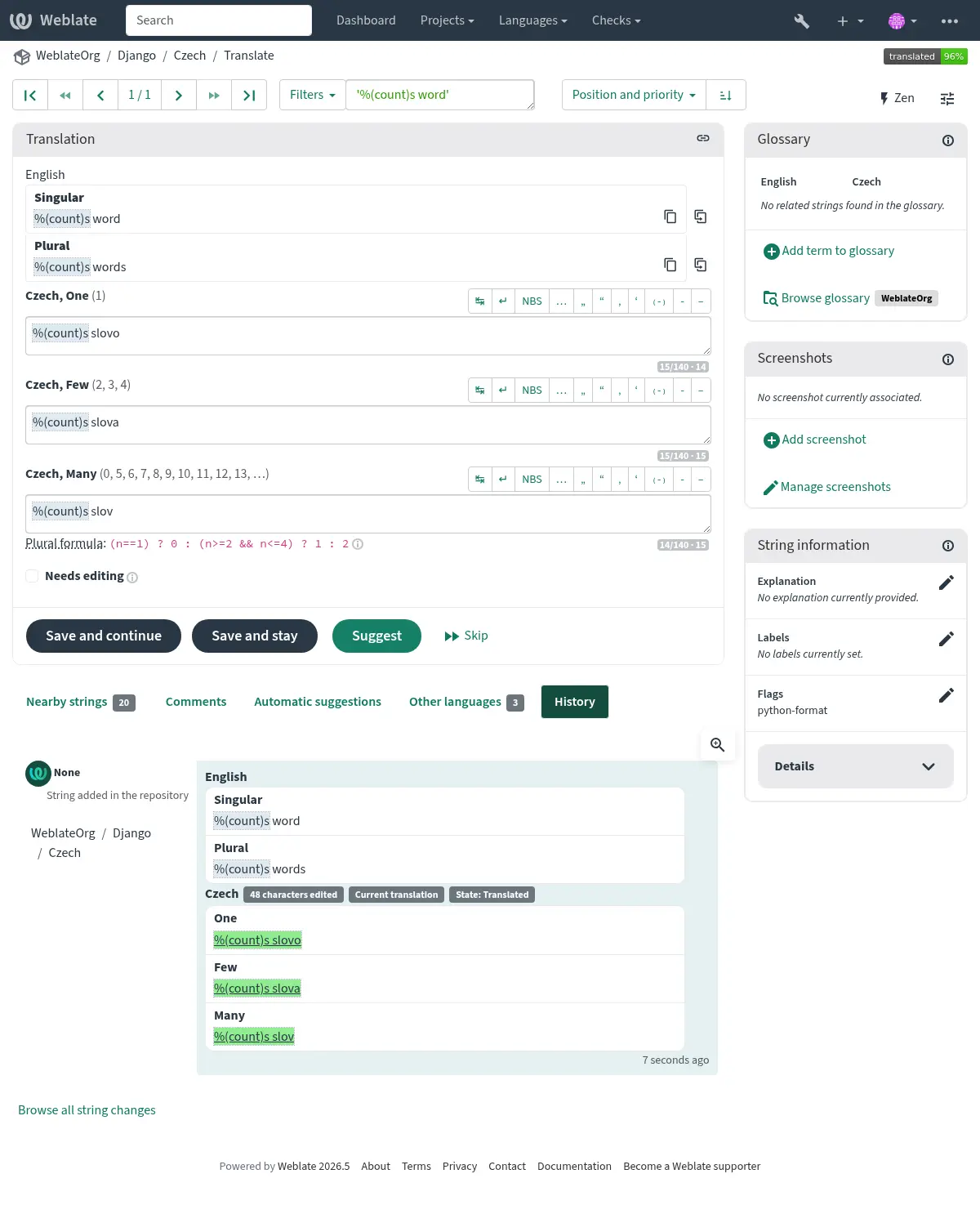
Besides checking, this will also highlight the formatting strings to easily insert them into translated strings:
Ciąg znaków interpolacji AngularJS
- Podsumowanie:
Ciągi interpolacji AngularJS nie pasują do źródła.
- Zakres:
przetłumaczone ciągi
- Sprawdź klasę:
weblate.checks.angularjs.AngularJSInterpolationCheck- Check identifier:
angularjs_format- Trigger:
This check needs to be enabled using a flag.
- Dostępna flaga:
angularjs-format- Flaga do zignorowania:
ignore-angularjs-format
- Przykład ciągu formatu z nazwami:
Your balance is {{amount}} {{ currency }}
Zobacz także
Automatyczne formatowanie komponentów
- Podsumowanie:
Symbole zastępcze automatycznych komponentów nie pasują do źródła.
- Zakres:
przetłumaczone ciągi
- Sprawdź klasę:
weblate.checks.format.AutomatticComponentsCheck- Check identifier:
automattic_components_format- Trigger:
This check needs to be enabled using a flag.
- Dostępna flaga:
automattic-components-format- Flaga do zignorowania:
ignore-automattic-components-format
- Przykład prostego ciągu formatu:
They bought {{strong}}apples{{/strong}}.
Zobacz także
Format C
- Podsumowanie:
Ciąg w formacie C nie pasuje do źródła.
- Zakres:
przetłumaczone ciągi
- Sprawdź klasę:
weblate.checks.format.CFormatCheck- Check identifier:
c_format- Trigger:
This check needs to be enabled using a flag.
- Dostępna flaga:
c-format- Flaga do zignorowania:
ignore-c-format
- Przykład prostego ciągu formatu:
There are %d apples- Przykład ciągu formatu pozycji:
Your balance is %1$d %2$s
Zobacz także
Format C#
- Podsumowanie:
Ciąg w formacie C# nie pasuje do źródła.
- Zakres:
przetłumaczone ciągi
- Sprawdź klasę:
weblate.checks.format.CSharpFormatCheck- Check identifier:
c_sharp_format- Trigger:
This check needs to be enabled using a flag.
- File formats automatically enabling this check:
- Dostępna flaga:
c-sharp-format,csharp-format- Flaga do zignorowania:
ignore-c-sharp-format
- Przykład ciągu formatu pozycji:
There are {0} apples
Zobacz także
Literały szablonu ECMAScript
- Podsumowanie:
Literały szablonu ECMAScript nie są zgodne ze źródłem.
- Zakres:
przetłumaczone ciągi
- Sprawdź klasę:
weblate.checks.format.ESTemplateLiteralsCheck- Check identifier:
es_format- Trigger:
This check needs to be enabled using a flag.
- File formats automatically enabling this check:
- Dostępna flaga:
es-format- Flaga do zignorowania:
ignore-es-format
- Przykład interpolacji:
There are ${number} apples
Zobacz także
interpolacja i18next
Dodane w wersji 4.0.
- Podsumowanie:
Interpolacja i18next nie pasuje do źródła.
- Zakres:
przetłumaczone ciągi
- Sprawdź klasę:
weblate.checks.format.I18NextInterpolationCheck- Check identifier:
i18next_interpolation- Trigger:
This check needs to be enabled using a flag.
- File formats automatically enabling this check:
- Dostępna flaga:
i18next-interpolation- Flaga do zignorowania:
ignore-i18next-interpolation
- Przykład interpolacji:
There are {{number}} apples- Przykład zagnieżdżania:
There are $t(number) apples
Zobacz także
ICU MessageFormat
Dodane w wersji 4.9.
- Podsumowanie:
Błędy składniowe i/lub niezgodności symboli zastępczych w ciągach ICU MessageFormat.
- Zakres:
przetłumaczone ciągi
- Sprawdź klasę:
weblate.checks.icu.ICUMessageFormatCheck- Check identifier:
icu_message_format- Trigger:
This check needs to be enabled using a flag.
- File formats automatically enabling this check:
- Dostępna flaga:
icu-message-format- Flaga do zignorowania:
ignore-icu-message-format
- Przykład interpolacji:
There {number, plural, one {is one apple} other {are # apples}}.
This check has support for both pure ICU MessageFormat messages as well as ICU with simple
XML tags. You can configure the behavior of this check by using icu-flags:*, either by
opting into XML support or by disabling certain sub-checks. For example, the following flag
enables XML support while disabling validation of plural sub-messages:
icu-message-format, icu-flags:xml:-plural_selectors
|
Enable support for simple XML tags. By default, XML tags
are parsed loosely. Stray |
|
Enable support for strict XML tags. All |
|
Wyłącz wyróżnianie symboli zastępczych w edytorze. |
|
Disable requiring sub-messages to have an |
|
Skip checking that sub-message selectors match the source. |
|
Pomiń sprawdzanie, czy typy symboli zastępczych są zgodne ze źródłem. |
|
Skip checking that no placeholders are present that were not present in the source string. |
|
Skip checking that no placeholders are missing that were present in the source string. |
Additionally, when strict-xml is not enabled but xml is enabled, you can use the
icu-tag-prefix:PREFIX flag to require that all XML tags start with a specific string.
For example, the following flag will only allow XML tags to be matched if they start with
<x::
icu-message-format, icu-flags:xml, icu-tag-prefix:"x:"
This would match <x:link>click here</x:link> but not <strong>this</strong>.
Format Java
- Podsumowanie:
Ciąg w formacie Java nie pasuje do źródła.
- Zakres:
przetłumaczone ciągi
- Sprawdź klasę:
weblate.checks.format.JavaFormatCheck- Check identifier:
java_printf_format- Trigger:
This check needs to be enabled using a flag.
- File formats automatically enabling this check:
Zasoby z ciągami Androida, Zasoby mobilne Kotlina, Compose Multiplatform resources
- Dostępna flaga:
java-printf-format- Flaga do zignorowania:
ignore-java-printf-format
- Przykład prostego ciągu formatu:
There are %d apples- Przykład ciągu formatu pozycji:
Your balance is %1$d %2$s
Zmienione w wersji 4.14: This used to be toggled by the java-format flag, it was changed for consistency with GNU gettext.
Zobacz także
Format Java Message
- Podsumowanie:
Ciąg Java MessageFormat nie pasuje do źródła.
- Zakres:
przetłumaczone ciągi
- Sprawdź klasę:
weblate.checks.format.JavaMessageFormatCheck- Check identifier:
java_format- Trigger:
This check needs to be enabled using a flag.
- File formats automatically enabling this check:
- Dostępna flaga:
auto-java-messageformat,java-format- Automatic flag behavior:
auto-java-messageformat: Treat a text as conditional Java MessageFormat, enabling Format Java Message only when the source contains Java MessageFormat placeholders.- Flaga do zignorowania:
ignore-java-format
- Przykład ciągu formatu pozycji:
There are {0} apples
Zmienione w wersji 4.14: This used to be toggled by java-messageformat flag, it was changed for consistency with GNU gettext.
This check validates that format string is valid for the Java MessageFormat
class. Besides matching format strings in the curly braces, it also verifies
single quotes as they have a special meaning. Whenever writing single quote, it
should be written as ''. When not paired, it is treated as beginning of
quoting and will not be shown when rendering the string.
Zobacz także
Format JavaScript
- Podsumowanie:
Ciąg w formacie JavaScript nie pasuje do źródła.
- Zakres:
przetłumaczone ciągi
- Sprawdź klasę:
weblate.checks.format.JavaScriptFormatCheck- Check identifier:
javascript_format- Trigger:
This check needs to be enabled using a flag.
- Dostępna flaga:
javascript-format- Flaga do zignorowania:
ignore-javascript-format
- Przykład prostego ciągu formatu:
There are %d apples
Zobacz także
Format Laravel
- Podsumowanie:
Ciąg w formacie Laravel nie pasuje do źródła.
- Zakres:
przetłumaczone ciągi
- Sprawdź klasę:
weblate.checks.format.LaravelFormatCheck- Check identifier:
laravel_format- Trigger:
This check needs to be enabled using a flag.
- File formats automatically enabling this check:
- Dostępna flaga:
laravel-format- Flaga do zignorowania:
ignore-laravel-format
- Przykład ciągu formatu z nazwami:
The :attribute must be :value
Zobacz także
Format Lua
- Podsumowanie:
Ciąg w formacie Lua nie pasuje do źródła.
- Zakres:
przetłumaczone ciągi
- Sprawdź klasę:
weblate.checks.format.LuaFormatCheck- Check identifier:
lua_format- Trigger:
This check needs to be enabled using a flag.
- Dostępna flaga:
lua-format- Flaga do zignorowania:
ignore-lua-format
- Przykład prostego ciągu formatu:
There are %d apples
Zobacz także
Format Object Pascal
- Podsumowanie:
Ciąg formatu Object Pascal nie jest zgodny ze źródłem.
- Zakres:
przetłumaczone ciągi
- Sprawdź klasę:
weblate.checks.format.ObjectPascalFormatCheck- Check identifier:
object_pascal_format- Trigger:
This check needs to be enabled using a flag.
- Dostępna flaga:
object-pascal-format- Flaga do zignorowania:
ignore-object-pascal-format
- Przykład prostego ciągu formatu:
There are %d apples
Format Objective-C
Dodane w wersji 5.17.
- Podsumowanie:
Ciąg formatu Objective-C nie pasuje do źródła.
- Zakres:
przetłumaczone ciągi
- Sprawdź klasę:
weblate.checks.format.ObjCFormatCheck- Check identifier:
objc_format- Trigger:
This check needs to be enabled using a flag.
- File formats automatically enabling this check:
- Dostępna flaga:
objc-format- Flaga do zignorowania:
ignore-objc-format
Procent symboli zastępczych
Dodane w wersji 4.0.
- Podsumowanie:
Procent zapychaczy nie jest zgodny ze źródłem.
- Zakres:
przetłumaczone ciągi
- Sprawdź klasę:
weblate.checks.format.PercentPlaceholdersCheck- Check identifier:
percent_placeholders- Trigger:
This check needs to be enabled using a flag.
- Dostępna flaga:
percent-placeholders- Flaga do zignorowania:
ignore-percent-placeholders
- Przykład prostego ciągu formatu:
There are %number% apples
Zobacz także
Format nawiasów klamrowych Perla
- Podsumowanie:
Ciąg w formacie nawiasów klamrowych Perla nie pasuje do źródła.
- Zakres:
przetłumaczone ciągi
- Sprawdź klasę:
weblate.checks.format.PerlBraceFormatCheck- Check identifier:
perl_brace_format- Trigger:
This check needs to be enabled using a flag.
- Dostępna flaga:
perl-brace-format- Flaga do zignorowania:
ignore-perl-brace-format
- Przykład ciągu formatu z nazwami:
There are {number} apples
Zobacz także
Format języka Perl
- Podsumowanie:
Ciąg w formacie Perl nie pasuje do źródła.
- Zakres:
przetłumaczone ciągi
- Sprawdź klasę:
weblate.checks.format.PerlFormatCheck- Check identifier:
perl_format- Trigger:
This check needs to be enabled using a flag.
- Dostępna flaga:
perl-format- Flaga do zignorowania:
ignore-perl-format
- Przykład prostego ciągu formatu:
There are %d apples- Przykład ciągu formatu pozycji:
Your balance is %1$d %2$s
Zobacz także
Format PHP
- Podsumowanie:
Ciąg w formacie PHP nie pasuje do źródła.
- Zakres:
przetłumaczone ciągi
- Sprawdź klasę:
weblate.checks.format.PHPFormatCheck- Check identifier:
php_format- Trigger:
This check needs to be enabled using a flag.
- Dostępna flaga:
php-format- Flaga do zignorowania:
ignore-php-format
- Przykład prostego ciągu formatu:
There are %d apples- Przykład ciągu formatu pozycji:
Your balance is %1$d %2$s
Format klamrowy Python
- Podsumowanie:
Ciąg w formacie Python brace nie pasuje do źródła.
- Zakres:
przetłumaczone ciągi
- Sprawdź klasę:
weblate.checks.format.PythonBraceFormatCheck- Check identifier:
python_brace_format- Trigger:
This check needs to be enabled using a flag.
- Dostępna flaga:
python-brace-format- Flaga do zignorowania:
ignore-python-brace-format
- Prosty format ciągów:
There are {} apples- Przykład ciągu formatu z nazwami:
Your balance is {amount} {currency}
Zobacz także
Format Python
- Podsumowanie:
Ciąg w formacie Python nie pasuje do ciągu źródłowego.
- Zakres:
przetłumaczone ciągi
- Sprawdź klasę:
weblate.checks.format.PythonFormatCheck- Check identifier:
python_format- Trigger:
This check needs to be enabled using a flag.
- Dostępna flaga:
python-format- Flaga do zignorowania:
ignore-python-format
- Prosty format ciągów:
There are %d apples- Przykład ciągu formatu z nazwami:
Your balance is %(amount)d %(currency)s
Format Qt
- Podsumowanie:
Ciąg w formacie Qt nie pasuje do źródła.
- Zakres:
przetłumaczone ciągi
- Sprawdź klasę:
weblate.checks.qt.QtFormatCheck- Check identifier:
qt_format- Trigger:
This check needs to be enabled using a flag.
- Dostępna flaga:
qt-format- Flaga do zignorowania:
ignore-qt-format
- Przykład ciągu formatu pozycji:
There are %1 apples
Zobacz także
Forma liczby mnogiej Qt
- Podsumowanie:
Ciąg w formacie liczby mnogiej Qt nie pasuje do źródła.
- Zakres:
przetłumaczone ciągi
- Sprawdź klasę:
weblate.checks.qt.QtPluralCheck- Check identifier:
qt_plural_format- Trigger:
This check needs to be enabled using a flag.
- Dostępna flaga:
qt-plural-format- Flaga do zignorowania:
ignore-qt-plural-format
- Przykład ciągu w formacie liczby mnogiej:
There are %Ln apple(s)
Zobacz także
Format Ruby
- Podsumowanie:
Ciąg w formacie Ruby nie pasuje do źródła.
- Zakres:
przetłumaczone ciągi
- Sprawdź klasę:
weblate.checks.ruby.RubyFormatCheck- Check identifier:
ruby_format- Trigger:
This check needs to be enabled using a flag.
- Dostępna flaga:
ruby-format- Flaga do zignorowania:
ignore-ruby-format
- Przykład prostego ciągu formatu:
There are %d apples- Przykład ciągu formatu pozycji:
Your balance is %1$f %2$s- Przykład ciągu formatu z nazwami:
Your balance is %+.2<amount>f %<currency>s- Named template string:
Your balance is %{amount} %{currency}
Zobacz także
Format Scheme
- Podsumowanie:
Ciąg w formacie Scheme nie pasuje do źródła.
- Zakres:
przetłumaczone ciągi
- Sprawdź klasę:
weblate.checks.format.SchemeFormatCheck- Check identifier:
scheme_format- Trigger:
This check needs to be enabled using a flag.
- Dostępna flaga:
scheme-format- Flaga do zignorowania:
ignore-scheme-format
- Przykład prostego ciągu formatu:
There are ~d apples
Formatowanie Vue I18n
- Podsumowanie:
Formatowanie Vue I18n nie pasuje do źródła.
- Zakres:
przetłumaczone ciągi
- Sprawdź klasę:
weblate.checks.format.VueFormattingCheck- Check identifier:
vue_format- Trigger:
This check needs to be enabled using a flag.
- Dostępna flaga:
vue-format- Flaga do zignorowania:
ignore-vue-format
- Nazwane formatowanie:
There are {count} apples- Formatowanie i18n w Rails:
There are %{count} apples- Połączone wiadomości lokalne:
@:message.dio @:message.the_world!
Zostało przetłumaczone
- Podsumowanie:
Ten ciąg został już przetłumaczony w przeszłości.
- Zakres:
wszystkie ciągi
- Sprawdź klasę:
weblate.checks.consistency.TranslatedCheck- Check identifier:
translated- Trigger:
This check is always enabled but can be ignored using a flag.
- Flaga do zignorowania:
ignore-translated
Means a string has been translated already. This can happen when the translations have been reverted in VCS or lost otherwise.
Niespójność
- Podsumowanie:
Ten ciąg tekstowy ma więcej niż jedno tłumaczenie w tym projekcie lub jest nieprzetłumaczony w niektórych komponentach.
- Zakres:
wszystkie ciągi
- Sprawdź klasę:
weblate.checks.consistency.ConsistencyCheck- Check identifier:
inconsistent- Trigger:
This check is always enabled but can be ignored using a flag.
- Flaga do zignorowania:
ignore-inconsistent
Weblate checks translations of the same string across all translation within a project to help you keep consistent translations.
The check fails on differing translations of one string within a project. This can also lead to inconsistencies in displayed checks. You can find other translations of this string on the Other occurrences tab.
Ta kontrola dotyczy wszystkich komponentów w projekcie, które mają włączoną opcję Zezwól na propagację tłumaczenia.
Podpowiedź
For performance reasons, the check might not find all inconsistencies, it limits number of matches.
Informacja
This check also fires in case the string is translated in one component and not in another. It can be used as a quick way to manually handle strings which are untranslated in some components just by clicking on the Use this translation button displayed on each line in the Other occurrences tab.
You can use Tłumaczenie automatyczne add-on to automate translating of newly added strings which are already translated in another component.
Niespójny reStructuredText
Dodane w wersji 5.10.
- Podsumowanie:
Niespójny znacznik reStructuredText w przetłumaczonej wiadomości.
- Zakres:
przetłumaczone ciągi
- Sprawdź klasę:
weblate.checks.markup.RSTReferencesCheck- Check identifier:
rst-references- Trigger:
This check needs to be enabled using a flag.
- Dostępna flaga:
rst-text- Flaga do zignorowania:
ignore-rst-references
Odniesienia do terminów reStructuredText lub inne znaczniki nie odpowiadają źródłu. Typowymi przyczynami tych błędów są:
Mismatched or missing backticks.
Missing spaces or interpunction around the reference. The reStructuredText inline blocks need to be separated by non-word characters.
Space between inline tag and backticks.
The reference name is not being translated.
Using quotes instead of backticks.
Mismatched substitutions or footnote references.
Zobacz także
Użyto litery Kashida
- Podsumowanie:
Ozdobne litery kashida nie powinny być używane.
- Zakres:
przetłumaczone ciągi
- Sprawdź klasę:
weblate.checks.chars.KashidaCheck- Check identifier:
kashida- Trigger:
This check is always enabled but can be ignored using a flag.
- Flaga do zignorowania:
ignore-kashida
The decorative Kashida letters should not be used in translation. These are also known as Tatweel.
Zobacz także
Łącza Markdown
- Podsumowanie:
Łącza Markdown nie pasują do źródła.
- Zakres:
przetłumaczone ciągi
- Sprawdź klasę:
weblate.checks.markup.MarkdownLinkCheck- Check identifier:
md-link- Trigger:
This check needs to be enabled using a flag.
- File formats automatically enabling this check:
- Dostępna flaga:
md-text- Flaga do zignorowania:
ignore-md-link
Łącza Markdown nie pasują do źródła.
Zobacz także
Odniesienia do Markdown
- Podsumowanie:
Odnośniki do łączy Markdown nie pasują do źródła.
- Zakres:
przetłumaczone ciągi
- Sprawdź klasę:
weblate.checks.markup.MarkdownRefLinkCheck- Check identifier:
md-reflink- Trigger:
This check needs to be enabled using a flag.
- File formats automatically enabling this check:
- Dostępna flaga:
md-text- Flaga do zignorowania:
ignore-md-reflink
Odnośniki do łączy Markdown nie pasują do źródła.
Zobacz także
Składnia Markdown
- Podsumowanie:
Składnia Markdown nie pasuje do źródła.
- Zakres:
przetłumaczone ciągi
- Sprawdź klasę:
weblate.checks.markup.MarkdownSyntaxCheck- Check identifier:
md-syntax- Trigger:
This check needs to be enabled using a flag.
- File formats automatically enabling this check:
- Dostępna flaga:
md-text- Flaga do zignorowania:
ignore-md-syntax
Składnia Markdown nie pasuje do źródła
Zobacz także
Maksymalna długość tłumaczenia
- Podsumowanie:
Tłumaczenie nie powinno przekraczać określonej długości.
- Zakres:
przetłumaczone ciągi
- Sprawdź klasę:
weblate.checks.chars.MaxLengthCheck- Check identifier:
max-length- Trigger:
This check needs to be enabled using a flag.
- Dostępna flaga:
max-length- Flaga do zignorowania:
ignore-max-length
Checks that translations are of acceptable length to fit available space. This only checks for the length of translation characters.
Unlike the other checks, the flag should be set as a key:value pair like
max-length:100.
Podpowiedź
This check looks at number of chars, what might not be the best metric when using proportional fonts to render the text. The Maksymalny rozmiar tłumaczenia check does check actual rendering of the text.
The replacements: flag might be also useful to expand placeables before
checking the string.
When xml-text flag is also used, the length calculation ignores XML tags.
Maksymalny rozmiar tłumaczenia
- Podsumowanie:
Tłumaczenie renderowanego tekstu nie powinno przekraczać podanego rozmiaru.
- Zakres:
przetłumaczone ciągi
- Sprawdź klasę:
weblate.checks.render.MaxSizeCheck- Check identifier:
max-size- Trigger:
This check needs to be enabled using a flag.
- Dostępna flaga:
max-size- Flaga do zignorowania:
ignore-max-size
Translation rendered text should not exceed given size. It renders the text with line wrapping and checks if it fits into given boundaries.
This check needs one or two parameters - maximal width and maximal number of lines. In case the number of lines is not provided, one line text is considered.
You can also configure used font by font-* directives (see
Dostosowywanie zachowania za pomocą flag), for example following translation flags say that the
text rendered with ubuntu font size 22 should fit into two lines and 500
pixels:
max-size:500:2, font-family:ubuntu, font-size:22
Podpowiedź
You might want to set font-* directives in Konfiguracja komponentu to have the same
font configured for all strings within a component. You can override those
values per string in case you need to customize it per string.
The replacements: flag might be also useful to expand placeables before
checking the string.
When xml-text flag is also used, the length calculation ignores XML tags.
Niedopasowane \n
- Podsumowanie:
Number of \n literals in translation does not match source.
- Zakres:
przetłumaczone ciągi
- Sprawdź klasę:
weblate.checks.chars.EscapedNewlineCountingCheck- Check identifier:
escaped_newline- Trigger:
This check is always enabled but can be ignored using a flag.
- Flaga do zignorowania:
ignore-escaped-newline
Usually escaped newlines are important for formatting program output.
Check fails if the number of \n literals in translation does not match the source.
Niedopasowany dwukropek
- Podsumowanie:
Źródło i tłumaczenie nie kończą się dwukropkiem.
- Zakres:
przetłumaczone ciągi
- Sprawdź klasę:
weblate.checks.chars.EndColonCheck- Check identifier:
end_colon- Trigger:
This check is always enabled but can be ignored using a flag.
- Flaga do zignorowania:
ignore-end-colon
Checks that colons are replicated between both source and translation. The presence of colons is also checked for various languages where they do not belong (Chinese or Japanese).
Zobacz także
Niedopasowane wielokropki
- Podsumowanie:
Źródło i tłumaczenie nie kończą się wielokropkiem.
- Zakres:
przetłumaczone ciągi
- Sprawdź klasę:
weblate.checks.chars.EndEllipsisCheck- Check identifier:
end_ellipsis- Trigger:
This check is always enabled but can be ignored using a flag.
- Flaga do zignorowania:
ignore-end-ellipsis
Checks that trailing ellipses are replicated between both source and translation.
This only checks for real ellipsis (…) not for three dots (...).
An ellipsis is usually rendered nicer than three dots in print, and sounds better with text-to-speech.
Zobacz także
Niedopasowany wykrzyknik
- Podsumowanie:
Źródło i tłumaczenie nie kończą się wykrzyknikiem.
- Zakres:
przetłumaczone ciągi
- Sprawdź klasę:
weblate.checks.chars.EndExclamationCheck- Check identifier:
end_exclamation- Trigger:
This check is always enabled but can be ignored using a flag.
- Flaga do zignorowania:
ignore-end-exclamation
Checks that exclamations are replicated between both source and translation. The presence of exclamation marks is also checked for various languages where they do not belong (Chinese, Japanese, Korean, Armenian, Limbu, Myanmar or Nko).
Zobacz także
Niedopasowana kropka
- Podsumowanie:
Źródło i tłumaczenie nie kończą się kropką.
- Zakres:
przetłumaczone ciągi
- Sprawdź klasę:
weblate.checks.chars.EndStopCheck- Check identifier:
end_stop- Trigger:
This check is always enabled but can be ignored using a flag.
- Flaga do zignorowania:
ignore-end-stop
Checks that full stops are replicated between both source and translation. The presence of full stops is checked for various languages where they do not belong (Chinese, Japanese, Devanagari or Urdu).
Zobacz także
Niedopasowany interrobang
- Podsumowanie:
Źródło i tłumaczenie nie kończą się inteerrobangiem.
- Zakres:
przetłumaczone ciągi
- Sprawdź klasę:
weblate.checks.chars.EndInterrobangCheck- Check identifier:
end_interrobang- Trigger:
This check is always enabled but can be ignored using a flag.
- Flaga do zignorowania:
ignore-end-interrobang
Checks that interrobang marks are replicated between both source and translation. It allows the swap between „!?” and „?!”.
Zobacz także
Niedopasowany znak zapytania
- Podsumowanie:
Źródło i tłumaczenie nie kończą się znakiem zapytania.
- Zakres:
przetłumaczone ciągi
- Sprawdź klasę:
weblate.checks.chars.EndQuestionCheck- Check identifier:
end_question- Trigger:
This check is always enabled but can be ignored using a flag.
- Flaga do zignorowania:
ignore-end-question
Checks that question marks are replicated between both source and translation. The presence of question marks is also checked for various languages where they do not belong (Armenian, Arabic, Chinese, Korean, Japanese, Ethiopic, Vai or Coptic).
Zobacz także
Niedopasowany średnik
- Podsumowanie:
Źródło i tłumaczenie nie kończą się średnikiem.
- Zakres:
przetłumaczone ciągi
- Sprawdź klasę:
weblate.checks.chars.EndSemicolonCheck- Check identifier:
end_semicolon- Trigger:
This check is always enabled but can be ignored using a flag.
- Flaga do zignorowania:
ignore-end-semicolon
Checks that semicolons at the end of sentences are replicated between both source and translation.
Zobacz także
Niedopasowanie podziałów wierszy
- Podsumowanie:
Liczba nowych wierszy w tłumaczeniu nie jest zgodna ze źródłem.
- Zakres:
przetłumaczone ciągi
- Sprawdź klasę:
weblate.checks.chars.NewLineCountCheck- Check identifier:
newline-count- Trigger:
This check is always enabled but can be ignored using a flag.
- Flaga do zignorowania:
ignore-newline-count
Usually newlines are important for formatting program output. Check fails if the number of new lines in translation does not match the source.
Brakująca forma liczby mnogiej
- Podsumowanie:
Niektóre formy liczby mnogiej są nieprzetłumaczone.
- Zakres:
przetłumaczone ciągi
- Sprawdź klasę:
weblate.checks.consistency.PluralsCheck- Check identifier:
plurals- Trigger:
This check is always enabled but can be ignored using a flag.
- Flaga do zignorowania:
ignore-plurals
Checks that all plural forms of a source string have been translated. Specifics on how each plural form is used can be found in the string definition.
Failing to fill in plural forms will in some cases lead to displaying nothing when the plural form is in use.
Wiele wielkich liter
Dodane w wersji 5.16.
- Podsumowanie:
Tłumaczenie zawiera słowa z wieloma błędnie postawionymi wielkimi literami.
- Zakres:
przetłumaczone ciągi
- Sprawdź klasę:
weblate.checks.chars.MultipleCapitalCheck- Check identifier:
multiple_capital- Trigger:
This check is always enabled but can be ignored using a flag.
- Flaga do zignorowania:
ignore-multiple-capital
Checks for misplaced capitalization by detecting words that contain consecutive
uppercase letters in otherwise lowercase or normally capitalized text (for
example, HEllo or CAmelCase). Strings that contain capitalization in the
source string are allowed to contain capitalization in the translation.
Niestandardowe znaki w języku kabylskim
Dodane w wersji 5.12.
- Podsumowanie:
Użyj znormalizowanych znaków łacińskich języka kabylskiego (np. Ɣ zamiast greckiego γ; ɛ zamiast ε).
- Zakres:
przetłumaczone ciągi
- Sprawdź klasę:
weblate.checks.chars.KabyleCharactersCheck- Check identifier:
kabyle-characters- Trigger:
This check is always enabled but can be ignored using a flag.
- Flaga do zignorowania:
ignore-kabyle-characters
Checks that Kabyle translations use correct Kabyle letters and not similar Greek ones, which were often used before Kabyle characters were standardized in Unicode.
Symbole zastępcze
Zmienione w wersji 4.3: Możesz użyć wyrażenia regularnego jako symbolu zastępczego.
Zmienione w wersji 4.13: With the case-insensitive flag, the placeholders are not case-sensitive.
- Podsumowanie:
W tłumaczeniu brakuje niektórych symboli zastępczych.
- Zakres:
przetłumaczone ciągi
- Sprawdź klasę:
weblate.checks.placeholders.PlaceholderCheck- Check identifier:
placeholders- Trigger:
This check needs to be enabled using a flag.
- Dostępna flaga:
placeholders- Flaga do zignorowania:
ignore-placeholders
Translation is missing some placeholders. These are either extracted from the
translation file or defined manually using placeholders flag, more can be
separated with colon, strings with space can be quoted:
placeholders:$URL$:$TARGET$:"some long text"
In case you have some syntax for placeholders, you can use a regular expression:
placeholders:r"%[^% ]%"
You can also have case insensitive placeholders:
placeholders:$URL$:$TARGET$,case-insensitive
Zobacz także
Zabroniony znak początkowy
Dodane w wersji 5.9.
- Podsumowanie:
Ciąg zaczyna się od znaku niedozwolonego w CSV.
- Zakres:
glossary strings
- Sprawdź klasę:
weblate.checks.glossary.ProhibitedInitialCharacterCheck- Check identifier:
prohibited_initial_character- Trigger:
This check is always enabled but can be ignored using a flag.
- Flaga do zignorowania:
ignore-prohibited-initial-character
The glossary is often shared as CSV and using some characters at the beginning is restricted by many applications as these can cause the text being evaluated as an expression. This also affects Glossaries in automatic suggestion where many services use CSV for synchronizing glossaries and reject such strings.
Odstępy między czcionkami
Zmienione w wersji 5.10: This check used to apply to Breton language as well, but it was limited to French only.
- Podsumowanie:
Brak niełamliwej spacji przed podwójnym znakiem interpunkcyjnym.
- Zakres:
przetłumaczone ciągi
- Sprawdź klasę:
weblate.checks.chars.PunctuationSpacingCheck- Check identifier:
punctuation_spacing- Trigger:
This check is always enabled but can be ignored using a flag.
- Flaga do zignorowania:
ignore-punctuation-spacing
Checks that there is non breakable space before double punctuation sign (exclamation mark, question mark, semicolon and colon). This rule is used only in a few selected languages like French, where space before double punctuation sign is a typographic rule.
Zobacz także
Wyrażenie regularne
Zmienione w wersji 5.10: Extended support for advanced regular expressions including Unicode codepoint properties.
- Podsumowanie:
Tłumaczenie nie pasuje do wyrażenia regularnego.
- Zakres:
przetłumaczone ciągi
- Sprawdź klasę:
weblate.checks.placeholders.RegexCheck- Check identifier:
regex- Trigger:
This check needs to be enabled using a flag.
- Dostępna flaga:
regex- Flaga do zignorowania:
ignore-regex
Translation does not match regular expression. The expression is either extracted from the
translation file or defined manually using regex flag:
regex:^foo|bar$
The matching also supports Unicode codepoint properties, including scripts and blocks:
regex:^[-_\p{L}\p{N}\p{sc=Deva}\p{sc=Thai}]{1,32}$
Podpowiedź
Use Symbole zastępcze for detecting missing placeholders in the string.
Zobacz także
Błąd składniowy reStructuredText
Dodane w wersji 5.10.
- Podsumowanie:
Błąd składniowy reStructuredText w tłumaczeniu.
- Zakres:
przetłumaczone ciągi
- Sprawdź klasę:
weblate.checks.markup.RSTSyntaxCheck- Check identifier:
rst-syntax- Trigger:
This check needs to be enabled using a flag.
- Dostępna flaga:
rst-text- Flaga do zignorowania:
ignore-rst-syntax
Błąd składni reStructuredText w tłumaczeniu. Problemy, których należy szukać:
Mismatched closing/opening tags.
Missing spaces or interpunction around the reference. The reStructuredText inline blocks need to be separated by non-word characters.
Using quotes instead of backticks.
Zobacz także
Ponownie użyte tłumaczenie
Dodane w wersji 4.18.
- Podsumowanie:
Różne ciągi są przetłumaczone tak samo.
- Zakres:
przetłumaczone ciągi
- Sprawdź klasę:
weblate.checks.consistency.ReusedCheck- Check identifier:
reused- Trigger:
This check is always enabled but can be ignored using a flag.
- Flaga do zignorowania:
ignore-reused
Check that fails if the same translation is used on different source strings. Such translations can be intentional, but can also confuse users.
Te same liczby mnogie
- Podsumowanie:
Niektóre formy mnogie są przetłumaczone w ten sam sposób.
- Zakres:
przetłumaczone ciągi
- Sprawdź klasę:
weblate.checks.consistency.SamePluralsCheck- Check identifier:
same-plurals- Trigger:
This check is always enabled but can be ignored using a flag.
- Flaga do zignorowania:
ignore-same-plurals
Check that fails if some plural forms are duplicated in the translation. In most languages they have to be different.
Początek od nowej linii
- Podsumowanie:
Źródło i tłumaczenie nie zaczynają się od nowej linii.
- Zakres:
przetłumaczone ciągi
- Sprawdź klasę:
weblate.checks.chars.BeginNewlineCheck- Check identifier:
begin_newline- Trigger:
This check is always enabled but can be ignored using a flag.
- Flaga do zignorowania:
ignore-begin-newline
Newlines usually appear in source strings for good reason, omissions or additions can lead to formatting problems when the translated text is put to use.
Zobacz także
Spacje początkowe
- Podsumowanie:
Źródło i tłumaczenie nie zaczynają się od tej samej liczby spacji.
- Zakres:
przetłumaczone ciągi
- Sprawdź klasę:
weblate.checks.chars.BeginSpaceCheck- Check identifier:
begin_space- Trigger:
This check is always enabled but can be ignored using a flag.
- Flaga do zignorowania:
ignore-begin-space
A space in the beginning of a string is usually used for indentation in the interface and thus important to keep.
Zakończenie nową linią
- Podsumowanie:
Źródło i tłumaczenie nie kończą się nową linią.
- Zakres:
przetłumaczone ciągi
- Sprawdź klasę:
weblate.checks.chars.EndNewlineCheck- Check identifier:
end_newline- Trigger:
This check is always enabled but can be ignored using a flag.
- Flaga do zignorowania:
ignore-end-newline
Newlines usually appear in source strings for good reason, omissions or additions can lead to formatting problems when the translated text is put to use.
Zobacz także
Końcowa spacja
- Podsumowanie:
Źródło i tłumaczenie nie kończą się spacją.
- Zakres:
przetłumaczone ciągi
- Sprawdź klasę:
weblate.checks.chars.EndSpaceCheck- Check identifier:
end_space- Trigger:
This check is always enabled but can be ignored using a flag.
- Flaga do zignorowania:
ignore-end-space
Checks that trailing spaces are replicated between both source and translation.
Trailing space is usually utilized to space out neighbouring elements, so removing it might break layout.
Niezmienione tłumaczenie
- Podsumowanie:
Źródło i tłumaczenie są identyczne.
- Zakres:
przetłumaczone ciągi
- Sprawdź klasę:
weblate.checks.same.SameCheck- Check identifier:
same- Trigger:
This check is always enabled but can be ignored using a flag.
- Flaga do zignorowania:
ignore-same
Happens if the source and corresponding translation strings are identical, down to at least one of the plural forms. Some strings commonly found across all languages are ignored, and various markups are stripped. This reduces the number of false positives.
This check can help find strings mistakenly untranslated.
The default behavior of this check is to exclude words from the built-in terms
list from the checking. These are words which are frequently not being
translated. This is useful to avoid false positives on short strings, which
consist only of a single word which is the same in several languages. This list
can be disabled by adding strict-same flag to a string or component.
Zmienione w wersji 4.17: With check-glossary flag (see Nie jest zgodny z słownikiem), the
untranslatable glossary terms are excluded from the checking.
Niebezpieczny HTML
- Podsumowanie:
Tłumaczenie używa niebezpiecznych znaczników HTML.
- Zakres:
przetłumaczone ciągi
- Sprawdź klasę:
weblate.checks.markup.SafeHTMLCheck- Check identifier:
safe-html- Trigger:
This check needs to be enabled using a flag.
- File formats automatically enabling this check:
- Dostępna flaga:
auto-safe-html,safe-html- Automatic flag behavior:
auto-safe-html: Treat a text as conditional HTML, enabling Niebezpieczny HTML only for plain text or source strings that contain standard HTML markup or valid custom elements. This is useful for extended Markdown variants such as MDX, where angle-bracket syntax may not be HTML.- Flaga do zignorowania:
ignore-safe-html
The translation uses unsafe HTML markup. This check has to be enabled using
safe-html flag (see Dostosowywanie zachowania za pomocą flag). There is also accompanied
autofixer which can automatically sanitize the markup.
Podpowiedź
When md-text flag is also used, the Markdown style links are also allowed.
Zobacz także
The HTML check is performed by the Ammonia library.
URL
- Podsumowanie:
The translation does not contain a URL.
- Zakres:
przetłumaczone ciągi
- Sprawdź klasę:
weblate.checks.markup.URLCheck- Check identifier:
url- Trigger:
This check needs to be enabled using a flag.
- Dostępna flaga:
url- Flaga do zignorowania:
ignore-url
The translation does not contain a URL. This is triggered only in case the unit is marked as containing URL. In that case the translation has to be a valid URL.
Znaczniki XML
- Podsumowanie:
Tagi XML w tłumaczeniu nie pasują do źródła.
- Zakres:
przetłumaczone ciągi
- Sprawdź klasę:
weblate.checks.markup.XMLTagsCheck- Check identifier:
xml-tags- Trigger:
This check is always enabled but can be ignored using a flag.
- Flaga do zignorowania:
ignore-xml-tags
This usually means the resulting output will look different. In most cases this is not a desired result from changing the translation, but occasionally it is.
Checks that XML tags are replicated between both source and translation.
The check is automatically enabled for XML like strings. You might need to add
xml-text flag in some cases to force turning it on.
Informacja
This check is disabled by the safe-html flag as the HTML cleanup done by
it can produce HTML markup which is not valid XML.
Składnia XML
- Podsumowanie:
Tłumaczenie nie jest w prawidłowym formacie XML.
- Zakres:
przetłumaczone ciągi
- Sprawdź klasę:
weblate.checks.markup.XMLValidityCheck- Check identifier:
xml-invalid- Trigger:
This check is always enabled but can be ignored using a flag.
- Flaga do zignorowania:
ignore-xml-invalid
The XML markup is not valid.
The check is automatically enabled for XML like strings. You might need to add
xml-text flag in some cases to force turning it on.
Informacja
This check is disabled by the safe-html flag as the HTML cleanup done by
it can produce HTML markup which is not valid XML.
Znak spacji o zerowej szerokości
- Podsumowanie:
Tłumaczenie zawiera dodatkowy znak spacji o zerowej szerokości.
- Zakres:
przetłumaczone ciągi
- Sprawdź klasę:
weblate.checks.chars.ZeroWidthSpaceCheck- Check identifier:
zero-width-space- Trigger:
This check is always enabled but can be ignored using a flag.
- Flaga do zignorowania:
ignore-zero-width-space
Zero-width space (<U+200B>) characters are used to break messages within words (word wrapping).
As they are usually inserted by mistake, this check is triggered once they are present in translation. Some programs might have problems when this character is used.
Zobacz także
Sprawdzanie źródła
Source checks can help developers improve the quality of source strings.
Wielokropek
- Podsumowanie:
Ciąg zawiera trzy kropki
(...)zamiast znaku wielokropka(…).- Zakres:
teksty źródłowe
- Sprawdź klasę:
weblate.checks.source.EllipsisCheck- Check identifier:
ellipsis- Trigger:
This check is always enabled but can be ignored using a flag.
- Flaga do zignorowania:
ignore-ellipsis
This fails when the string uses three dots (...) when it should use an ellipsis character (…).
Using the Unicode character is in most cases the better approach and looks better rendered, and may sound better with text-to-speech.
Zobacz także
Wewnętrzny HTML źródła Fluent
Dodane w wersji 5.0.
- Podsumowanie:
Źródło Fluent powinno być prawidłowym wewnętrznym HTML.
- Zakres:
teksty źródłowe
- Sprawdź klasę:
weblate.checks.fluent.inner_html.FluentSourceInnerHTMLCheck- Check identifier:
fluent-source-inner-html- Trigger:
This check needs to be enabled using a flag.
- File formats automatically enabling this check:
- Dostępna flaga:
fluent-source-inner-html- Flaga do zignorowania:
ignore-fluent-source-inner-html
Fluent is often used in contexts where the value for a Message (or Term) is
meant to be used directly as .innerHTML (rather than .textContent) for
some HTML element. For example, when using the Fluent DOM package.
The aim of this check is to predict how the value will be parsed as inner HTML, assuming an HTML5 conforming parser, to catch cases where there would be some „unintended” loss of the string, without being too strict about technical parsing errors that do not lead to a loss of the string.
This check is applied to the value of Fluent Messages or Terms, but not their Attributes. For Messages, the Fluent Attributes are often just HTML attribute values, so can be arbitrary strings. For Terms, the Fluent Attributes are often language properties that can only be referenced in the selectors of Fluent Select Expressions.
Generally, most Fluent values are not expected to contain any HTML markup. Therefore, this check does not expect or want translators and developers to have to care about strictly avoiding any technical HTML5 parsing errors (let alone XHTML parsing errors). Instead, this check will just want to warn them when they may have unintentionally opened an HTML tag or inserted a character reference.
Moreover, for the Fluent values that intentionally contain HTML tags or character references, this check will verify some „good practices”, such as matching closing and ending tags, valid character references, and quoted attribute values. In addition, whilst the HTML5 specification technically allows for quite arbitrary tag and attribute names, this check will restrain them to some basic ASCII values that should cover the standard HTML5 element tags and attributes, as well as allow some custom element or attribute names. This is partially to ensure that the user is using HTML intentionally.
Przykłady:
Wartość |
Warns? |
Reason |
|---|---|---|
|
tak |
The |
|
nie |
The |
|
tak |
Missing a closing tag. |
|
tak |
|
|
nie |
Custom element tag with a matching closing tag. |
|
nie |
|
|
nie |
|
|
tak |
The attribute value is not quoted. |
|
tak |
Non-ASCII tag name. |
|
tak |
The |
|
nie |
The character reference seems to be intentional. |
|
tak |
The |
|
tak |
Źródło znaków jest nieprawidłowe. |
|
tak |
The Fluent variable may unintentionally become a tag. |
|
tak |
The Fluent variable may unintentionally become a character reference. |
Informacja
This check will not ensure the inner HTML is safe or sanitized, and is not
meant to protect against malicious attempts to alter the inner HTML.
Moreover, it should be remembered that Fluent variables and references may
expand to arbitrary strings, so could expand to arbitrary HTML unless they
are escaped. As an exception, a < or & character before a Fluent
reference will trigger this check since even an escaped value could lead to
unexpected results.
Informacja
The Fluent DOM package has further limitations, such as allowed tags and attributes, which this check will not enforce.
Zobacz także
Składnia źródła Fluent
Dodane w wersji 5.0.
- Podsumowanie:
Błąd składni Fluent w źródle.
- Zakres:
teksty źródłowe
- Sprawdź klasę:
weblate.checks.fluent.syntax.FluentSourceSyntaxCheck- Check identifier:
fluent-source-syntax- Trigger:
This check needs to be enabled using a flag.
- File formats automatically enabling this check:
- Dostępna flaga:
fluent-source-syntax- Flaga do zignorowania:
ignore-fluent-source-syntax
In Weblate, Fluent strings use Fluent syntax for references and variables, but also for more complex features like defining attributes and selector variants, including plurals. This check ensures that the syntax used in source will be valid for Fluent.
Składnia ICU MessageFormat
Dodane w wersji 4.9.
- Podsumowanie:
Błędy składniowe w ciągach ICU MessageFormat.
- Zakres:
teksty źródłowe
- Sprawdź klasę:
weblate.checks.icu.ICUSourceCheck- Check identifier:
icu_message_format_syntax- Trigger:
This check needs to be enabled using a flag.
- File formats automatically enabling this check:
- Dostępna flaga:
icu-message-format- Flaga do zignorowania:
ignore-icu-message-format
Zobacz także
Długo nieprzetłumaczone
Dodane w wersji 4.1.
- Podsumowanie:
Ciąg nie był tłumaczony przez długi czas.
- Zakres:
teksty źródłowe
- Sprawdź klasę:
weblate.checks.source.LongUntranslatedCheck- Check identifier:
long_untranslated- Trigger:
This check is always enabled but can be ignored using a flag.
- Flaga do zignorowania:
ignore-long-untranslated
When the string has not been translated for a long time, it can indicate a problem in a source string making it hard to translate.
Wiele nieudanych kontroli
- Podsumowanie:
Tłumaczenia w kilku językach nie przeszły kontroli.
- Zakres:
teksty źródłowe
- Sprawdź klasę:
weblate.checks.source.MultipleFailingCheck- Check identifier:
multiple_failures- Trigger:
This check is always enabled but can be ignored using a flag.
- Flaga do zignorowania:
ignore-multiple-failures
Numerous translations of this string have failing quality checks. This is usually an indication that something could be done to improve the source string.
This check failing can quite often be caused by a missing full stop at the end of a sentence, or similar minor issues which translators tend to fix in translation, while it would be better to fix it in the source string.
Wiele nienazwanych zmiennych
Dodane w wersji 4.1.
- Podsumowanie:
W łańcuchu znajduje się wiele nienazwanych zmiennych, co uniemożliwia tłumaczom zmianę ich kolejności.
- Zakres:
teksty źródłowe
- Sprawdź klasę:
weblate.checks.format.MultipleUnnamedFormatsCheck- Check identifier:
unnamed_format- Trigger:
This check is always enabled but can be ignored using a flag.
- Flaga do zignorowania:
ignore-unnamed-format
W łańcuchu znajduje się wiele nienazwanych zmiennych, co uniemożliwia tłumaczom zmianę ich kolejności.
Consider using named variables instead to allow translators to reorder them.
Niespluralizowane
- Podsumowanie:
Ciąg jest używany jako liczba mnoga, ale nie przy użyciu form mnogich.
- Zakres:
teksty źródłowe
- Sprawdź klasę:
weblate.checks.source.OptionalPluralCheck- Check identifier:
optional_plural- Trigger:
This check is always enabled but can be ignored using a flag.
- Flaga do zignorowania:
ignore-optional-plural
The string is used as a plural, but does not use plural forms. In case your translation system supports this, you should use the plural aware variant of it.
For example with Gettext in Python it could be:
from gettext import ngettext

print(ngettext("Selected %d file", "Selected %d files", files) % files)
Placeables in automatic suggestion
Checks for placeables expose information on current placeables and this can be used to instruct automatic suggestion engines to keep them. The support for this varies in different services and in many cases there is no way to enforce keeping placeables intact.
Zobacz także