Proces tłumaczenia
Using Weblate raises quality, reduces manual work, and brings everyone involved in the localization process closer to each other. It is up to you to decide how many of Weblate features you want to make use of.
The following is not a complete list of ways to configure Weblate. You can base other workflows on the examples listed here.
Dostosowywanie przepływu pracy
In addition to configuration at Konfiguracja projektu and Konfiguracja komponentu (as Włącz przeglądy, Włącz sugestie, Głosowanie na sugestie, and Automatycznie akceptuj sugestie), the translation workflow can be customized per language.
Site-wide workflow customization can be done while Zmiana definicji języka.
Per-project customization can be done on each language page of the project.
All workflow settings can be overridden, the only limitation is that Włącz przeglądy needs to be turned on and can only be disabled in the per-language customization.
The first existing setting applies:
Project-language customization
Language customization
The project/component settings
Informacja
Please be careful when using site-wide override as that applies to all projects (unless they have own overrides for a given language).
Dostęp do tłumaczeń
The access control is not discussed in detail as a whole in the workflows, as most of its options can be applied to any workflow. Please consult the respective documentation on how to manage access to translations.
In the following chapters, any user means a user who has access to the translation. It can be any authenticated user if the project is public, or a user with Translate permission to the project.
Stan tłumaczenia
Each translated string can be in one of the following states:
- Nieprzetłumaczone
Translation is empty, it might or not be stored in the file, depending on the file format.
- Wymaga edycji
Translation needs editing, this is usually the result of fuzzy matching or translator action. Depending on the file format it might be marked as needing edit (for example as it gets a
fuzzyflag in the gettext file).- Wymaga przeredagowania
Translation needs to be rewritten because of a source string change.
- Wymaga sprawdzenia
State used for source/template strings that need developer review. It is typically set for new source strings imported from the VCS when the Source edit addon is enabled, or when a source string is reported for checking.
- Translated / Waiting for review
Translation is made. The translated state is shown as „Waiting for review” if reviews are enabled.
- Zatwierdzone
Translation has been approved in the review. It can no longer be changed by translators, but only by reviewers. Translators can only add suggestions to it.
This state is only available when reviews are enabled.
- Tylko do odczytu
String is read-only as a result of having
read-onlyflag, being a non-editable source string, or marked such in the translation file.- Sugestie
Suggestions are stored in Weblate only and not in the translation file.
W miarę możliwości stany są reprezentowane w plikach tłumaczeń.
Podpowiedź
If the file format you use does not support storing states, you might want to use the Oznacz niezmienione tłumaczenia jako „Wymaga przeredagowania” add-on to flag unchanged strings as needing rewriting.
Informacja
The Filtr jakości tłumaczeń determines which translation states are stored in the file.
Zobacz także
Bezpośrednie tłumaczenie
The most common setup for smaller teams, where anybody can translate directly. This is also the default setup in Weblate.
Każdy użytkownik może edytować tłumaczenia.
Suggestions are optional ways to suggest changes, when translators are not sure about the change.
Ustawienia |
Wartość |
Uwaga |
|---|---|---|
Włącz przeglądy |
wyłączona |
Skonfigurowane na poziomie projektu. |
Włącz sugestie |
na |
Przydatne, ponieważ użytkownicy mogą zgłaszać propozycje, gdy nie mają pewności. |
Głosowanie na sugestie |
wyłączona |
|
Automatycznie akceptuj sugestie |
0 |
|
Grupa Tłumaczy |
Użytkownicy |
Lub Przetłumacz z per-project access control. |
Grupa recenzentów |
N/A |
Nie używane. |
Ocena koleżeńska
With this workflow, anybody can add a suggestion, which needs approval from additional members before it is accepted as a translation.
Any user can add suggestions.
Any user can vote for suggestions.
Suggestions become translations when given a predetermined number of votes.
Ustawienia |
Wartość |
Uwaga |
|---|---|---|
Włącz przeglądy |
wyłączona |
Skonfigurowane na poziomie projektu. |
Włącz sugestie |
na |
|
Głosowanie na sugestie |
na |
|
Automatycznie akceptuj sugestie |
2 |
You can set higher value to require more peer reviews. |
Grupa Tłumaczy |
Użytkownicy |
Lub Przetłumacz z per-project access control. |
Grupa recenzentów |
N/A |
Not used, all translators review. |
Dedykowani recenzenci
With dedicated reviewers you have two groups of users, one able to submit translations, and one able to review them to ensure translations are consistent and that the quality is good.
Any user can edit unapproved translations.
Recenzent może zatwierdzać / cofać zatwierdzenie ciągów.
Reviewer can edit all translations (including approved ones).
Suggestions can also be used to suggest changes for approved strings.
Ustawienia |
Wartość |
Uwaga |
|---|---|---|
Włącz przeglądy |
na |
Skonfigurowane na poziomie projektu. |
Włącz sugestie |
na |
Przydatne, ponieważ użytkownicy mogą zgłaszać propozycje, gdy nie mają pewności. |
Głosowanie na sugestie |
wyłączona |
|
Automatycznie akceptuj sugestie |
0 |
|
Grupa Tłumaczy |
Użytkownicy |
Lub Przetłumacz z per-project access control. |
Grupa recenzentów |
Recenzenci |
Or Review with per-project access control. |
Włączanie przeglądów
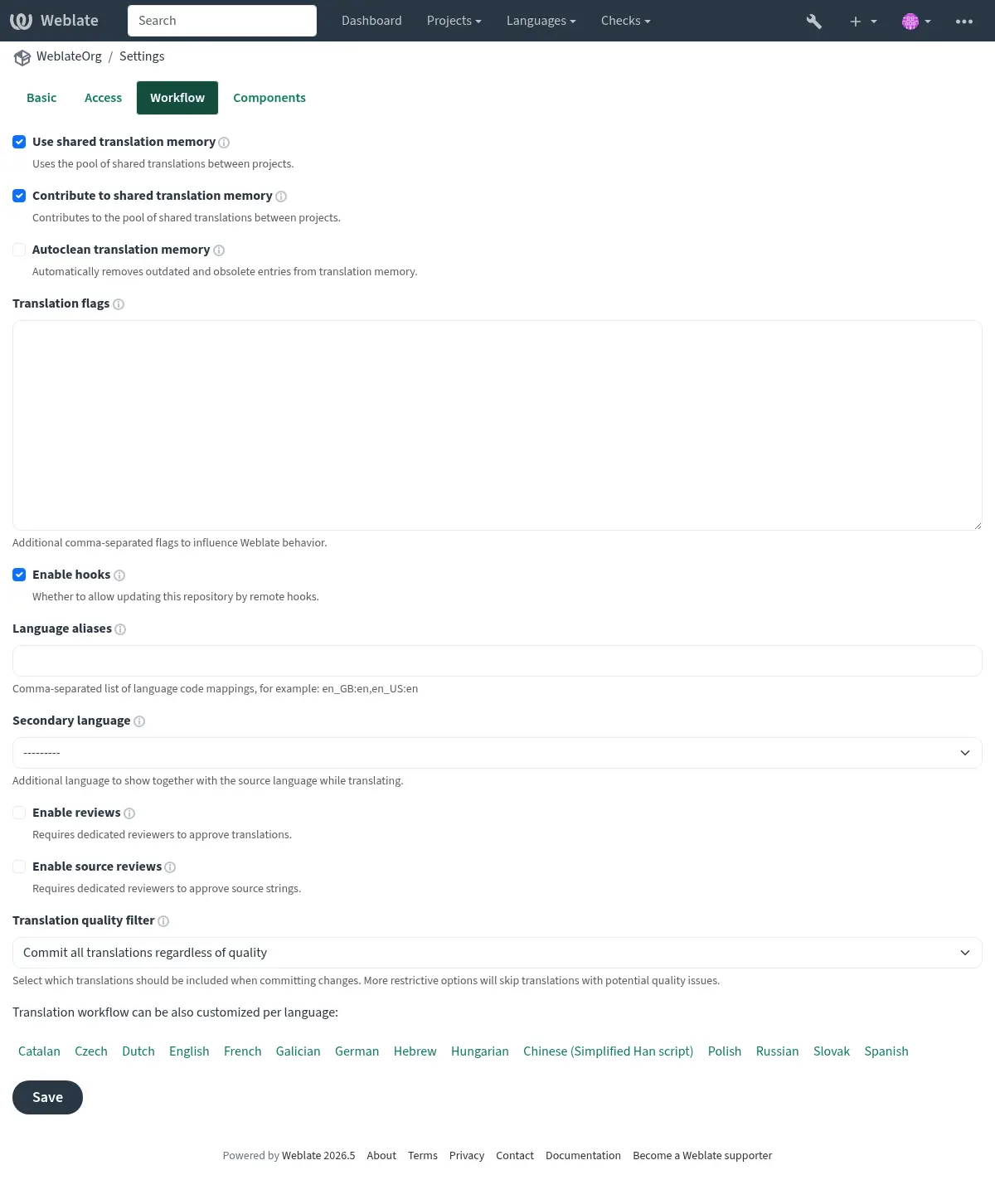
Reviews can be turned on in the project configuration, from the Workflow subpage of project settings (to be found in the Operations → Settings menu):
Quality gateway for the source strings
The original source language strings usually come from developers, since they write the code and provide the initial strings. However, developers are often not native speakers of the source language and do not provide the desired quality of the source strings. The intermediate translation can help you address this - there is an additional quality gateway for the strings between developers and translators.
By setting the Plik języka pośredniego, this file is used for translating
strings to the source language by translators/editors while it is owned by the
developers (often using arbitrary languages such as en_devel). Once this
stage is done, strings are available for translations to target languages,
based on what is now a polished source language stored in the
Jednojęzyczny bazowy plik języka.
String consolidation using secondary language
When Plik języka pośredniego cannot be used to consolidate the strings, you can choose one of the translations to act as a secondary language. The language can be configured in a project (Język dodatkowy) or in a component (Język dodatkowy). It is then shown to the translators while translating (see Języki dodatkowe) and can be optionally used as a source for machine translations (see Source strings for the machine translation).
This setup can be useful with mixed language source strings and consolidating them into a single translation, which is then used as a baseline for other work.
Recenzje ciągów źródłowych
With Włącz przeglądy źródeł enabled, the review process can be applied for source strings. Once enabled, users can report issues with source strings. The actual process depends on whether bilingual or monolingual formats are in use.
For monolingual formats, source string review functions similarly to Dedykowani recenzenci — once an issue with a source string is reported, the source string is marked as Needs editing.
Bilingual formats do not allow direct editing of source strings (these are typically extracted directly from the source code). In this case, a Source needs review label is attached to strings reported by translators. You should review such strings and either edit them in the source code, or remove the label.