Fluxuri de lucru de traducere
Using Weblate raises quality, reduces manual work, and brings everyone involved in the localization process closer to each other. It is up to you to decide how many of Weblate features you want to make use of.
The following is not a complete list of ways to configure Weblate. You can base other workflows on the examples listed here.
Personalizare flux de lucru
In addition to configuration at Configurația proiectului and Configurația componentei (as Activează recenzii, Activați sugestiile, Votare sugestie, and Automatically accept suggestions), the translation workflow can be customized per language.
Site-wide workflow customization can be done while Modificarea definițiilor lingvistice.
Per-project customization can be done on each language page of the project.
All workflow settings can be overridden, the only limitation is that Activează recenzii needs to be turned on and can only be disabled in the per-language customization.
The first existing setting applies:
Project-language customization
Language customization
The project/component settings
Notă
Please be careful when using site-wide override as that applies to all projects (unless they have own overrides for a given language).
Acces la traducere
The access control is not discussed in detail as a whole in the workflows, as most of its options can be applied to any workflow. Please consult the respective documentation on how to manage access to translations.
In the following chapters, any user means a user who has access to the translation. It can be any authenticated user if the project is public, or a user with Translate permission to the project.
Statele de traducere
Each translated string can be in one of the following states:
- Netradus
Traducerea este goală, aceasta poate fi sau nu stocată în fișier, în funcție de formatul fișierului.
- Necesită editare
Translation needs editing, this is usually the result of fuzzy matching or translator action. Depending on the file format it might be marked as needing edit (for example as it gets a
fuzzyflag in the gettext file).- Needs rewriting
Translation needs to be rewritten because of a source string change.
- Needs checking
State used for source/template strings that need developer review. It is typically set for new source strings imported from the VCS when the Source edit addon is enabled, or when a source string is reported for checking.
- Translated / Waiting for review
Translation is made. The translated state is shown as „Waiting for review” if reviews are enabled.
- Aprobat
Traducerea a fost aprobată în cadrul revizuirii. Aceasta nu mai poate fi modificată de către traducători, ci doar de către revizori. Traducătorii pot adăuga doar sugestii la ea.
Această stare este disponibilă numai atunci când sunt activate revizuirile.
- Doar în citire
String is read-only as a result of having
read-onlyflag, being a non-editable source string, or marked such in the translation file.- Sugestii
Sugestiile sunt stocate doar în Weblate și nu în fișierul de traducere.
Statele sunt reprezentate în fișierele de traducere atunci când este posibil.
Sugestie
If the file format you use does not support storing states, you might want to use the Flag unchanged translations as „Needs rewriting” add-on to flag unchanged strings as needing rewriting.
Notă
The Translation quality filter determines which translation states are stored in the file.
Traducere directă
The most common setup for smaller teams, where anybody can translate directly. This is also the default setup in Weblate.
Care utilizator poate edita traduceri.
Sugestiile sunt modalități opționale de a sugera modificări, atunci când traducătorii nu sunt siguri în legătură cu modificarea.
Setarea |
Valoare |
Notă |
|---|---|---|
Activează recenzii |
oprit |
Configurat la nivel de proiect. |
Activați sugestiile |
pe |
Useful for users to be able to suggest when they are not sure. |
Votare sugestie |
oprit |
|
Automatically accept suggestions |
0 |
|
Grupul de traducători |
Utilizatori |
Or Translate with per-project access control. |
Grupul de recenzenți |
N/A |
Nu a fost folosit. |
Evaluare reciprocă
With this workflow, anybody can add a suggestion, which needs approval from additional members before it is accepted as a translation.
Care utilizator poate adăuga sugestii.
Care utilizator poate vota pentru sugestii.
Sugestiile devin traduceri atunci când primesc un număr prestabilit de voturi.
Setarea |
Valoare |
Notă |
|---|---|---|
Activează recenzii |
oprit |
Configurat la nivel de proiect. |
Activați sugestiile |
pe |
|
Votare sugestie |
pe |
|
Automatically accept suggestions |
2 |
You can set higher value to require more peer reviews. |
Grupul de traducători |
Utilizatori |
Or Translate with per-project access control. |
Grupul de recenzenți |
N/A |
Nu se utilizează, toți traducătorii revizuiesc. |
Recenzori dedicați
Cu recenzori dedicați aveți două grupuri de utilizatori, unul care poate trimite traduceri și altul care le poate revizui pentru a se asigura că traducerile sunt consecvente și de bună calitate.
Care utilizator poate edita traduceri neaprobate.
Revizorul poate aproba / dezaproba șirurile de caractere.
Revizorul poate edita toate traducerile (inclusiv cele aprobate).
Sugestiile pot fi, de asemenea, utilizate pentru a sugera modificări pentru șirurile de caractere aprobate.
Setarea |
Valoare |
Notă |
|---|---|---|
Activează recenzii |
pe |
Configurat la nivel de proiect. |
Activați sugestiile |
pe |
Useful for users to be able to suggest when they are not sure. |
Votare sugestie |
oprit |
|
Automatically accept suggestions |
0 |
|
Grupul de traducători |
Utilizatori |
Or Translate with per-project access control. |
Grupul de recenzenți |
Revizorii |
Or Review with per-project access control. |
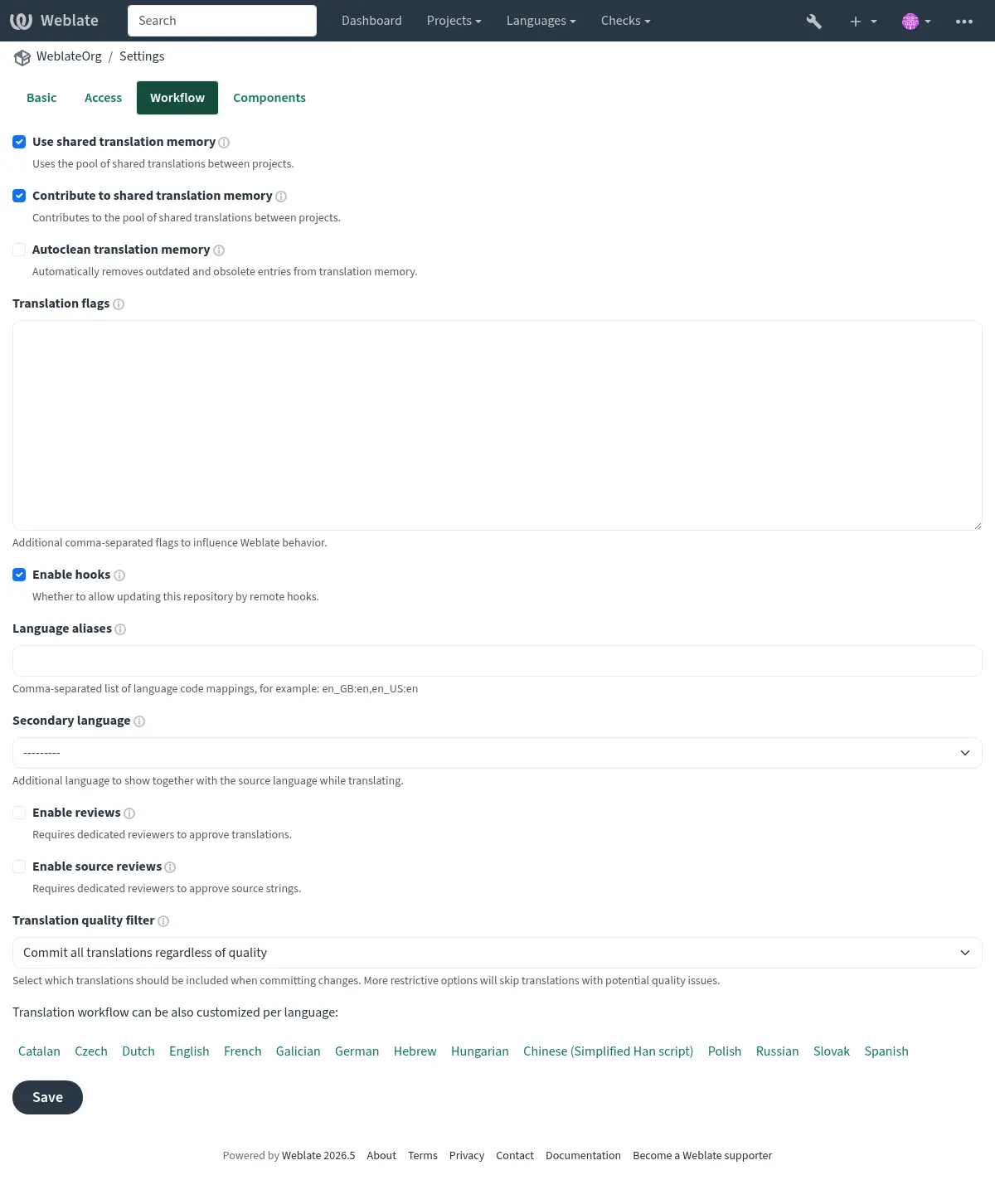
Activarea recenziilor
Reviews can be turned on in the project configuration, from the Workflow subpage of project settings (to be found in the Operations → Settings menu):
Poartă de calitate pentru șirurile sursă
The original source language strings usually come from developers, since they write the code and provide the initial strings. However, developers are often not native speakers of the source language and do not provide the desired quality of the source strings. The intermediate translation can help you address this - there is an additional quality gateway for the strings between developers and translators.
By setting the Fișier de limbă intermediar, this file is used for translating
strings to the source language by translators/editors while it is owned by the
developers (often using arbitrary languages such as en_devel). Once this
stage is done, strings are available for translations to target languages,
based on what is now a polished source language stored in the
Fișier de limbă de bază monolingvă.
String consolidation using secondary language
When Fișier de limbă intermediar cannot be used to consolidate the strings, you can choose one of the translations to act as a secondary language. The language can be configured in a project (Secondary language) or in a component (Secondary language). It is then shown to the translators while translating (see Limbi secundare) and can be optionally used as a source for machine translations (see Source strings for the machine translation).
This setup can be useful with mixed language source strings and consolidating them into a single translation, which is then used as a baseline for other work.
Sursa șiruri de recenzii
With Activează revizuiri sursă enabled, the review process can be applied for source strings. Once enabled, users can report issues with source strings. The actual process depends on whether bilingual or monolingual formats are in use.
For monolingual formats, source string review functions similarly to Recenzori dedicați — once an issue with a source string is reported, the source string is marked as Needs editing.
Bilingual formats do not allow direct editing of source strings (these are typically extracted directly from the source code). In this case, a Source needs review label is attached to strings reported by translators. You should review such strings and either edit them in the source code, or remove the label.