Gluais
Is féidir le gach tionscadal gluais amháin nó níos mó a áireamh chun téarmaí agus a n-aistriúcháin is fearr leo a stóráil. Cuidíonn gluaiseanna le haistriúcháin a choinneáil comhsheasmhach trí théarmaí comhoiriúnacha a thaispeáint san eagarthóir aistriúcháin.
Is comhpháirteanna aistriúcháin rialta iad gluaiseanna a bhfuil iompraíocht speisialta acu. Stórálann an teanga foinse na téarmaí a chuardaíonn Weblate i dteaghráin foinse. Stórálann gach aistriúchán gluaise an téarma is fearr leat, an téarma toirmiscthe, nó an iontráil neamh-inaistrithe do theanga sprice amháin.
Taispeántar téarmaí ón nglós ina bhfuil focail ón teaghrán foinse atá aistrithe faoi láthair i mbarra taoibh an eagarthóra aistriúcháin.
Hint
Ní úsáidtear na téarmaí gluais i seiceálacha cáilíochta ach amháin má chumasaíonn tú é sin, féach Ní leanann gluais le haghaidh tuilleadh eolais.
Conas a oibríonn meaitseáil gluaise
Nuair a aistríonn tú comhpháirt rialta, déanann Weblate cuardach ar an teaghrán foinse le haghaidh téarmaí ó theanga foinse na ngluaiseachtaí tionscadail. Nuair a oireann téarma, déanann Weblate cuardach ar an iontráil ghluaiseachta chomhfhreagrach don teanga atá á haistriú faoi láthair agus taispeánann sé san eagarthóir í.
Ciallaíonn sé seo go gcaithfidh iontrálacha gluaise a bheith ann sa teanga sprice gluaise le go mbeidh siad le feiceáil agus an teanga sprice sin á haistriú. Is féidir le gluais sa teanga foinse amháin sainmhínithe agus comhthéacs a stóráil fós, ach ní sholáthróidh sé meaitseálacha sa teanga sprice do theangacha nach bhfuil iontrálacha gluaise acu.
Más mian leat go mbeadh téarma i láthair i ngach teanga den ghluais, marcáil an iontráil foinse mar Téarmaíocht. Mura n-athraítear an téarma i ngach teanga, bain úsáid as Téarmaí do-aistrithe; ná cuir le chéile é le téarmaíocht ach amháin nuair is mian leat go gcruthóidh agus go gcothabhálfaidh Weblate iontrálacha do gach teanga den ghluais.
Gluaiseanna a bhainistiú
Changed in version 4.5: Is comhpháirteanna aistrithe rialta iad gluaiseanna anois agus is féidir leat na gnéithe Weblate go léir a úsáid orthu — ag trácht, ag stóráil i gcianstór, nó ag cur mínithe.
Úsáid comhpháirt ar bith mar ghluais trí Úsáid mar ghluais a chur ar siúl. Is féidir leat gluaiseanna iolracha a chruthú le haghaidh tionscadal amháin.
Cruthaítear gluais fholamh do thionscadal ar leith go huathoibríoch leis an tionscadal. Roinntear gluaiseanna i measc gach comhpháirte den tionscadal céanna, agus go roghnach le tionscadail eile ag baint úsáide as Roinn i dtionscadail as comhpháirt na gluaise faoi seach.
Breathnaíonn an chomhpháirt gluaise cosúil le haon chomhpháirt eile in Weblate le lipéad daite breise:
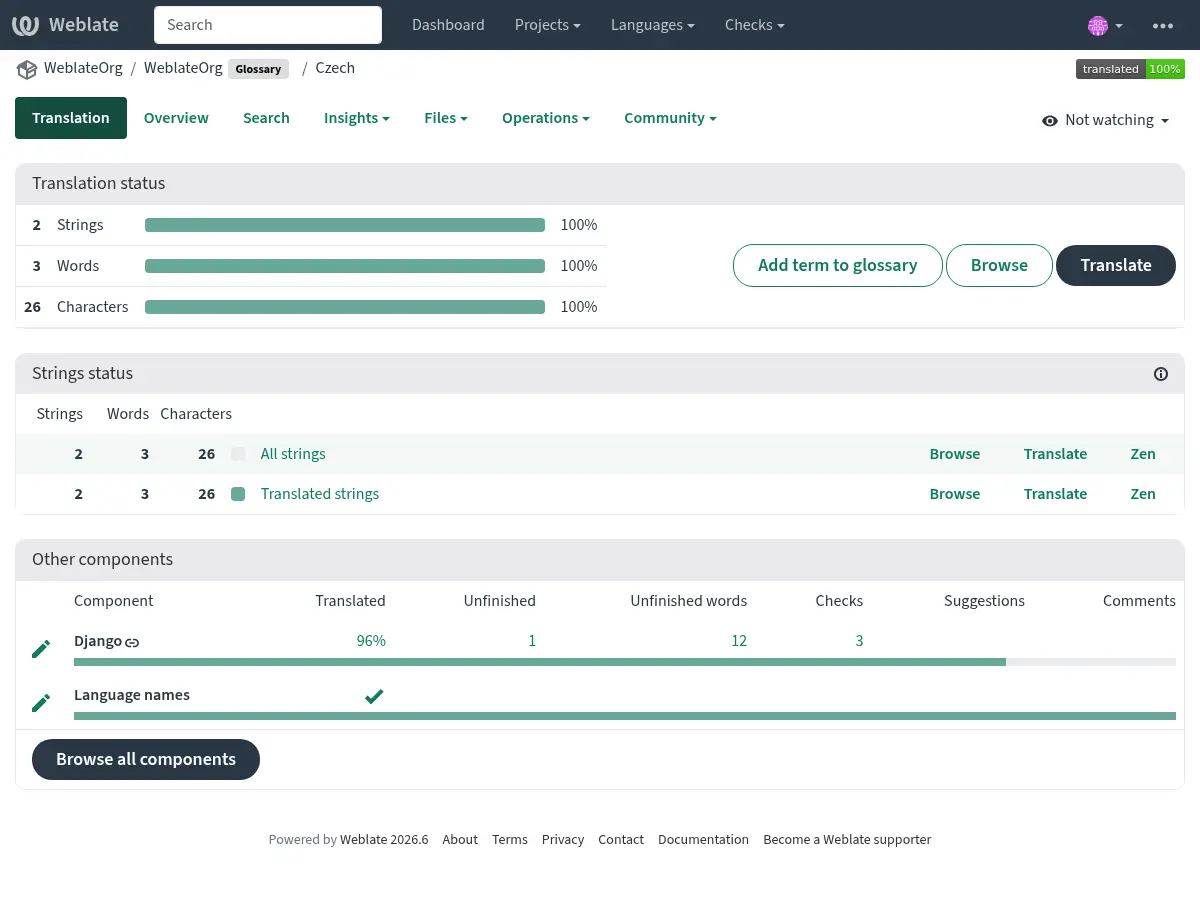
Is féidir leat gach téarma gluais a bhrabhsáil:
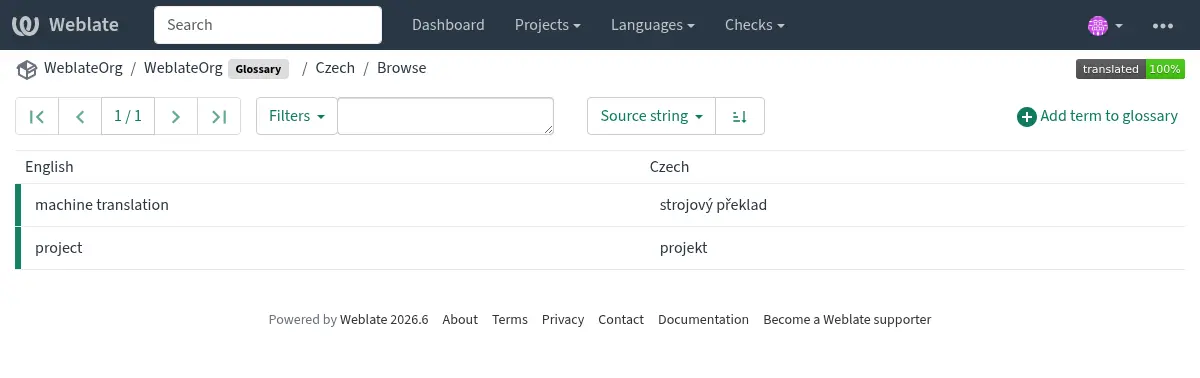
nó cuir in eagar iad mar aistriúcháin ar bith.
Téarmaí gluaise
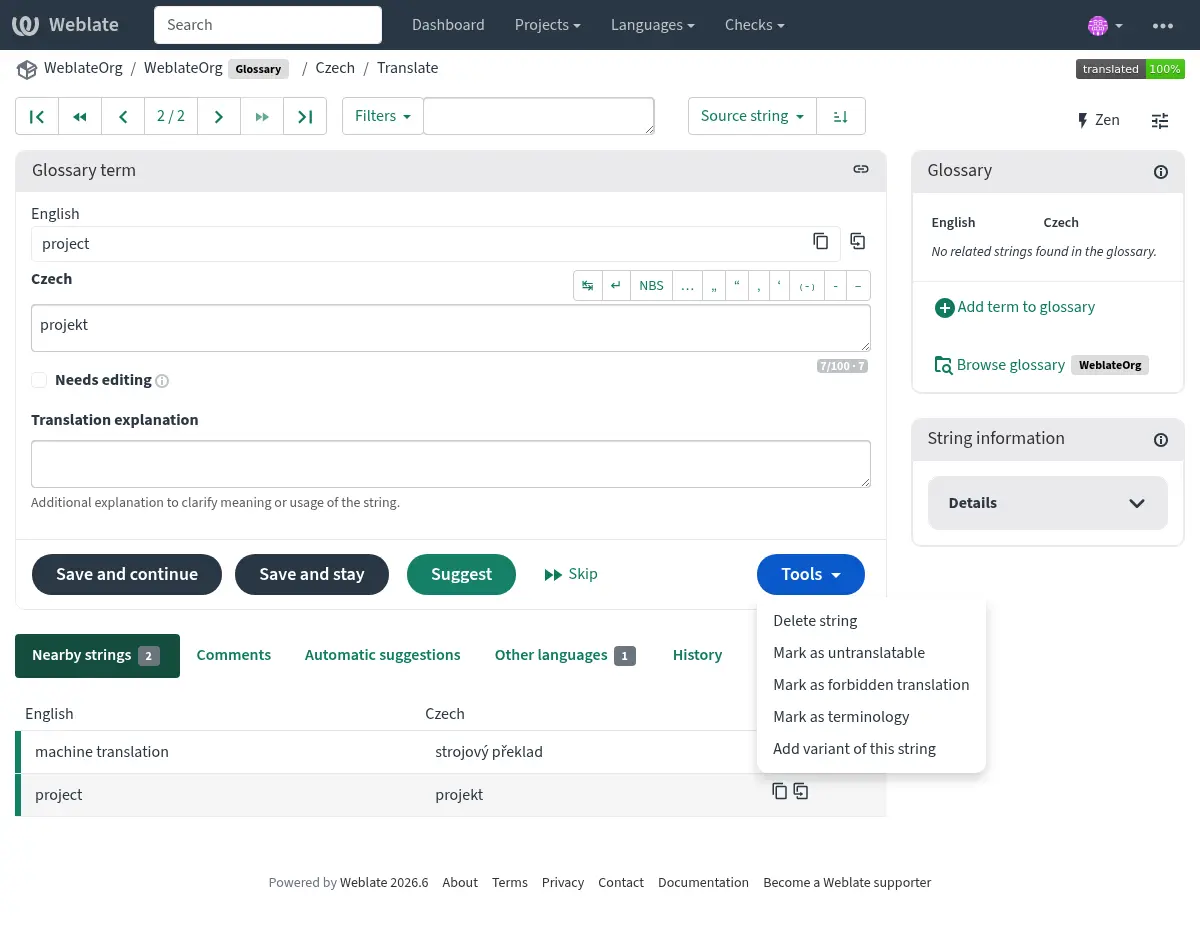
Aistrítear téarmaí gluais ar an mbealach céanna a dhéantar teaghráin rialta. Is féidir leat gnéithe breise a scoránaigh leis an roghchlár Tools do gach téarma.
See also
Cineál |
Cuspóir |
|---|---|
Gnáththéarma gluaise |
Aistriúchán nó míniú is fearr le haghaidh téarma i dteanga amháin nó níos mó. |
Coinnítear an téarma foinse Weblate i láthair i ngach teanga den ghluais ionas gur féidir aistriúcháin atá ar iarraidh a rianú agus a líonadh. |
|
Téarma ba chóir a fhágáil gan athrú nó nár chóir a aistriú. |
|
Aistriúchán nár cheart a úsáid don téarma foinseach. |
|
Focal malartach, giorrúchán, nó foirm níos giorra grúpáilte le téarma gluaise eile. |
Ag roghnú téarmaí gluaise
Roghnaigh téarmaí gluaise de réir brí agus lucht féachana, ní hamháin de réir chruth litriúil an fhocail. Má tá téarma foinseach débhríoch, cuir míniú leis ionas go mbeidh a fhios ag aistritheoirí cén bhrí is infheidhme sa tionscadal.
Tá iontrálacha glosaire thar a bheith úsáideach le haghaidh ainmneacha branda, acrainmneacha, gnéithe táirgí, téarmaí teicniúla, agus focail nua-chumtha nó traslitrithe. Bain úsáid as malairtí le haghaidh giorrúchán nó focail níos giorra, marcáil téarmaí tábhachtacha tras-teanga mar Téarmaíocht, marcáil téarmaí nár cheart a athrú mar Téarmaí do-aistrithe, agus marcáil aistriúcháin mhíthreoracha mar Aistriúcháin toirmiscthe.
Téarmaí do-aistrithe
Added in version 4.5.
Má chuirtear aistriúchán téarmaí áirithe ar théarmaí sa ghlois ar an mbratach mar léamh-amháin trí eagarthóireacht mórchóir, trí chlóscríobh sa bhratach, nó trí úsáid a bhaint as Uirlisí ↓ Marcáil mar neamh-inaistrithe, ciallaíonn sé sin nach féidir iad a aistriú. Bain úsáid as seo le haghaidh ainmneacha brandaí, ainmneacha táirgí, fearainn, ainmneacha teicneolaíochta, nó téarmaí eile nach ceart a athrú i dteangacha eile. Aibhsítear téarmaí den sórt sin go hamhairc i mbarra taoibh an ghlois.
Is leor an bhratach léamh-amháin nuair a bhíonn an iontráil glosaire ann cheana féin sna teangacha ina bhfuil sé le taispeáint. Cuir an bhratach Téarmaíocht leis freisin ach amháin nuair ba chóir do Weblate an iontráil neamh-inaistrithe a chruthú agus a chothabháil i ngach teanga glosaire.
Aistriúcháin toirmiscthe
Added in version 4.5.
Má mharcálann tú aistriúcháin áirithe ar théarmaí sa ghlós mar toirmiscthe trí eagarthóireacht mórchóir, trí chlóscríobh sa bhratach, nó trí úsáid a bhaint as Tools ↓ Mark as forbidden translation ciallaíonn sé nach bhfuil siad le húsáid. Bain úsáid as seo chun aistriúchán a shoiléiriú nuair a bhíonn roinnt focal débhríoch nó nuair a d'fhéadfadh bríonna gan choinne a bheith leo.
Bain úsáid as iontrálacha toirmiscthe le haghaidh aistriúcháin ar cheart a sheachaint. Bain úsáid as gnáth-iontrálacha gluaise le haghaidh aistriúcháin is fearr leat.
Téarmaíocht
Added in version 4.5.
Trí bhratach a chur ar théarmaí áirithe sa ghluais sa teanga foinse mar téarmeolaíocht trí eagarthóireacht mórchóir, trí chlóscríobh sa bhratach, nó trí úsáid a bhaint as Uirlisí ↓ Marcáil mar théarmeolaíocht, cuirtear iontrálacha dóibh le gach teanga sa ghluais. Bain úsáid as seo le haghaidh téarmaí tábhachtacha ar cheart smaoineamh orthu go maith, agus brí chomhsheasmhach a choinneáil ar fud na dteangacha uile.
Tá bratach na téarmaíochta i riocht leanúnach, ní gníomh aonuaire amháin atá i gceist. Cé go bhfanann an bratach ar an téarma foinseach, déanann Weblate é a chóireáil mar théarmaíocht agus coinníonn sé iontráil dó i ngach teanga glosaire. Má bhaintear iontráil teanga, cruthaítear arís í leis an gcéad sioncrónú glosaire eile.
Má bhaintear an bhratach terminology, cuirtear stop leis an gcothabháil uathoibríoch seo, ach ní bhaintear ná ní aisiompaítear iontrálacha a cruthaíodh cheana féin. Fanann siad ina ngnáth-iontrálacha gluaise.
Is féidir aistriúcháin a bheith ar ghnáththéarma gluaise i ngach teanga freisin. Is é an difríocht ná nach ndéanann Weblate iontrálacha teanga atá ar iarraidh a athchruthú le haghaidh gnáththéarma tar éis iad a bhaint.
Leaganacha
Is bealach cineálach iad leaganacha chun teaghráin a ghrúpáil le chéile. Liostaítear gach leagan téarma i mbarra taoibh na gluaise agus iad á aistriú.
Hint
Is féidir leat é seo a úsáid chun giorrúcháin nó nathanna cainte níos giorra a chur leis ar feadh téarma.
See also
Iompórtáil glosaire
Cosúil le comhpháirteanna aistriúcháin rialta, is féidir leat gluaiseanna atá ann cheana a uaslódáil chuig Weblate. Tacaítear le formáidí cosúil le Comhaid CSV nó Formáid eXchange TermBase agus is féidir iad a uaslódáil, féach Aistriúcháin á n-uaslódáil.
Is féidir le comhaid TBX mínithe, meiteashonraí inléite amháin, agus bratacha gluaise a áireamh; féach Formáid eXchange TermBase le haghaidh mapáil chruinn meiteashonraí.
Cé gur féidir le TBX teangacha iolracha a bheith ann, mapálann Weblate comhaid chomhpháirte chuig teangacha fós ag baint úsáide as an masc comhaid chomhpháirte agus socruithe teanga. I gcás comhpháirt gluaise TBX, coinnigh teanga fhoinse na comhpháirte mar theanga téarma foinse agus ainmnigh comhaid aistriúcháin don teanga sprice a léiríonn siad. Seachain ainmniú comhad aistriúcháin leis an teanga chéanna leis an teanga fhoinse comhpháirte, mar go bhfuil an teanga fhoinse ann cheana féin i Weblate agus is féidir leis seo a bheith ina chúis le braiteadh teangacha dúblacha.
See also
Comhaid teanga agus sioncrónú
Leanann comhpháirteanna na ngluaise na teangacha a úsáideann na comhpháirteanna rialta sa tionscadal céanna. Nuair a chuirtear teanga le comhpháirt rialta, cuireann Weblate an teanga ghluaise atá ar iarraidh leis chomh maith ionas gur féidir meaitseáil ghluaise a thaispeáint don teanga sin.
Tá an sioncrónú teanga uathoibríoch seo d'aon ghnó. Is féidir le scagadh comhad teanga glosaire le Scagaire teanga líon na gcomhad bainistithe a laghdú, ach ciallaíonn sé freisin nach bhfuil aon iontrálacha glosaire ag Weblate le taispeáint do theangacha sprice atá scagtha amach.
Déantar iontrálacha téarmeolaíochta a shioncrónú freisin. Nuair a mharcáiltear téarma foinseach gluaise mar théarmaíocht, cruthaíonn Weblate iontrálacha atá ar iarraidh i ngach teanga gluaise agus athchruthaíonn sé iad má bhaintear iad agus an bhratach fós socraithe.
Ní féidir le Weblate aistriúcháin sheanda gluaise a ghlanadh ach amháin i gcás gluaiseanna atá á mbainistiú ag Weblate, ach amháin nuair nach n-úsáideann aon chomhpháirt rialta sa tionscadal an teanga sin fós, agus nuair nach bhfuil aon téarmaí aistrithe san aistriúchán sean-ghluaise. Má tá téarmaí fós sa sean-theanga ghluaise, coinníonn Weblate í agus tuairiscíonn sé í mar theanga ghluaise neamhúsáidte.
Patrúin choitianta socraithe
- Gluais mhíniúcháin i mBéarla amháin
Cuir téarmaí gluaise sa teanga foinse leis, maille le mínithe. Oibríonn sé seo mar liosta téarmaí cothabháilte, ach ní thaispeánfaidh sé meaitseálacha gluaise sa teanga sprice mura gcruthaíonn tú iontrálacha sna teangacha gluaise sprice freisin.
- Téarmeolaíocht riachtanach
Cuir téarmaí leis i dteanga foinse an fhoilseacháin, marcáil iad mar Téarmaíocht, agus lig d’aistritheoirí na hiontrálacha cruthaithe a líonadh isteach i ngach teanga sprice. Bain úsáid as mínithe chun an bhrí atá beartaithe a dhoiciméadú.
- Téarmaí nach féidir a aistriú
Marcáil téarmaí mar Téarmaí do-aistrithe nuair is ceart iad a fhágáil gan athrú. Cuir Téarmaíocht leis ach amháin nuair is ceart don téarma a bheith i láthair i ngach teanga den ghluais le haghaidh meaitseáil agus athbhreithnithe.
- Aistriúcháin toirmiscthe
Cuir an t-aistriúchán míthreorach leis mar iontráil Aistriúcháin toirmiscthe. Cuir an fhoclaíocht is fearr leis mar iontráil ghluais rialta ar leith nuair ba chóir d’aistritheoirí aistriúchán ar leith a úsáid ina ionad.
Gluaiseanna i moladh uathoibríoch
Added in version 5.3.
Úsáideann roinnt seirbhísí moltaí uathoibríocha gluaiseanna le linn an aistriúcháin, féach ar a ndoiciméadacht i Moltaí uathoibríocha le haghaidh tuilleadh eolais faoin tacaíocht.
Déantar an ghluais a phróiseáil sula nochtar don tseirbhís:
Déantar iontrálacha foinse dúblacha a scipeáil i gcás seirbhísí a bhfuil téarmaí foinse uathúla ag teastáil uathu. Is féidir le seirbhísí bunaithe ar LLM dúblaigh a fháil le mínithe chun iad a dhí-bhrí.
Baintear aon charachtair rialaithe agus spás bán tosaigh agus rianaithe.
Aistriúcháin toirmiscthe á scipeáil..
Note
Stórálann go leor seirbhísí gluaiseanna ar thaobh an fhreastalaí agus cuireann siad teorainn ar líon na ngluaiseanna sábháilte i bhfeidhm. Scriosann Weblate an ghluais is sine i gcónaí má ritheann sé as spás.