Integracja kontroli wersji
Weblate currently supports Git (with extended support for GitHub pull requests, GitLab merge requests, Gitea pull requests, Gerrit review requests, Subversion, Bitbucket Cloud pull requests, Bitbucket Data Center pull requests, and Azure DevOps pull requests) and Mercurial as version control back-ends.
For provider-specific setup steps that combine repository access, incoming notifications, and pushing translations back, see Code-hosting integrations.
Dostęp do repozytoriów
The VCS repository you want to use has to be accessible to Weblate. With a
publicly available repository you just need to enter the correct URL (for
example https://github.com/WeblateOrg/weblate.git), but for private
repositories or for push URLs the setup is more complex and requires
authentication.
Accessing repositories from Hosted Weblate
Informacja
This section applies only to Hosted Weblate (hosted.weblate.org). If you are running your own self-hosted Weblate instance, please see the next section instead.
For GitHub repositories on Hosted Weblate, use the Hosted Weblate app from Weblate’s Connect GitHub account flow whenever possible. The App grants repository access, receives incoming notifications, pushes translation branches, and creates pull requests without inviting the Hosted Weblate weblate user. See GitHub repository access for the full setup.
For direct SSH access outside the GitHub App workflow, and for Bitbucket,
Codeberg, and GitLab repositories, Hosted Weblate has a dedicated push user
(with the username weblate, e-mail hosted@weblate.org, and a
name or profile description Weblate push user).
Podpowiedź
There can be more Weblate users on the platforms, designated for other Weblate instances.
Searching by e-mail hosted@weblate.org is recommended to find the correct
user for Hosted Weblate.
You need to add this user as a collaborator and give it appropriate permissions to your repository (read-only is okay for cloning, write is required for pushing). Depending on the service and your organization’s settings, this happens immediately, or requires confirmation on the Weblate side.
The weblate user on GitHub accepts invitations automatically within five minutes when you intentionally use direct SSH access there. Manual processing might be needed on the other services, so please be patient.
For this direct SSH-user setup, once the weblate user is added to
your repository, you can configure Repozytorium kodu źródłowego and
URL repozytorium dla push using the SSH protocol, for example
git@example.com:group/project.git.
Accessing repositories on code-hosting sites (GitHub, GitLab, Bitbucket, Azure DevOps, …)
Informacja
This section applies to self-hosted Weblate instances. If you are using Hosted Weblate (hosted.weblate.org), see Accessing repositories from Hosted Weblate instead.
For self-hosted Weblate, a single private repository is often easiest to set up using an HTTPS repository URL with an access token, see Code-hosting integrations.
For multiple repositories, create a dedicated code-hosting user associated with a Weblate SSH key (see Weblate Klucz SSH). This way you associate Weblate SSH key with a single user, because platforms frequently enforce single use of an SSH key. Grant this user access to the repositories, and use SSH URLs to access them (see Repozytoria SSH).
Repozytoria SSH
One common method to access private repositories is based on SSH. Authorize the public Weblate SSH key (see Weblate Klucz SSH) to access the upstream repository this way.
Ostrzeżenie
On GitHub, each key can only be used once, see GitHub repository access and Accessing repositories from Hosted Weblate.
Weblate also stores the host key fingerprint upon first connection, and fails to connect to the host should it be changed later (see Weryfikacja kluczy hosta SSH).
In case adjustment is needed, do so from the Weblate admin interface:
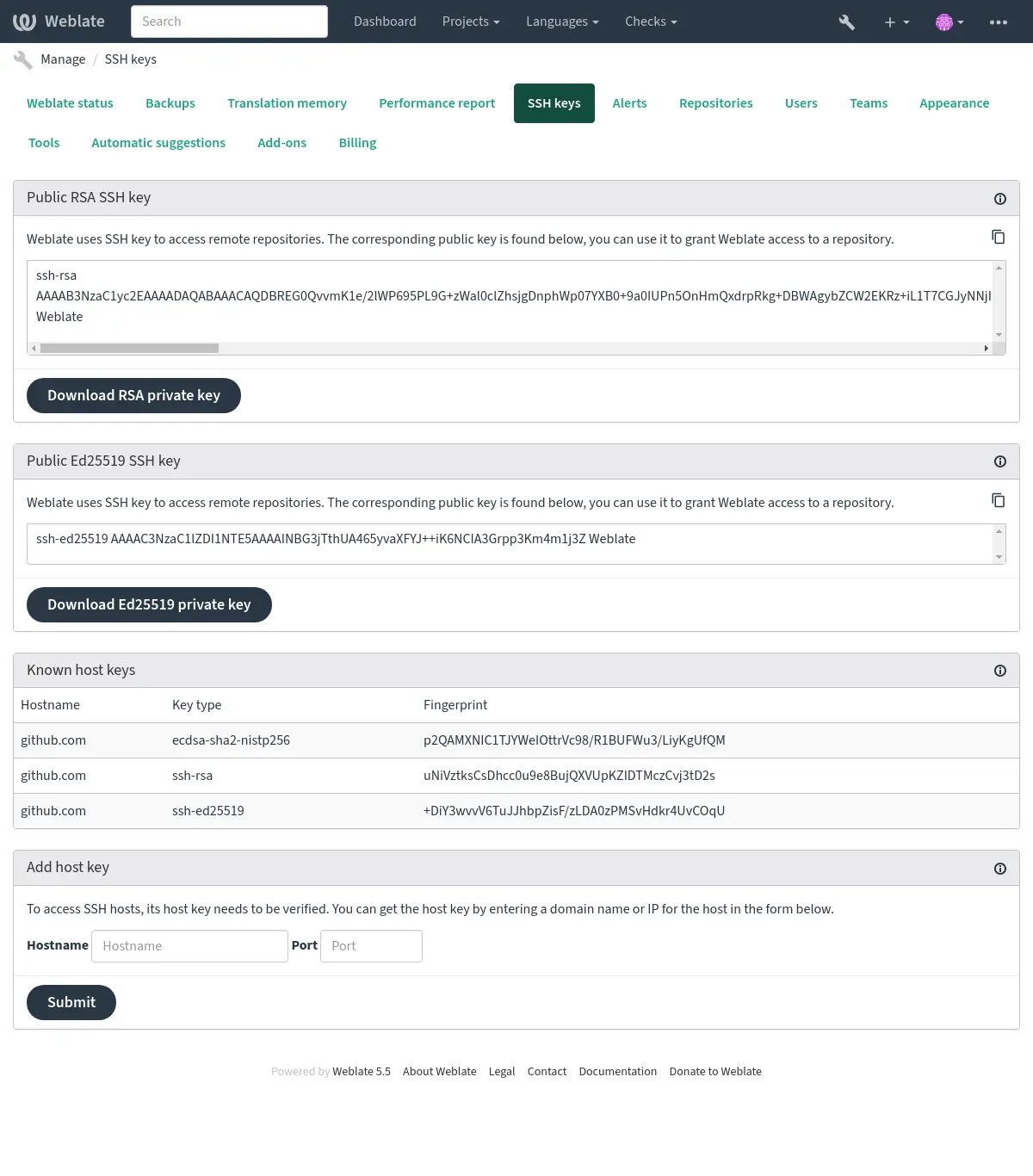
Weblate Klucz SSH
Zmienione w wersji 4.17: Weblate now generates both RSA and Ed25519 SSH keys. Using Ed25519 is recommended for new setups.
The Weblate public key is visible to all users browsing the About page.
Admins can generate or display the public key currently used by Weblate in the connection (from SSH keys) on the admin interface landing page.
Informacja
The corresponding private SSH key can not currently have a password, so ensure it is well protected.
Podpowiedź
Make a backup of the generated private Weblate SSH key.
Weryfikacja kluczy hosta SSH
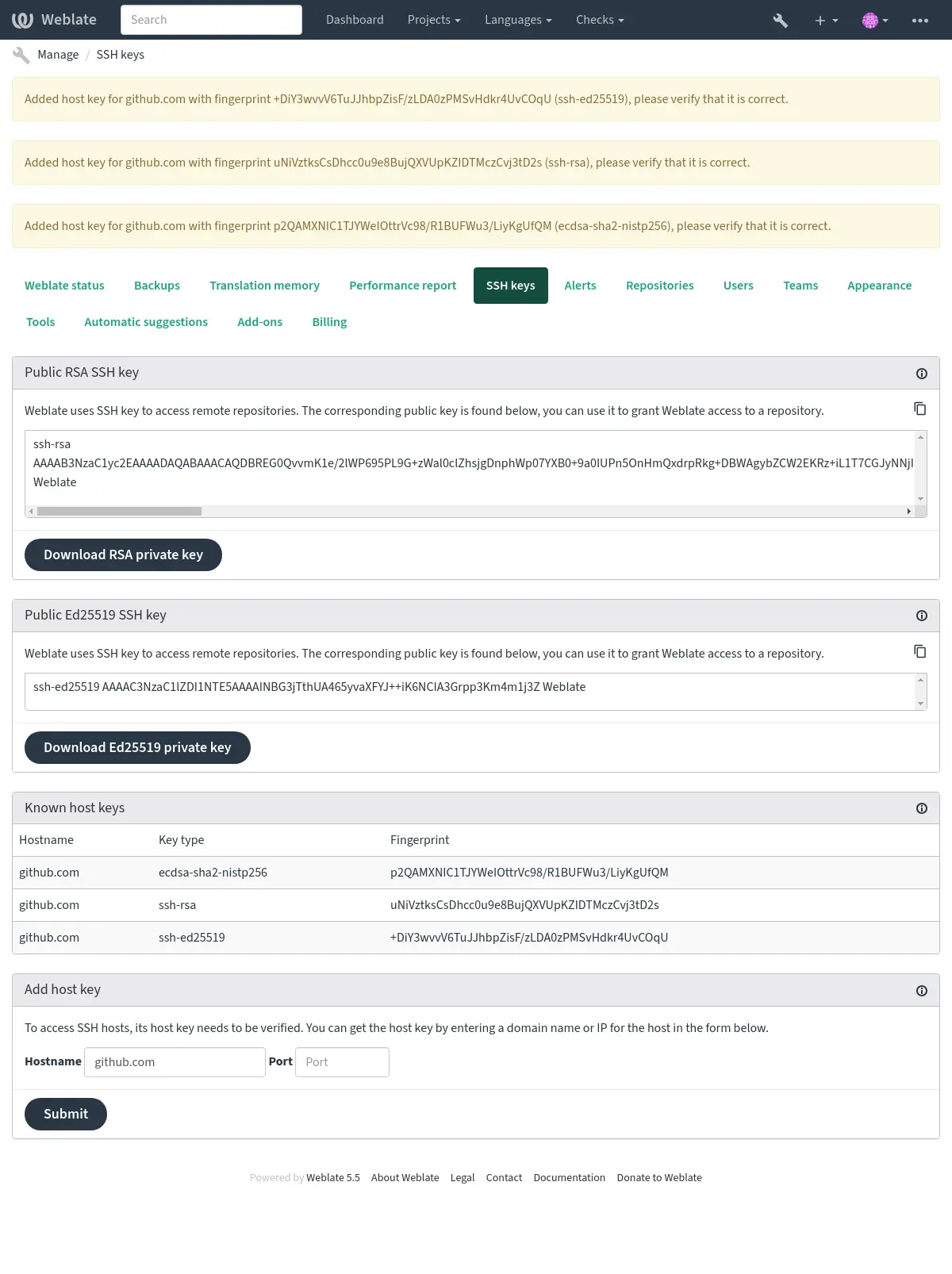
Weblate automatically stores the SSH host keys on first access and remembers them for further use.
In case you want to verify the key fingerprint before connecting to the
repository, add the SSH host keys of the servers you are going to access in
Add host key, from the same section of the admin interface. Enter
the hostname you are going to access (e.g. gitlab.com), and press
Submit. Verify its fingerprint matches the server you added.
The added keys with fingerprints are shown in the confirmation message:
Connecting to legacy SSH servers
Recent OpenSSH releases (for example the one used in Weblate Docker container) disable RSA signatures using the SHA-1 hash algorithm by default. This change has been made as the SHA-1 hash algorithm is cryptographically broken, and it is possible to create chosen-prefix hash collisions for <USD$50K.
For most users, this change should be invisible and there is no need to replace ssh-rsa keys. OpenSSH has supported RFC8332 RSA/SHA-256/512 signatures since release 7.2 and existing ssh-rsa keys will automatically use the stronger algorithm where possible.
Incompatibility is more likely when connecting to older SSH implementations that have not been upgraded or have not closely tracked improvements in the SSH protocol. The SSH connection to such server will fail with:
no matching host key type found. Their offer: ssh-rsa
For these cases, it may be necessary to selectively re-enable RSA/SHA1 to allow
connection and/or user authentication via the HostkeyAlgorithms and
PubkeyAcceptedAlgorithms options. For example, the following stanza in
DATA_DIR/ssh/config will enable RSA/SHA1 for host and user
authentication for a single destination host:
Host legacy-host
   HostkeyAlgorithms +ssh-rsa
   PubkeyAcceptedAlgorithms +ssh-rsa
We recommend enabling RSA/SHA1 only as a stopgap measure until legacy implementations can be upgraded or reconfigured with another key type (such as ECDSA or Ed25519).
Repozytoria GitHub
Detailed GitHub repository access is covered in GitHub repository access.
GitLab repositories
Detailed GitLab repository access is covered in GitLab repository access.
Wewnętrzne adresy URL Weblate
Share one repository setup between different components by referring to its
placement as weblate://project/component in other (linked) components. This
way linked components use the VCS repository configuration of the
main (referenced) component.
Ostrzeżenie
Removing main component also removes linked components.
Weblate automatically adjusts the repository URL when creating a component if it finds a component with a matching repository setup. You can override this in the last step of the component configuration.
Powody, dla których warto skorzystać z tej funkcji:
Saves disk space on the server, the repository is stored just once.
Makes the updates faster, only one repository is updated.
There is just single exported repository with Weblate translations (see Eksporter Git).
Some add-ons can operate on multiple components sharing one repository, for example Zesquashowane commity na Git.
Repozytoria HTTPS
Zobacz także
To access protected HTTPS repositories, include the username and password in the URL. Don’t worry, Weblate will strip this info when the URL is shown to users (if even allowed to see the repository URL at all).
For example the GitHub URL with authentication added might look like:
https://user:your_access_token@github.com/WeblateOrg/weblate.git.
In case you don’t provide credentials in the URL and the repository requires it, Git will fail with an error:
fatal: could not read Username for 'https://github.com': terminal prompts disabled
Zmienione w wersji 5.10.2: Weblate uses proactive authentication with Git 2.46.0 and newer when HTTP credentials are supplied.
This makes it possible to access Azure DevOps repositories and makes access to authenticated repositories faster.
Informacja
If your username or password contains special characters, those have to be
URL encoded, for example
https://user%40example.com:%24password%23@bitbucket.org/….
Korzystanie z proxy
If you need to access HTTP/HTTPS VCS repositories using a proxy server, configure the VCS to use it.
This can be done using the http_proxy, https_proxy, and all_proxy
environment variables, (as described in the cURL documentation)
or by enforcing it in the VCS configuration, for example:
git config --global http.proxy http://user:password@proxy.example.com:80
Informacja
The proxy configuration needs to be done under user running Weblate (see
also Uprawnienia systemu plików) and with HOME=$DATA_DIR/home (see
DATA_DIR), otherwise Git executed by Weblate will not use it.
Zobacz także
Git
Podpowiedź
Weblate needs Git 2.28 or newer.
Zobacz także
See Dostęp do repozytoriów for info on how to access different kinds of repositories.
Git z wymuszonym wypchnięciem
This behaves exactly like Git itself, the only difference being that it always force pushes. This is intended only in the case of using a separate repository for translations.
Ostrzeżenie
Use with caution, as this easily leads to lost commits in your upstream repository.
Dostosowywanie konfiguracji Git
Weblate invokes all VCS commands with HOME=$DATA_DIR/home (see
DATA_DIR), therefore editing the user configuration needs to be done
in DATA_DIR/home/.git.
GitHub pull requests
Detailed GitHub pull request setup is covered in GitHub pull requests.
GitLab merge requests
Detailed GitLab merge request setup is covered in GitLab merge requests.
Gitea pull requests
Detailed Gitea pull request setup is covered in Gitea pull requests.
Bitbucket Data Center pull requests
Detailed Bitbucket Data Center pull request setup is covered in Bitbucket Data Center pull requests.
Bitbucket Cloud pull requests
Detailed Bitbucket Cloud pull request setup is covered in Bitbucket Cloud pull requests.
Pagure merge requests
Detailed Pagure merge request setup is covered in Pagure merge requests.
Gerrit
Detailed Gerrit review request setup is covered in Gerrit review requests.
Azure DevOps pull requests
Detailed Azure DevOps pull request setup is covered in Azure DevOps pull requests.
Mercurial
Mercurial is another VCS you can use directly in Weblate.
Informacja
It should work with any Mercurial version, but there are sometimes incompatible changes to the command-line interface which breaks Weblate integration.
Zobacz także
See Dostęp do repozytoriów for info on how to access different kinds of repositories.
Subversion
Weblate uses git-svn to interact with subversion repositories. It is a Perl script that lets subversion be used by a Git client, enabling users to maintain a full clone of the internal repository and commit locally.
Informacja
Weblate tries to detect Subversion repository layout automatically - it supports both direct URLs for branch or repositories with standard layout (branches/, tags/ and trunk/). More info about this is to be found in the git-svn documentation. If your repository does not have a standard layout and you encounter errors, try including the branch name in the repository URL and leaving branch empty.
Poświadczenia Subversion
Weblate expects you to have accepted the certificate up-front (and your
credentials if needed). It will look to insert them into the DATA_DIR
directory. Accept the certificate by using svn once with the $HOME
environment variable set to the DATA_DIR:
# Use DATA_DIR as configured in Weblate settings.py, it is /app/data in the Docker
HOME=${DATA_DIR}/home svn co https://svn.example.com/example
Zobacz także
Pliki lokalne
Podpowiedź
Underneath, this uses Git. It requires Git installed and allows you to switch to using Git natively with full history of your translations.
Weblate can also operate without a remote VCS. The initial translations are imported by uploading them. Later you can replace individual files by file upload, or add translation strings directly from Weblate (currently available only for monolingual translations).
In the background Weblate creates a Git repository for you and all changes are tracked in. In case you later decide to use a VCS to store the translations, you already have a repository within Weblate can base your integration on.