Inscription et profil utilisateur
S’inscrire
Tout le monde peut parcourir les projets, voir les traductions ou suggérer des traductions par défaut. Seuls les utilisateurs enregistrés sont autorisés à enregistrer les modifications et sont crédités pour chaque traduction effectuée.
Vous pouvez vous inscrire en suivant les étapes suivantes :
Remplissez le formulaire d’inscription avec vos informations d’identification.
Activez l’inscription en suivant le lien figurant dans le courriel que vous recevez.
Ajustez éventuellement votre profil pour choisir les langues que vous connaissez.
Tableau de bord
Lorsque vous vous connectez, vous verrez un aperçu des projets et des composants, ainsi que leur progression respective en matière de traduction.
Les composants des projets que vous regardez sont affichés par défaut et référencés avec vos langues préférées.
Indication
Vous pouvez passer d’une vue à l’autre en utilisant les onglets de navigation.

Le menu comporte les options suivantes :
Projets > Parcourir tous les projets dans le menu principal affichant l’état de la traduction pour chaque projet de l’instance Weblate.
En sélectionnant une langue dans le menu principal Langues, vous verrez l’état de la traduction de tous les projets, filtrés par une de vos langues principales.
Traductions surveillées dans le tableau de bord affichera l’état de la traduction des projets que vous surveillez, filtré par vos langues principales.
En outre, la liste déroulante peut également afficher un nombre quelconque de liste de composants, ensembles de composants de projet préconfigurés par l’administrateur Weblate, voir Liste des composants.
Vous pouvez configurer votre tableau de bord personnel dans la section Préférences des paramètres de votre profil d’utilisateur.
Note
Lorsque Weblate est configuré pour un seul projet en utilisant SINGLE_PROJECT dans le fichier settings.py (voir Configuration), le tableau de bord ne sera pas affiché, car l’utilisateur sera redirigé vers l’unique projet ou composant à la place.
Profil utilisateur
Le profil utilisateur est accessible en cliquant sur l’icône d’utilisateur en haut à droite du menu supérieur, puis sur le menu Paramètres.
The settings tabs separate account and commit identity, public profile information, preferences, security, and developer access. Name and e-mail address are used in VCS commits, so keep this info accurate.
Note
Toutes les sélections de langue ne proposent que les langues actuellement traduites.
Indication
Demandez ou ajoutez d’autres langues que vous souhaitez traduire en cliquant sur le bouton pour les rendre également disponibles.
Langues
Langue de l’interface
Sélectionner la langue de l’interface utilisateur.
Langues traduites
Choose which languages you prefer to translate, and they will be offered on the main page of watched projects, so that you have easier access to all these translations in each of those languages.

Langues secondaires
Vous pouvez définir les langues secondaires qui vous sont présentées à titre indicatif lors de la traduction. L’image suivante montre un exemple où l’hébreu est affiché comme langue secondaire :

Indication
This can be also configured in the project (Langue secondaire) or component (Langue secondaire). In that case it can be used for Consolidation de chaîne en utilisant la langue secondaire.
Préférences
Thème
Choisir si Weblate doit suivre les paramètres système pour les thèmes sombre ou clair, ou sélectionner le thème manuellement.
Table columns
By default, Weblate hides some columns in listings (languages, components, projects, …) when the browser window is too narrow to fit them. Enable Show all columns in lists using horizontal scrolling to keep all columns instead and scroll the table horizontally when needed.
Use Visible columns in lists to choose which statistics columns are shown in the listings. This way you can hide numbers you are not interested in, or make room for additional ones such as Total strings.
Affichage du tableau de bord par défaut
Dans l’onglet Préférences, vous pouvez choisir laquelle des vues du tableau de bord disponibles doit être présentée par défaut. Si vous choisissez Liste de composants, vous devez sélectionner la liste des composants qui sera affichée dans la liste déroulante Liste de composants par défaut.
Voir aussi
Lien vers l’éditeur
Un lien vers le code source est affiché dans le navigateur web configuré dans la Configuration des composants par défaut.
Indication
En définissant Lien vers l’éditeur, vous utilisez votre éditeur local pour ouvrir le fichier de code source des chaînes traduites du système de contrôle des versions. Vous pouvez utiliser Balisage de modèle.
En général, quelque chose comme editor://open/?file={{filename}}&line={{line}} est une bonne option.
Voir aussi
Vous pouvez trouver plus d’informations sur l’enregistrement de protocoles URL personnalisés pour l’éditeur dans la documentation de Nette documentation.
Caractères spéciaux
Caractères spéciaux supplémentaires à ajouter au Clavier visuel.
Notifications
Abonnez-vous aux différentes notifications de l’onglet Notifications. Les notifications pour les évènements sélectionnés sur les projets surveillés ou administrés vous seront envoyées par courriel.
Certaines notifications ne sont envoyées que pour des évènements dans vos langues (par exemple au sujet de nouvelles chaînes à traduire), tandis que d’autres se déclenchent au niveau des composants (par exemple des erreurs de fusion). Ces deux groupes de notifications sont visuellement séparés dans les paramètres.
The Translation activity summary notification is digest-only and summarizes added, updated, translated, approved, needs editing, and unfinished strings.
Each periodic notification e-mail contains entries from all matching projects. Listings of individual changes contain up to 100 entries and indicate when additional entries were omitted, while grouped summaries are not limited.
Vous pouvez basculer les notifications pour les projets surveillés et les projets administrés et il est possible de les modifier (ou de les mettre en sourdine) pour chaque projet et chaque composant. Visitez la page d’aperçu du composant et sélectionnez le choix approprié dans le menu Surveillé.
Project and component notification subscriptions are automatically removed when you lose access to their targets. Cleanup runs hourly for a different group of users, checking every user once daily. Subscriptions are retained during temporary project blocks or while two-factor authentication requirements are unmet.
In case Automatically watch projects on contribution is enabled you
will automatically start watching projects upon contributing to them. The
default value depends on DEFAULT_AUTO_WATCH.
Note
Vous ne recevrez pas de notifications pour vos propres actions.
Indication
Le nombre de notifications envoyées est limité, vous ne recevrez pas plus de 1 000 courriels par jour. Au-delà, les notifications supplémentaires seront purgées.
Open Notification diagnostics from your notification settings to
inspect your own subscriptions. Administrators with management access and
permission to edit users can open the same page for another user from that
user’s Edit tab. The Overview tab includes watched
projects, notification languages, and subscriptions grouped by scope and target.
In the Diagnostics tab, enter an object path such as
project/category/component/cs. Project and category paths summarize inherited
project settings and exceptions across all accessible
components. Equivalent component settings are grouped together, with counts and
up to five example links to inspect individual components. Component paths show
effective settings and language restrictions; translation paths check the selected
language specifically. Broad summaries do not enumerate individual translations.
Summaries are limited to 200 accessible components and 10 original projects
(including the selected project). For larger scopes, choose a smaller category,
a component, or a translation; partial summaries are not shown.
Lists of more than five watched projects or notification languages show counts
instead of individual links.
Only events with a matching subscription are shown, including disabled subscriptions and subscriptions blocked by language or account conditions. Event conditions and overridden subscriptions are shown directly. Subscription links highlight the matching row in the Overview tab. Component example links open diagnostics for that component. Shared components use subscriptions from their original project.
The diagnostics check eligibility without sending e-mail. Notifications that depend on event details, such as mentions or alerts, are marked as conditional. Actual delivery also depends on the event author, digest content, and rate limits.

Compte
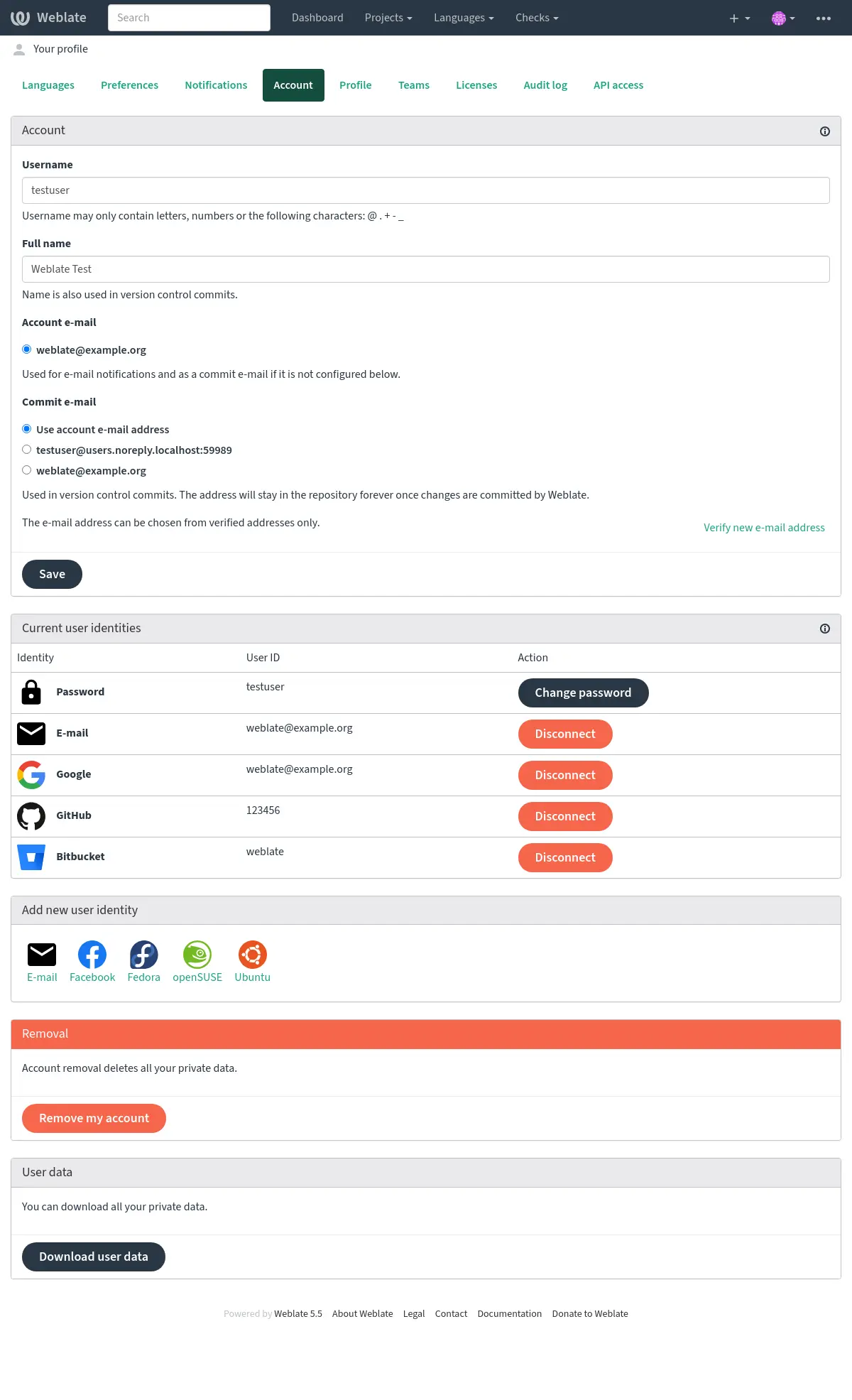
The Account tab contains your username, name, account e-mail, and commit identity. You can verify another e-mail address here. The account management section at the bottom lets you export your user data (see Weblate user data export), import settings, or remove your account.
When you add an e-mail address, verification instructions are sent to the new address; access to your old mailbox is not required. Open the verification link while signed in to the account where you requested it, then follow the confirmation steps. You may be asked for your current password. Adding an address does not change your account e-mail address. After verification, you can select the new address in the Account tab.
When a connected service provides e-mail verification data during sign-in, Weblate refreshes the addresses verified by that service. Missing e-mail claims leave the stored addresses unchanged; an explicitly empty verified-address list removes that service’s stored addresses. If your account e-mail loses its last verification, Weblate selects another available, verified address or clears the account e-mail if none is available. You can still sign in through the connected service. Add and verify an address to restore password recovery, then select it as your account e-mail to receive notifications. Verified secondary addresses can also be used for password recovery. Pending confirmation links for removed addresses are invalidated. An address still verified by another connected identity remains available.
If you changed your service’s e-mail addresses before upgrading Weblate, check your Account settings and replace any retired account e-mail. Previously removed addresses cannot always be identified automatically.
If the new address already belongs to another account, that mailbox receives guidance on recovering access instead of a verification link. Sign out before recovering the other account. Contact support, when available, for help moving an address between accounts. The browser displays the same confirmation page in both cases to avoid disclosing whether an account exists.
Changing or resetting your password invalidates pending e-mail additions. Request a new verification link to continue adding an address.
Account e-mail addresses match without regard to ASCII letter case. Non-ASCII characters must match exactly when signing in or resetting a password.
You can import settings from a user data file on the Account tab. Compatible language, editor, dashboard, watched-project, and public-profile settings replace the corresponding settings on this server. Unavailable values are skipped and shown after import. The file must be no larger than 50 MB. Contribution counts, activity history, username, and account e-mail are not imported.
Personal Saved searches from the file are added to your existing ones; a saved search with the same name is replaced.
General notification settings and commit identity choices can be imported separately by selecting the corresponding options. Both are off by default. An imported commit e-mail unknown to this account is replaced with the current site’s generated private address. If private addresses are disabled, the unknown address is skipped and your existing choice is preserved. Imported public e-mail addresses must be known to the current account. Both public and commit e-mail addresses must pass the current site’s e-mail validation. Project- and component-specific and one-time notification rules are included in the export but not imported.
The Commit e-mail and Commit name settings let you choose
private identities instead of your account e-mail and name in version control
commits. Use these to avoid publishing your real e-mail and name there. Be aware
that using a different e-mail can disconnect your contributions on other servers
(for example your contributions will no longer link to your profile on GitHub).
Administrators can make private identities the default by setting
PRIVATE_COMMIT_EMAIL_OPT_IN and PRIVATE_COMMIT_NAME_OPT_IN
to False. Your explicit choices override these defaults.
Voir aussi
Changes to these settings affect future commits. Names and e-mail addresses already recorded in repository history remain unchanged.

Profil public
Tous les champs de cette page sont facultatifs et peuvent être supprimés à tout moment, et en les remplissant, vous nous donnez votre accord pour partager ces données partout où votre profil utilisateur apparait.
Public profile URLs, such as Website URL, Contact URL, Fediverse URL, and Code site URL, should point to a website, contact, or profile page. Obvious direct file download links can be rejected, and public profile links show a warning before leaving Weblate where possible.
The Code site URL should use common code-hosting profile paths,
such as /username or /~username; existing repository-style links such
as /username/project or /group/subgroup/project are also accepted. The
Fediverse URL
should use common profile paths, such as /username, /@username,
/web/@username, /users/username, /accounts/username,
/channel/username, /profile/username, /u/username, or
/people/identifier.
L’avatar peut être affiché pour chaque utilisateur (en fonction du paramètre ENABLE_AVATARS). Les images sont obtenues en utilisant https://gravatar.com/.
Voir aussi
Security
The Security tab manages your password, connected sign-in identities, and two-factor authentication. Security keys, authenticator apps, and recovery codes each show their current status and management actions.
Note
The list of sign-in services depends on your Weblate configuration, but can include sites such as GitLab, GitHub, Google, Facebook, or Bitbucket and other OAuth 2.0 providers.
Previously connected services remain listed after an administrator removes their authentication backend. You can still use Disconnect to remove their sign-in identities from your account.
Licences
Developer settings
You can get or reset your API access token and view usage examples here. Use Manage code-hosting connections for integrations with workspaces you administer. These connections are separate from the sign-in identities in Security.
Activité
The audit log keeps track of the actions performed with your account. It logs IP address and browser for every important action with your account. The critical actions also trigger a notification to a primary e-mail address.
Voir aussi