Control acces
Weblate vine cu un sistem de privilegii bine definit pentru a atribui permisiuni utilizatorilor pentru întreaga instanță cu roluri predefinite sau prin atribuirea unuia sau mai multor grupuri de permisiuni utilizatorilor pentru tot sau pentru proiecte individuale, componente, glosare și așa mai departe.
Control acces proiect
Notă
Proiectele care rulează planul gratuit Libre pe Hosted Weblate sunt întotdeauna Public. Puteți trece la planul cu plată dacă doriți să restricționați accesul la proiectul dumneavoastră.
Limitați accesul utilizatorilor la proiecte individuale prin selectarea unei setări Control acces diferite. Opțiunile disponibile sunt:
- Public
Vizibil pentru toată lumea.
Orice utilizator autentificat poate contribui.
Depozitarul SCV ar putea fi expus tuturor.
Choose this for open-source projects, or when your Weblate instance is private or locked-down.
- Protected
Vizibil pentru toată lumea.
Numai utilizatorii selectați pot contribui.
Numai utilizatorii selectați pot accesa depozitarul SCV.
Alegeți acest lucru pentru a obține vizibilitate, dar aveți în continuare control asupra cine poate contribui.
- Private
Vizibil doar pentru utilizatori selectați.
Numai utilizatorii selectați pot contribui.
Numai utilizatorii selectați pot accesa depozitarul SCV.
Choose this for projects that should not be exposed publicly at all.
- Custom
Vizibil doar pentru utilizatori selectați.
Numai utilizatorii selectați pot contribui.
Numai utilizatorii selectați pot accesa depozitarul SCV.
Nu este disponibil pe Hosted Weblate.
Va trebui să configurați toate permisiunile folosind Controlul accesului la nivelul întregului site.
Choose this on your own Weblate instance if you want to define access in a specific, finely customizable way.
Control acces poate fi modificat în fila Acces din configurația (Operațiuni ↓ Setări) a fiecărui proiect.

Valoarea implicită poate fi modificată prin setarea DEFAULT_ACCESS_CONTROL.
Private and Custom projects can make their Public sharing engage pages and status widgets anonymously accessible without making the rest of the project public. Public sharing is disabled by default for these projects.
Notă
Aggregate statistics include Private projects and restricted components, including in site-wide, language, and workspace summaries. Object listings, names, and actions in the web interface and API remain permission-filtered, so these aggregates do not grant access to the underlying projects or components.
Notă
Generic incoming notification hooks are an explicit compatibility exception to identifier confidentiality. When supplied with a matching repository URL, their diagnostic response includes match counts and, when an update is scheduled, the project/component slug and API URL. This also applies to Private projects and restricted components, except components managed through an authenticated integration. The API URL does not bypass access control, and no project content or credentials are included. See Matching webhook targets.
Notă
Instance administrators can modify the default permission sets available to users in Public, Protected, and Private projects by using custom settings.
Vezi și
Workspace access control
Workspace-scoped teams are documented in Workspace access control.
Gestionarea controlului accesului pe proiect
Pentru proiecte Public, Protected and Private:
Granting users Manage project access (see List of privileges) allows them to assign other users in Public, Protected and Private (but not Custom) projects via adding them to teams.
When enabling a project feature requires a built-in team name already used by a custom team, the custom team receives a numeric suffix. Its memberships and permissions are preserved, and the settings page reports the rename.
Existing teams with duplicate names can still be edited without changing their names. Saving the project settings repairs duplicate names: a built-in team keeps its name, and additional teams receive numeric suffixes. Additional built-in teams become editable custom teams. Memberships and permissions are preserved, and the settings page reports the renames.
These are the default teams provided with Weblate; teams can be added or modified by users with sufficient privileges:
- Administrare
All available permissions for the project.
- Review
Approve translations in a review.
Available only if review workflow is on.
Numai pentru proiectele Protected și Private:
- Translate
Translate the project and upload translations made offline.
- Sources
Edit source strings (if allowed in the project settings) and source-string info.
- Languages
Manage translated languages (add or remove translations).
- Glossary
Manage glossary (add, remove, and upload entries).
- Memory
Manage translation memory.
- Screenshots
Manage screenshots (add, remove, and associate them to source strings).
- Automatic translation
Se poate utiliza traducerea automată.
- VCS
Manage VCS and access the exported repository.
- Billing
Access billing info and settings (see Facturare).

These features are available on the Access control page in the project’s menu Operations ↓ Users.
Sugestie
You can limit teams to languages or components, and assign them designated access roles (see List of privileges).
Before moving a component to another project, remove it from teams defined in its current project. Moving a category requires removing its components from such teams as well. Removing the last component from a team grants its roles to the whole project, so review the team’s membership and roles first.
Teams left with moved components by an earlier release show those assignments by component ID. The assignments grant no access to the destination project. You can remove them through the REST API after reviewing the effect of an empty component selection on the original project.
Administratori echipă
Added in version 4.15.
Each team can have team administrators, who can add and remove users within the team. Administrators relying on this designation must satisfy the team’s enforced two-factor authentication. Their team management access is suspended while they are blocked in any project covered by the team, or while a covered project requires two-factor authentication they have not configured. For a team covering multiple projects, the restriction applies to the whole team.
This is useful in case you want to build self-governed teams.
Site-wide team management
Site-wide team management is controlled by the global group.edit
permission. This is a trusted administrative permission which allows creating,
editing, and deleting site-wide teams, including changing their roles and
project, component, component list, and language selections.
Project and component assignments are not limited to projects the team manager can access directly. A team manager can therefore grant existing team members access to a private project without gaining direct access to that project.
Treat group.edit as instance-wide access management, not as permission to
manage only teams or projects already visible to the user. To delegate access
management within a narrower scope, use a project Administration team,
workspace administration, or a team administrator. Team
administrators can add and remove users, but cannot change the team’s access
scope.
Invitarea de noi utilizatori
Adăugarea de utilizatori existenți le va trimite invitația de confirmare. Cu REGISTRATION_OPEN, administratorul poate invita noi utilizatori folosind e-mail. Utilizatorii invitați trebuie să finalizeze procesul de înregistrare pentru a avea acces la proiect.
An invitation can also include team administration. The invitation states this explicitly, and the user becomes a team administrator only after accepting it. Team administrators can add or remove team members.
Nu este necesar să aveți privilegii la nivel de site pentru a face acest lucru, ar fi suficientă permisiunea de gestionare a accesului în domeniul de aplicare al proiectului (de exemplu, apartenența la echipa „Administrare”).
Sugestie
Dacă utilizatorul invitat a ratat valabilitatea invitației, trebuie creată o nouă invitație.
The same kind of invitations are available site-wide from the management interface on the Users tab. Both project administrators and site administrators can also invite multiple users at once by pasting whitespace-separated e-mail addresses. All invitations created in one bulk action use the selected team, and site-wide bulk invites also apply the selected superuser flag.
Opening the Users page requires recent identity verification, including for users with read-only access. Weblate requests a second factor when configured, or an existing sign-in credential otherwise. Verification remains valid for ten minutes and is checked again when submitting changes.
Site-wide user management is controlled by the global user.edit
permission. Unlike project access management, this is a trusted administrative
permission which allows editing user accounts across the whole instance. It
includes adding or removing the managed account from any site-wide, workspace,
or project team, and granting or revoking superuser status, even for the
caller’s own account. These actions do not require the Manage teams
permission or separate authority over the affected team.
Treat user.edit as effectively equivalent to superuser access, not as a
limited helpdesk permission. To delegate access management within a narrower
scope, use a project Administration team or a team administrator instead.
Site administrators can also disable password authentication for a user. The Regenerate API key option is enabled by default so that the current personal API key stops working. Clear it only when the current API key should remain active.
Bulk invitations are processed individually. Invalid addresses and addresses with an already pending invitation are skipped while valid invitations are still created and sent.
Schimbat în versiunea 5.0: Weblate acum nu creează automat conturi și nu adaugă utilizatori în echipe. Acest lucru se face numai după confirmarea din partea utilizatorului.
Account security findings
In Manage → Users, select Validate leaked
passwords to upload a CSV report containing usernames or e-mail addresses and
passwords. This requires the global user.edit permission and recent identity
verification. Reports and findings are shared with other administrators who have
this permission. Opening the security report or an individual finding also
requires recent identity verification.
The CSV upload form opens on a separate page after identity verification. If verification expires before the upload is submitted, confirm your identity again and select the file for another upload. Weblate does not retain uploads rejected because verification expired.
Weblate detects common delimiters and credential column names automatically. If detection fails, configure the delimiter, whether the file has a header, and the column numbers, starting from one. Use UTF-8 files of at most 10 MiB and 50,000 data rows. The uploaded file remains available for configuration for one hour. Validation runs in the background and redirects to stored findings when complete. The summary counts unknown or ambiguous accounts, unusable passwords, malformed or duplicate entries, and matching or nonmatching passwords.
Identifiers are matched against exact usernames, primary e-mail addresses, and verified secondary e-mail addresses. E-mail matching uses the same normalization as account recovery. Inactive users and bot accounts are included. Ambiguous identifiers are not used for password resets. Only confirmed matches become findings. Passwords are never displayed or stored in findings; the uploaded credentials are temporarily encrypted and deleted after processing or expiry.
The Security report link appears once findings or validation reports exist. Findings remain available with their history after handling them. Filter by status, type, or scan. Select Validation reports to return to previous uploads, including reports with no matches and reports still running or that failed. Reports record the uploaded filename and the administrator who submitted it. Individual reports include resolved and dismissed findings by default. Finding history links to each report that detected the issue, and finding details list these reports under Detected in reports. Use the breadcrumbs to move between user management, the security report, validation reports, and findings.
Open findings on the current page are selected by default. Select or clear checkboxes in the browser, then submit an action. Actions apply only to checked findings shown on that page; selections do not carry across pages. Bulk actions require confirmation:
Reset passwords for selected accounts disables matching local passwords, invalidates sessions, revokes all API tokens, and notifies accounts with an e-mail address. Single sign-on and two-factor authentication settings are preserved. Passwords changed since validation are skipped and their obsolete findings resolved.
Dismiss selected findings records the administrator’s decision without changing credentials or notifying the account. A later upload confirming the exposure reopens the finding; retrying the same scan does not.
The deployment check weblate.W052 warns while open findings exist. Resolve or
dismiss them in the report to clear the warning. A matching credential establishes
that the current password was present in the report; it does not establish where
it was exposed.
An upgrade check also reports verified e-mail addresses that match their account’s primary address only under the database’s former locale-sensitive comparison. These findings indicate a possible earlier account compromise. The address remains usable until an administrator reviews the finding. The Remove lookalike e-mail identities and reset selected accounts action removes the suspect verified address and associated sign-in identity, disables the account password, invalidates sessions, revokes API tokens, and notifies the primary address. Dismiss a finding only after confirming that the address is intentionally linked to the account.
Utilizator blocat
Added in version 4.7.
If users misbehave in your project, you can block them from contributing. Blocked users cannot access the project or use their project permissions, including project administration permissions. Site superusers are exempt.
Blocking preserves team memberships. Permissions granted by those memberships apply again when the block expires or is removed. Blocking does not cancel background work that was already authorized or remove existing administrative configuration, such as add-ons.
Remove a user’s project administration or team administration rights before blocking them. Weblate rejects new blocks on administrators and direct administrative team assignments to users blocked in a covered project. Changes to broader team roles or project scope can still create such a combination; the block continues to suppress project permissions in that case. Project blocks do not revoke independent workspace permissions.
Cleaning up user contributions
When blocking spam or abusive accounts, project administrators can also clean up the user’s existing contributions in that project. Use Operations ↓ Users, block the user, and select the cleanup actions in the block form. For users who are already blocked, use Clean up user contributions in the blocked users list.
The available cleanup actions are:
Revert user edits reverts the latest editable translations by the user.
Reject user suggestions rejects pending suggestions by the user.
Delete user comments deletes comments by the user.
Site administrators with the site-wide user.edit permission can perform
the same bulk cleanup across all projects from the
management interface on the Users
tab. Open the user’s profile, select the Edit tab, and use
Contribution cleanup.
Gestionarea permisiunilor per proiect
You can set your projects to Protected or Private (see Control acces proiect), and manage users access per-project.
În mod implicit, acest lucru împiedică Weblate să acorde accesul oferit de Users și Viewers default teams din cauza configurației proprii a acestor echipe. Acest lucru nu vă împiedică să acordați permisiuni pentru aceste proiecte la nivelul întregului site prin modificarea echipelor implicite, prin crearea uneia noi sau prin crearea unor setări personalizate suplimentare pentru componente individuale, așa cum este descris în Controlul accesului la nivelul întregului site de mai jos.
Unul dintre principalele avantaje ale gestionării permisiunilor prin intermediul interfeței de utilizator Weblate este că puteți delega acest lucru altor utilizatori fără a le acorda privilegiul de superutilizator. Pentru a face acest lucru, adăugați-i la echipa Administration a proiectului.
This project-scoped delegation is separate from the site-wide user.edit
permission. Membership in a project Administration team allows managing
access only for that project, while user.edit grants site-wide user
management in the Weblate UI and API and should be assigned only to fully
trusted site administrators.
Per-project access tokens
Added in version 4.10.
You can define project-scoped access tokens in API access tab. The API tokens can have expiry date set, and their permissions can be customized by team memberships same as with users.
Controlul accesului la nivelul întregului site
Notă
Această funcție nu este disponibilă pe Hosted Weblate.
The permission system is based on roles defining a set of permissions, and teams linking roles to users and translations, read Utilizatori, roluri, grupuri și permisiuni for more details.
The most powerful features of the Weblate’s access control system can be configured in the Interfața de gestionare. You can use it to manage permissions of any project. You don’t necessarily have to switch it to Custom access control to utilize it. However you must have superuser privileges in order to use it.
Dacă nu sunteți interesat de detaliile implementării și doriți doar să creați o configurație suficient de simplă bazată pe valorile implicite sau nu aveți acces la întregul site la întreaga instalare Weblate (cum ar fi pe Hosted Weblate), vă rugăm să consultați secțiunea Gestionarea controlului accesului pe proiect.
Gestionarea permisiunilor la nivelul întregului site
Pentru a gestiona deodată permisiunile pentru o întreagă instanță, adăugați utilizatorii la echipele corespunzătoare default teams:
Users (this is done by default by the automatic team assignment).
Revizori (dacă folosiți review workflow cu revizori dedicați).
Managers (dacă doriți să delegați majoritatea operațiunilor de gestionare altcuiva).
Ar trebui să păstrați toate proiectele configurate ca Public (a se vedea Control acces proiect), altfel permisiunile la nivel de site oferite de apartenența la echipele Users și Reviewers nu vor avea niciun efect.
You may also grant additional permissions to the default teams. To change a built-in role for every team using it, customize its permissions as described in Default teams and roles. For example, adding screenshot permissions to Power user affects the Users team and any other teams assigned that role.
To change permissions for only one team, create a custom role and assign it to that team. Custom roles remain independent of upstream defaults. To reduce a team’s permissions, replace or remove its existing roles as needed; adding a narrower role does not revoke permissions granted by another role.
De asemenea, puteți defini noi echipe personalizate. Dacă doriți să continuați să vă gestionați permisiunile la nivelul întregului site pentru aceste echipe, alegeți o valoare corespunzătoare pentru Selecția proiectului (de exemplu, Toate proiectele sau Toate proiectele publice).
Permisiuni personalizate pentru limbi, componente sau proiecte
Vă puteți crea propriile echipe dedicate pentru a gestiona permisiunile pentru obiecte distincte, cum ar fi limbile, componentele și proiectele. Deși aceste echipe pot acorda doar privilegii suplimentare, nu puteți revoca nicio permisiune acordată de echipele la nivel de site sau pe proiect prin adăugarea unei alte echipe personalizate.
Exemplu:
Restricting translation to Czech to a selected set of translators, (while keeping translations to other languages public):
Remove the permission to translate Czech from all users. In the default configuration this can be done by altering the Users default team. Built-in teams reject this change in the team management UI, use the Django admin interface instead.
Grup Utilizatori¶ Toate limbile
Oprit
Limbi
Toate în afară de Cehă
Adăugați o echipă dedicată traducătorilor din Cehă.
Grupul Traducători de limba ceh㶠Roluri
Utilizatori puternici
Selecție proiect
Toate proiectele publice
Toate limbile
Oprit
Limbi
Cehă
Adăugați în această echipă utilizatorii cărora doriți să le acordați permisiuni.
Management permissions this way is powerful, but can be quite a tedious job. You can only delegate it to other users by granting them Superuser status.
Utilizatori, roluri, grupuri și permisiuni
Modelele de autentificare constau din mai multe obiecte:
- Permisiuni
Individual permission defined by Weblate. Permissions cannot be assigned to users, only through assignment of roles.
- Rol
A role defines a set of permissions (and can be reused in several places).
- Utilizator
A user can belong to several teams.
- Grup
Groups connect roles and users with authentication objects (projects, languages, components, and component lists).
Notă
O echipă nu poate avea niciun rol atribuit, în acest caz se presupune accesul oricui pentru a naviga prin proiect (vezi mai jos).
Project-browsing access
Un utilizator trebuie să fie membru al unei echipe legate de proiect sau de orice componentă din cadrul proiectului. A avea calitatea de membru este suficient, nu sunt necesare permisiuni specifice pentru a parcurge proiectul (aceasta este folosită în echipa implicită Vizualizatori, vezi Lista de echipe).
Component-browsing access
Granting browsing access to a user in one project gives it access to any component with derived browsing permissions. With Acces restricționat on, ordinary component access requires an explicit grant. Users with Edit project settings permission can also browse all components in that project.
Domeniul de utilizare al echipelor
Scopul permisiunii atribuite de rolurile din echipe este aplicat conform următoarelor reguli:
Dacă echipa specifică orice Component list, toate permisiunile acordate membrilor acelei echipe sunt acordate pentru toate componentele din listele de componente atașate echipei și se acordă un acces fără permisiuni suplimentare pentru toate proiectele în care se află aceste componente. Componente și Proiecte sunt ignorate.
Utilizarea listelor uriașe de componente ar putea avea un impact asupra performanței, vă rugăm să luați în considerare acordarea accesului prin proiecte.
Dacă echipa specifică vreo Componente, toate permisiunile acordate membrilor acelei echipe sunt acordate pentru toate componentele atașate echipei și se acordă un acces fără permisiuni suplimentare pentru toate proiectele în care se află aceste componente. . Proiectele sunt ignorate.
Otherwise, if the team specifies any Projects, either by directly listing them or by having Projects selection set to a value like All public projects, all those permissions are applied to all the projects, which effectively grants the same permissions to access all projects unrestricted components.
The restrictions imposed by a team’s Languages are applied separately, when it’s verified if a user has access to perform certain actions. Namely, it’s applied only to actions directly related to the translation process itself like reviewing, saving translations, adding suggestions, and creating new translations. Requesting a language from maintainers does not create a translation and remains available outside the team’s language selection.
Individual team memberships can further limit these permissions to selected languages. Leaving the per-member language limit empty applies no additional limit beyond the team language selection. The same language limit can be set when inviting new users to a project team. When a per-member language limit is set, the membership grants only permissions that can be evaluated for one of those languages. Project-wide, component-wide and global permissions from that team are not granted for that member.
Aggregate translation downloads apply these rules to each translation. Project, category, component, component-list, and workspace archives contain only components and languages for which the user has Download translation file permission. Restricted components therefore require an explicit component grant for this permission even when the user can download unrestricted components in the same project.
The VCS permissions to commit, push, reset, and update are evaluated on the component that owns the repository. A member needs component-wide permission on that owner, even when starting an operation from a linked component in another project. Permissions on linked components neither grant this authority nor restrict the owner’s authorized users. A per-member language limit cannot grant these permissions.
Linking a component accepts the owner’s authority over the shared checkout. Repository operations affect the whole checkout and its linked components. They do not grant access to otherwise inaccessible component pages.
Project-wide repository status and operations include repositories for which the member has permission on the owner. Other repositories are listed separately and are not inspected or changed. An operation is denied when none of the project’s repositories are available to it.
The Manage reports permission applies to the complete selected report scope. It grants access to report data from restricted components and, at workspace scope, private projects even when those descendants are not otherwise visible to the user. Grant it only to users trusted with all report data in that scope. Complete workspace reports are unavailable to regular users until they configure two-factor authentication when any project in the workspace enforces it. Superusers and bot accounts are exempt.
The Edit component settings permission allows administrative operations that can affect repository contents. For example, users can choose files through component settings or install and configure component add-ons. An automatic translation add-on can copy translations from an eligible restricted source component into a component its manager can access, even if that manager can not directly access the source; see Suplimente. For a linked component, these operations use the complete shared checkout. Grant this permission only to users trusted by the repository owner with that checkout. Ordinary translation permissions do not grant this administrative access.
Repository-wide VCS permissions protect explicit commit, push, reset, and update operations. They are not required for Weblate’s normal background commit and push of translation changes made through an authorized component.
The Edit project settings permission authorizes persistent administration across the project. Project backups contain all components, including restricted ones. It also grants direct access to all project components and allows editing their settings, deleting them, and changing restricted access, subject to billing limits. It does not grant translation, review, or download permissions. On restricted components, these action permissions must come from a team scoped to the component or a component list containing it; project-scoped action permissions do not apply, including for project administrators. Project and category add-ons also operate on all compatible components in their configured scope. Grant this permission only to users trusted with the complete project data and these administrative effects.
Add-on configuration is stored system configuration rather than a delegation from the account which saved it. Component add-ons can consume inputs outside the destination component when the add-on documents such a source scope. The available configuration and the meaning of options such as all compatible components do not vary with the administrator who last saved the add-on. The add-on continues to run if the configuring user’s permissions or account later change; review or remove the configuration separately during access revocation.
Sugestie
Use All languages or Project selection to automate inclusion of all languages or projects.
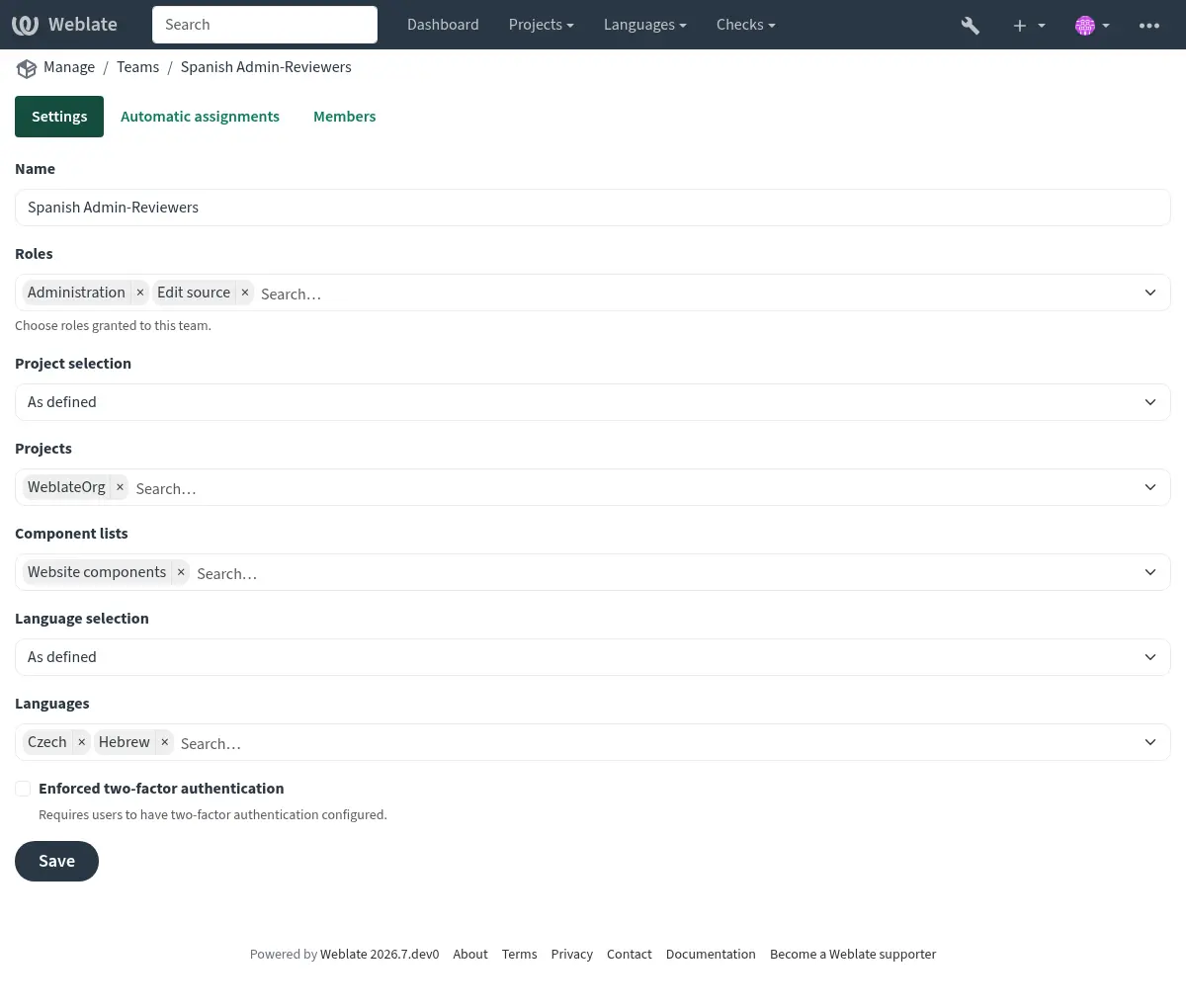
Exemplu:
A project
foowith the components:foo/barandfoo/baz, with reviewing and management rights, in the following team:
Grupul Spanish Administratori-Revizori¶ Roluri
Review strings, Manage repository
Componente
foo/bar
Limbi
Spaniolă
Members of that team will have these permissions (assuming the default role settings):
Acces general (navigare) la întregul proiect
foo, inclusiv la ambele componente din el:foo/barșifoo/baz.Revizuirea șirurilor de caractere în traducerea spaniolă
foo/bar(nu în altă parte).Gestionați VCS pentru întregul depozit
foo/bar, de exemplu, confirmați modificările în așteptare făcute de traducători pentru toate limbile.
Atribuirea automată a echipelor
While editing the Team, you can specify Automatic assignments, which is a list of regular expressions used to automatically assign newly created users to a team based on their e-mail addresses. Rules are evaluated only upon account creation, for every new user on the instance.
For project and workspace teams, matching rules create invitations. Users receive an e-mail identifying automatic team assignment as the source and must accept the invitation before joining. Pending invitations are also available in account settings. Accounts without an e-mail address see the invitation only in account settings. Team managers can see pending invitations.
For site-defined teams, matching users are added directly. This includes the default teams. Existing memberships are not changed by this behavior.
The most common use-case for the feature is to assign all new users to some
default team. This behavior is used for the default Users and Guest teams
(see Lista de echipe). Use regular expression ^.*$ to match all users.
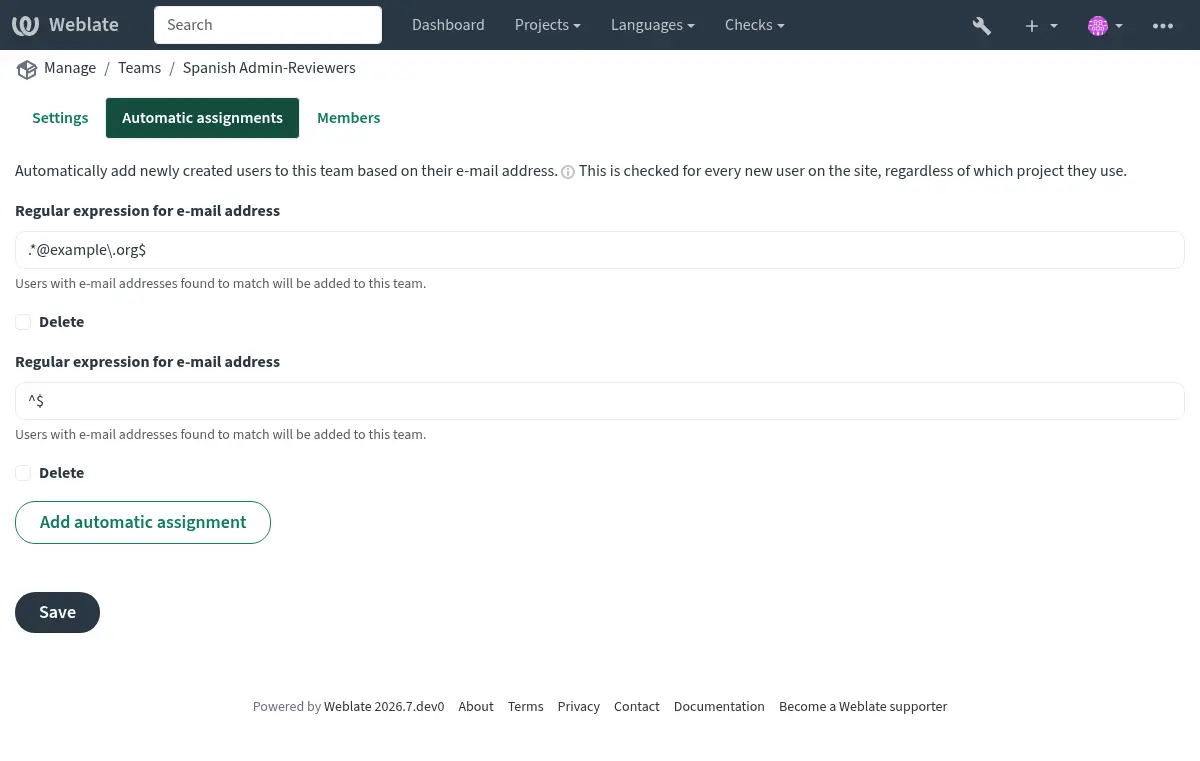
Another use-case for this option might be to
give some additional privileges to employees of your company by default.
Assuming all of them use corporate e-mail addresses on your domain, this can
be accomplished with an expression like ^.*@mycompany.com.
Notă
Atribuirea automată a echipelor la Utilizatori și Vizualizatori este întotdeauna recreată atunci când se face upgrade de la o versiune Weblate la alta. Dacă doriți să o dezactivați, setați expresia regulată la ^$ (care nu se va potrivi cu nimic).
Notă
Bulk inviting through the user interface creates invitations. Existing users still have to confirm the invitation before they become team members.
Default teams and roles
After installation, a default set of teams is created (see Lista de echipe).
These roles and teams are created upon installation. Administrators can edit built-in role permissions in the management interface or through the REST API. Built-in roles have fixed names and cannot be deleted. The role list identifies built-in roles and indicates whether their permissions are customized. Editing a role affects every team assigned that role. You no longer need to create a custom role solely to change built-in defaults; use a custom role when you need an independent permission set for selected teams.
During upgrades, database migrations merge changes to the built-in defaults with your assigned permissions. Locally added permissions remain assigned, and locally removed permissions remain excluded. New upstream permissions are added, and permissions removed from upstream defaults are removed. Custom roles are unchanged. The merge compares permission sets, not editing history: keeping an existing default permission does not record a separate local addition. If an upstream permission is removed and later reintroduced, it is treated as a new upstream addition. A previous local removal does not survive the permission’s intervening absence from upstream defaults.
To discard customizations, select built-in roles and use Reset built-in roles to defaults in the management interface, then confirm the reset. Resetting applies the current upstream defaults to all teams using those roles.
Schimbat în versiunea 2026.11: Built-in role permissions became editable. On the first upgrade to this version, existing built-in roles are assumed to be synchronized and receive the current defaults. Earlier changes made through the API or database are replaced. Subsequent upgrades preserve local customizations.
Existing custom roles named Discover users or View user profiles are
renamed with a (custom) suffix before the new built-in roles are created.
A numbered suffix is used if that name is already taken. Their permissions
and team assignments are preserved.
Confidential collaboration
The resource permission contribution.view_author controls contributor
attribution in translation history, comments, suggestions, activity, feeds, and
the REST API. Built-in translation and review roles grant it by default,
including Administration. History and attribution remain stored;
hiding identities does not remove changes, timestamps, diffs, or revert actions.
Vezi și
Configuring confidential collaboration for the combined role and team configuration.
Regenerated translation exports require translation.download and remain
available without contributor identity access when the exporter explicitly
supports identity-safe output. Original files, original-file archives, and
unclassified exporters also require contribution.view_author because their
metadata can contain contributor identities. The built-in Access
repository and Manage languages roles grant contributor identity
access to preserve their original-file download capability. Remove this grant
from those roles too when configuring confidential collaboration.
The following inventory summarizes independent identity disclosure paths:
Surface |
Authorization |
|---|---|
Editor attribution, history, comments, suggestions, feeds, notifications |
|
Regenerated content exports |
|
Original files and unclassified exports |
Download permission and contributor identity access |
Independent |
|
Full reports and change downloads |
Independent |
Own-data reports |
The report creator, limited to their own contributions |
Membership, directory, and profile information |
Existing access-management and user permissions |
Workspace-only attribution |
|
Unscoped global attribution |
Site administrators |
Administrator-configured add-on searches |
Persistent administrative configuration, independent of direct contributor access |
Administrator-configured integrations |
Trusted destinations; contributor identities are retained |
Author filters in full reports and change downloads use their independent
reports.view and change.download permissions, including when
contribution.view_author is removed.
Workspace grants do not override project, component, or language restrictions when a history entry has a more specific resource scope.
Original archives omit auxiliary files when their translation scope is not allowed. Auxiliary files without a translation scope require component-wide download and contributor identity permissions.
Configured add-ons retain their administrative search scope, just as they do for restricted components. Removing a configuring user’s contributor identity access does not disable the saved operation.
Individual notifications use the recipient’s permissions. Administrator-managed integrations, including webhooks and Slack, are trusted exports and can retain contributor identities. Configure their destinations for an appropriately restricted audience, or disable them. Weblate cannot control onward sharing or remove copies already delivered to mailboxes, downloaded files, or external systems.
This feature hides system-provided attribution, not identifying text entered by users in translations, comments, announcements, filenames, or other content. It does not provide comprehensive anonymity or prevent correlation using timing and content. See Privacy configuration for the separate Git commit identity, profile, and discovery controls.
List of privileges
Domeniu de aplicare |
Permisiune |
Built-in roles |
|---|---|---|
Contribuitori |
View contributor identities |
Administration |
Edit source |
||
Add suggestion |
||
Access repository |
||
Power user |
||
Translation coordinator |
||
Review strings |
||
Translate |
||
Manage languages |
||
Modificări |
Descărcare modificări |
Administration |
Comentarii |
Publicare comentariu |
Administration |
Edit source |
||
Power user |
||
Translation coordinator |
||
Review strings |
||
Translate |
||
Ștergere comentariu |
Administration |
|
Rezolvare comentariu |
Administration |
|
Translation coordinator |
||
Review strings |
||
Componentă |
Editare setări componente |
Administration |
Blocare componentă, împiedicare traducere |
Administration |
|
Manage repository |
||
Glosar |
Adăugare intrare în glosar |
Administration |
Manage glossary |
||
Power user |
||
Translation coordinator |
||
Add glossary terminology |
Administration |
|
Manage glossary |
||
Translation coordinator |
||
Editare intrare în glosar |
Administration |
|
Manage glossary |
||
Power user |
||
Translation coordinator |
||
Ștergere intrare în glosar |
Administration |
|
Manage glossary |
||
Power user |
||
Translation coordinator |
||
Încărcare intrări în glosar |
Administration |
|
Manage glossary |
||
Power user |
||
Translation coordinator |
||
Translation services |
Utilizare sugestii automate |
Administration |
Edit source |
||
Power user |
||
Translation coordinator |
||
Review strings |
||
Translate |
||
Memorie de traducere |
Editare memorie de traducere |
Administration |
Manage translation memory |
||
Ștergere memoria de traducere |
Administration |
|
Manage translation memory |
||
Proiecte |
Editare setări proiect |
Administration |
Gestionare acces proiect |
Administration |
|
Rapoarte |
Manage reports |
Administration |
Workspace administration |
||
Capturi de ecran |
Adăugare captură de ecran |
Administration |
Translation coordinator |
||
Manage screenshots |
||
Editare captură de ecran |
Administration |
|
Translation coordinator |
||
Manage screenshots |
||
Ștergere captură de ecran |
Administration |
|
Translation coordinator |
||
Manage screenshots |
||
Șiruri sursă |
Editare informații suplimentare despre șir |
Administration |
Edit source |
||
Șiruri |
Adăugare șir nou |
Administration |
Eliminarea unui șir |
Administration |
|
Respingere control nereușit |
Administration |
|
Edit source |
||
Power user |
||
Translation coordinator |
||
Review strings |
||
Translate |
||
Editare șir de caractere |
Administration |
|
Edit source |
||
Power user |
||
Translation coordinator |
||
Review strings |
||
Translate |
||
Revizuire șiruri |
Administration |
|
Translation coordinator |
||
Review strings |
||
Bulk edit strings |
Administration |
|
Bulk editing |
||
Editare șir de caractere atunci când sugestiile sunt puse în aplicare |
Administration |
|
Translation coordinator |
||
Review strings |
||
Editare șiruri sursă |
Administration |
|
Edit source |
||
Power user |
||
Translation coordinator |
||
Sugestii |
Acceptare sugestie |
Administration |
Edit source |
||
Power user |
||
Translation coordinator |
||
Review strings |
||
Translate |
||
Adăugare sugestie |
Administration |
|
Edit source |
||
Add suggestion |
||
Power user |
||
Translation coordinator |
||
Review strings |
||
Translate |
||
Ștergere sugestie |
Administration |
|
Power user |
||
Translation coordinator |
||
Votare sugestie |
Administration |
|
Edit source |
||
Power user |
||
Translation coordinator |
||
Review strings |
||
Translate |
||
Traduceri |
Adăugare limbă pentru traducere |
Administration |
Power user |
||
Translation coordinator |
||
Manage languages |
||
Efectuare traducerea automată |
Administration |
|
Automatic translation |
||
Ștergere traducerea existentă |
Administration |
|
Manage languages |
||
Descărcare fișier de traducere |
Administration |
|
Edit source |
||
Access repository |
||
Power user |
||
Translation coordinator |
||
Review strings |
||
Translate |
||
Manage languages |
||
Adăugare mai multe limbi pentru traducere |
Administration |
|
Manage languages |
||
Încărcături |
Definire autor pentru traducerea încărcată |
Administration |
Suprascriere șiruri existente cu încărcare |
Administration |
|
Edit source |
||
Power user |
||
Translation coordinator |
||
Review strings |
||
Translate |
||
Încărcare traduceri |
Administration |
|
Edit source |
||
Power user |
||
Translation coordinator |
||
Review strings |
||
Translate |
||
SCV |
Accesare depozitar intern |
Administration |
Access repository |
||
Power user |
||
Translation coordinator |
||
Manage repository |
||
Comite modificări în depozitarul intern |
Administration |
|
Manage repository |
||
Încărcare modificarea din depozitarul intern |
Administration |
|
Manage repository |
||
Resetare modificări în depozitarul intern |
Administration |
|
Manage repository |
||
Vezi locația depozitarului cu sursă principală |
Administration |
|
Access repository |
||
Power user |
||
Translation coordinator |
||
Manage repository |
||
Actualizare depozitar intern |
Administration |
|
Manage repository |
||
Anunțuri |
Post announcements |
Administration |
Translation coordinator |
||
Delete announcements |
Administration |
|
Translation coordinator |
||
Workspaces |
Edit workspace settings |
Workspace administration |
Add projects to workspace |
Workspace administration |
|
Add workspace projects |
||
Manage workspace access |
Workspace administration |
|
Privilegii la nivelul întregului site |
Browse users |
Discover users |
Search resource contributors |
Discover users |
|
View user profiles |
View user profiles |
|
Utilizare interfață de gestionare |
||
Manage site configuration |
||
Adăugare proiecte noi |
Add new projects |
|
Add new workspaces |
Add new projects |
|
Adăugare definiții de limbă |
||
Gestionare definiții de limbă |
||
Gestionare echipe |
||
View team info |
||
Gestionare utilizatori |
||
View user info |
||
Gestionare roluri |
||
View role info |
||
Gestionare anunțuri |
||
Gestionare memorie de traducere |
||
Manage translation services |
||
Gestionare liste de componente |
||
Gestionează facturare |
||
Manage site-wide add-ons |
Atenționare
Roles do not have a separate scope; the permissions in a role determine its scope. A role containing a permission listed under Site wide privileges grants that permission across the Weblate instance when assigned through a site-wide team. The team’s project selection does not narrow these permissions.
Site-wide privileges are not granted to any default role. Treat any roles
containing them, including customized built-in roles, as trusted administrative
access because some are effectively equivalent to superuser status. For example, group.edit
allows changing team scope to grant access to private projects, and
user.edit allows users to change their own team memberships and grant
themselves superuser status. See Site-wide team management and
site-wide user management for details.
List of built-in roles
Discover users |
|
View user profiles |
|
Administrare |
|
Edit source |
|
Add suggestion |
|
Access repository |
|
Manage glossary |
|
Power user |
|
Translation coordinator |
|
Review strings |
|
Translate |
|
Manage languages |
|
Bulk editing |
|
Automatic translation |
|
Manage translation memory |
|
Manage screenshots |
|
Manage repository |
|
Workspace administration |
|
Add workspace projects |
|
Add new projects |
|
Lista de echipe
Următoarele echipe sunt create la instalare (sau după executarea setupgroups) și puteți să le modificați. Cu toate acestea, migrația le va recreea dacă le ștergeți sau le redenumiți.
- Oaspeți
Definește permisiunile pentru utilizatorii neautentificați.
This team only contains anonymous users (see
ANONYMOUS_USER_NAME).Remove roles from this team to limit permissions for non-authenticated users.
Default roles: Add suggestion, Access repository, View user profiles
- Vizualizatori
This role ensures the visibility of public projects to all users. By default, all users are members of this team.
By default, automatic team assignment makes all new accounts members of this team when they join.
Roluri implicite: niciunul
- Utilizatori
Default team for all users.
By default, automatic team assignment makes all new accounts members of this team when they join.
Default roles: Power user, Discover users, View user profiles
- Revizorii
Grup pentru recenzori (see Fluxuri de lucru de traducere).
Roluri implicite: Review strings
- Manageri
Grup pentru administratori.
Roluri implicite: Administration
- Project creators
Added in version 5.1.
Users who can create new projects.
Default roles: Add new projects
Atenționare
Never remove the predefined Weblate teams and users, as that can lead to unexpected problems! If you have no use for them, simply remove all their privileges instead.
Restricții suplimentare de acces
If you want to use your Weblate installation in a less public manner, i.e. allow
new users on an invitational basis only, it can be done by configuring Weblate
in such a way that only known users have an access to it. In order to do so, you can set
REGISTRATION_OPEN to False to prevent registrations of any new
users, and set REQUIRE_LOGIN to True to require signing in to access
all the site pages. This is basically the way to lock your Weblate installation.
Additionally, changing DEFAULT_ACCESS_CONTROL to 100 will make
all newly created projects private, requiring explicit access to be granted.
Sugestie
Puteți utiliza built-in Invitarea de noi utilizatori pentru a adăuga noi utilizatori.
Expiration of user accounts
Each account can have an expiry set. After the expiration, the account will be automatically disabled. This is used for Per-project access tokens, but can be utilized for regular users as well.
See Privacy configuration to configure user discovery and profile access through roles.