Registro y perfil de usuario
Registro
De forma predeterminada, todos pueden explorar proyectos, ver traducciones o sugerir traducciones. Solo los usuarios registrados pueden guardar los cambios y se les atribuye el mérito por cada traducción realizada.
Puedes registrarte siguiendo unos sencillos pasos:
Complete el formulario de registro con sus credenciales.
Activa el registro siguiendo el enlace del correo-e que recibirás.
Opcionalmente, ajusta tu perfil para elegir qué idiomas conoces.
Cuadro de mando
Al iniciar sesión, observará una descripción general de los proyectos y componentes, así como su respectiva progresión de traducción.
De manera predeterminada se muestran los componentes de los proyectos que monitoriza, así como enlaces directos en las lenguas preferidas que haya establecido.
Consejo
Puede escoger vistas diferentes utilizando las pestañas de navegación.
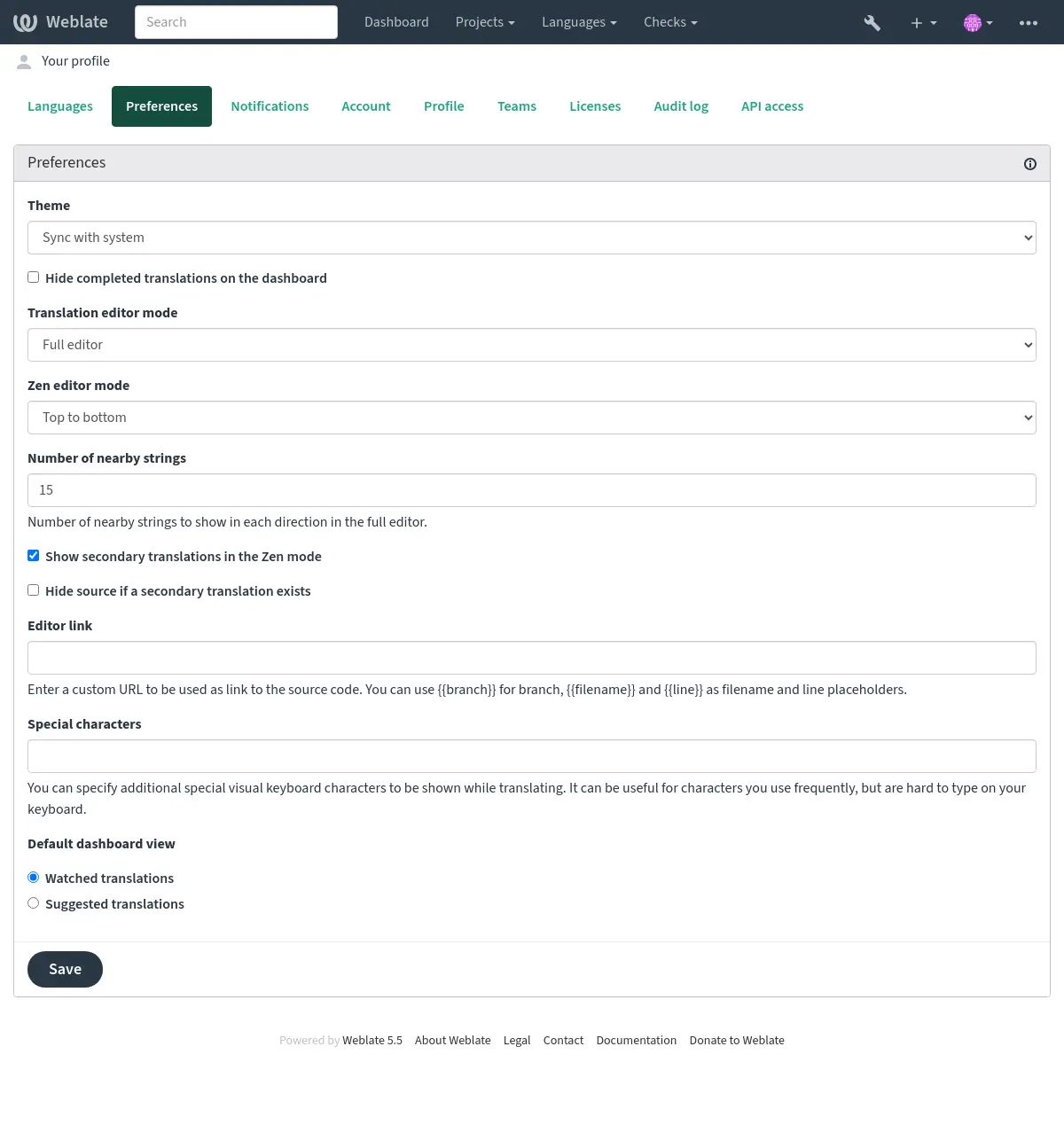
El menú tiene estas opciones:
Projectos > Examinar todos los proyectos en el menú principal mostrando el estado de la traducción por cada proyecto en la instancia de Weblate.
Seleccione un idioma en el menú Idiomas principal, esto mostrará el estado de la traducción de todos los proyectos, filtrados por uno o sus idiomas principales.
Watched translations dentro del cuadro de mando mostrará estado de traducción de solo estos proyectos que está vigilando, filtrado por su idioma primario.
En adición, el menú desplegable también puede mostrar cualquier número de listas de componentes, conjuntos de componentes de proyecto preconfigurados por el administrador de Weblate, consulte Listas de componentes.
Puede configurar su personal predeterminado de vista del cuadro de mando en la sección Preferences de sus ajustes del perfil de usuario.
Nota
Cuando Weblate está configurado para un solo proyecto usando SINGLE_PROJECT en el archivo settings.py (consulte Configuración), el panel no se mostrará, ya que el usuario será redirigido a un solo proyecto o componente.
Perfil de usuario
Para acceder a su perfil de usuario, pulse en el icono de su cuenta en el extremo derecho del menú superior y, en el menú, elija Configuración.
The settings tabs separate account and commit identity, public profile information, preferences, security, and developer access. Name and e-mail address are used in VCS commits, so keep this info accurate.
Nota
Todas las selecciones de idiomas solo ofrecen los idiomas traducidos actualmente.
Consejo
Solicite o agregue otros idiomas que desee traducir pulsando en el botón para que también estén disponibles.
Idiomas
Idioma de interfaz
Elija el idioma en el que desea exhibir la interfaz de usuario.
Idiomas traducidos
Elija los idiomas en los que prefiera traducir y se le ofrecerán en la página principal de los proyectos supervisados, de tal modo que se le facilite el acceso a todas esas traducciones en esos idiomas.
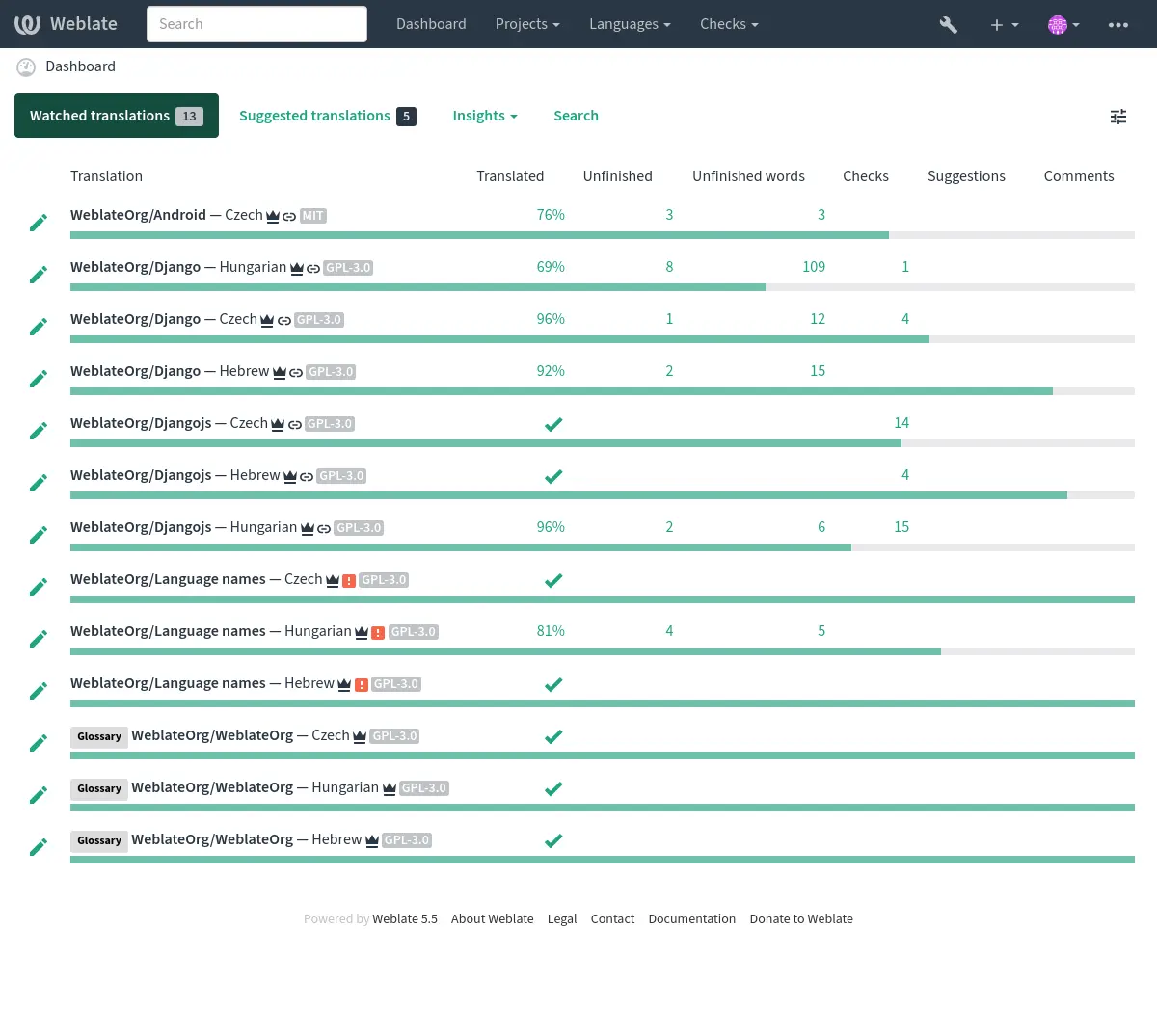
Idiomas secundarios
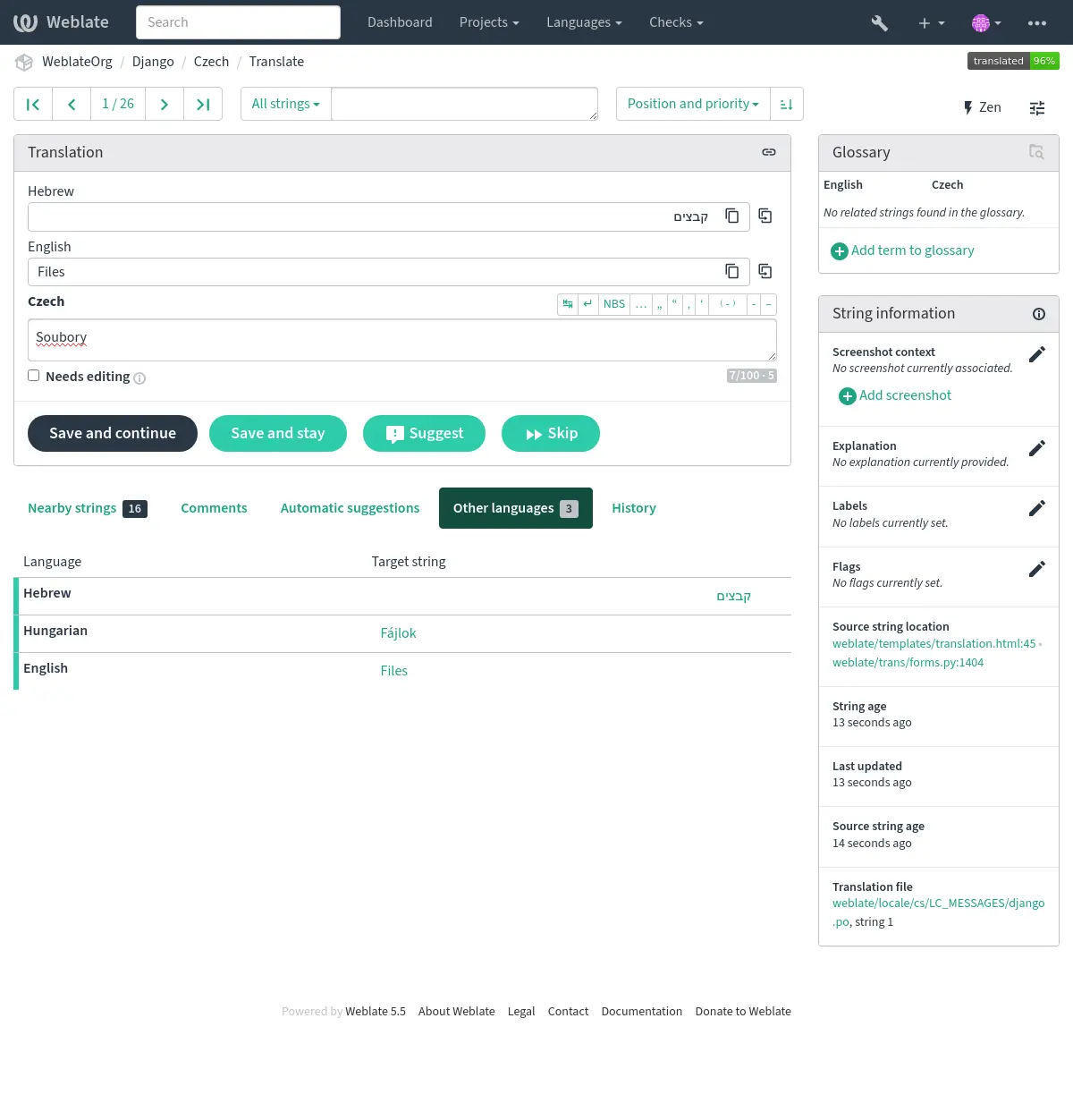
Puede definir qué idiomas secundarios mostrar para que le sirvan de guía al traducir. La siguiente imagen muestra un ejemplo, en el cual la lengua hebrea se muestra como secundaria:
Consejo
Esto también se puede configurar en el proyecto (Idioma secundario) o en el componente (Idioma secundario). En ese caso, se puede usar para Consolidación de cadenas mediante lengua secundaria.
Preferencias
Tema
Elija si Weblate sigue la configuración del sistema para el tema oscuro o claro, o elija uno de ellos manualmente.
Table columns
By default, Weblate hides some columns in listings (languages, components, projects, …) when the browser window is too narrow to fit them. Enable Show all columns in lists using horizontal scrolling to keep all columns instead and scroll the table horizontally when needed.
Use Visible columns in lists to choose which statistics columns are shown in the listings. This way you can hide numbers you are not interested in, or make room for additional ones such as Total strings.
Vista predeterminada del cuadro de mando
En la pestaña Preferencias, puede elegir qué vista del panel de control se mostrará de forma predeterminada. Si selecciona la lista de componentes, debe seleccionar el Listado de componente que se exhibirá desde el menú desplegable del Listado del componente predeterminado.
Ver también
Enlace del editor
Se muestra un enlace al código fuente en el navegador web configurado en el Configuración de componentes de manera predeterminada.
Consejo
Al configurar el Editor link, se usa el editor local para abrir el archivo de código fuente VCS de las cadenas traducidas. Se puede usar el Marcación de plantilla.
Usualmente algo como editor://open/?file={{filename}}&line={{line}} es una buena opción.
Ver también
Puede encontrar más información sobre cómo registrar protocolos de URL personalizados para el editor en la documentación de Nette.
Caracteres especiales
Caracteres adicionales especiales a incluir en el Teclado visual.
Notificaciones
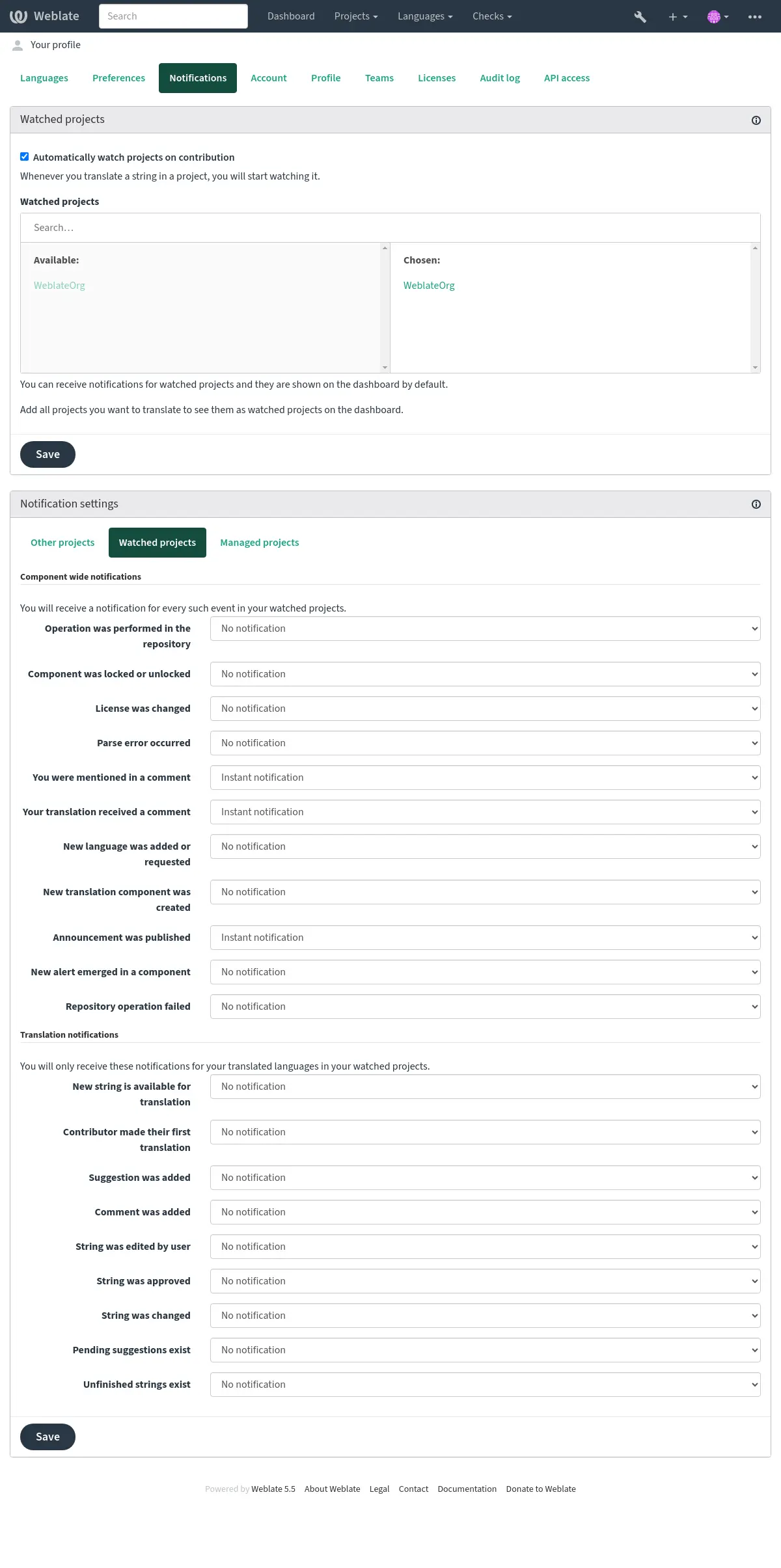
Suscríbete a diversas notificaciones desde la pestaña Notificaciones. Recibirás notificaciones por correo electrónico sobre sucesos seleccionados en proyectos supervisados o administrados.
Algunas notificaciones se envían solo para sucesos en tus idiomas (por ejemplo, sobre nuevas cadenas para traducir), mientras que otras se activan a nivel de componente (por ejemplo, errores de fusión). Estos dos grupos de notificaciones están visualmente separados en los ajustes.
The Translation activity summary notification is digest-only and summarizes added, updated, translated, approved, needs editing, and unfinished strings.
Each periodic notification e-mail contains entries from all matching projects. Listings of individual changes contain up to 100 entries and indicate when additional entries were omitted, while grouped summaries are not limited.
Puede activar o desactivar las notificaciones de los proyectos supervisados y administrados, y ajustarlas (o silenciarlas) por proyecto y componente. Visite la página de resumen de componentes y seleccione la opción adecuada en el menú Supervisión.
Project and component notification subscriptions are automatically removed when you lose access to their targets. Cleanup runs hourly for a different group of users, checking every user once daily. Subscriptions are retained during temporary project blocks or while two-factor authentication requirements are unmet.
In case Automatically watch projects on contribution is enabled you
will automatically start watching projects upon contributing to them. The
default value depends on DEFAULT_AUTO_WATCH.
Nota
No recibirá ninguna notificación por sus propias acciones.
Consejo
El envío de notificaciones es limitado; no recibirá más de 1.000 correos electrónicos al día. Cualquier otra notificación será descartada.
Open Notification diagnostics from your notification settings to
inspect your own subscriptions. Administrators with management access and
permission to edit users can open the same page for another user from that
user’s Edit tab. The Overview tab includes watched
projects, notification languages, and subscriptions grouped by scope and target.
In the Diagnostics tab, enter an object path such as
project/category/component/cs. Project and category paths summarize inherited
project settings and exceptions across all accessible
components. Equivalent component settings are grouped together, with counts and
up to five example links to inspect individual components. Component paths show
effective settings and language restrictions; translation paths check the selected
language specifically. Broad summaries do not enumerate individual translations.
Summaries are limited to 200 accessible components and 10 original projects
(including the selected project). For larger scopes, choose a smaller category,
a component, or a translation; partial summaries are not shown.
Lists of more than five watched projects or notification languages show counts
instead of individual links.
Only events with a matching subscription are shown, including disabled subscriptions and subscriptions blocked by language or account conditions. Event conditions and overridden subscriptions are shown directly. Subscription links highlight the matching row in the Overview tab. Component example links open diagnostics for that component. Shared components use subscriptions from their original project.
The diagnostics check eligibility without sending e-mail. Notifications that depend on event details, such as mentions or alerts, are marked as conditional. Actual delivery also depends on the event author, digest content, and rate limits.
Cuenta
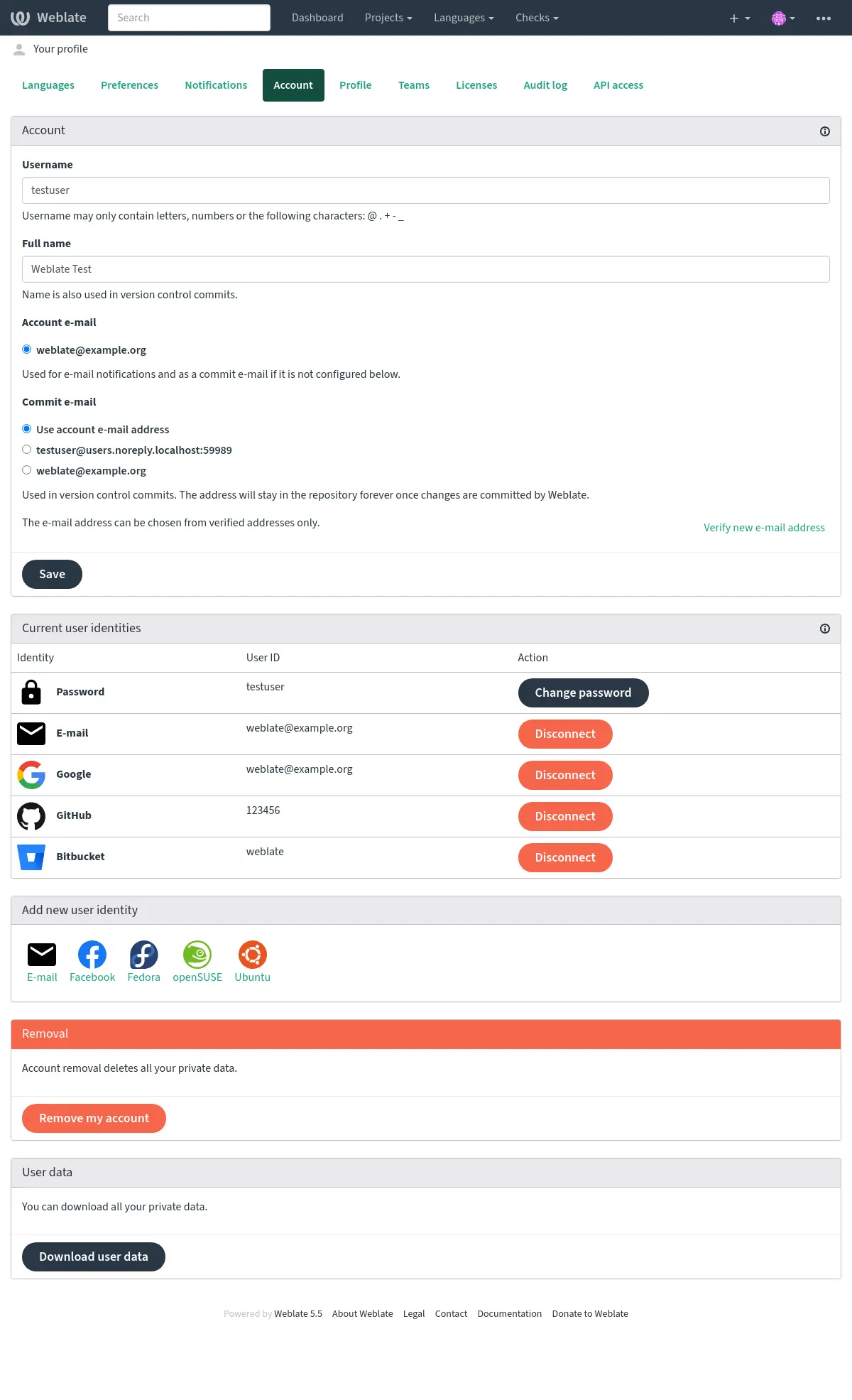
The Account tab contains your username, name, account e-mail, and commit identity. You can verify another e-mail address here. The account management section at the bottom lets you export your user data (see Weblate user data export), import settings, or remove your account.
When you add an e-mail address, verification instructions are sent to the new address; access to your old mailbox is not required. Open the verification link while signed in to the account where you requested it, then follow the confirmation steps. You may be asked for your current password. Adding an address does not change your account e-mail address. After verification, you can select the new address in the Account tab.
When a connected service provides e-mail verification data during sign-in, Weblate refreshes the addresses verified by that service. Missing e-mail claims leave the stored addresses unchanged; an explicitly empty verified-address list removes that service’s stored addresses. If your account e-mail loses its last verification, Weblate selects another available, verified address or clears the account e-mail if none is available. You can still sign in through the connected service. Add and verify an address to restore password recovery, then select it as your account e-mail to receive notifications. Verified secondary addresses can also be used for password recovery. Pending confirmation links for removed addresses are invalidated. An address still verified by another connected identity remains available.
If you changed your service’s e-mail addresses before upgrading Weblate, check your Account settings and replace any retired account e-mail. Previously removed addresses cannot always be identified automatically.
If the new address already belongs to another account, that mailbox receives guidance on recovering access instead of a verification link. Sign out before recovering the other account. Contact support, when available, for help moving an address between accounts. The browser displays the same confirmation page in both cases to avoid disclosing whether an account exists.
Changing or resetting your password invalidates pending e-mail additions. Request a new verification link to continue adding an address.
Account e-mail addresses match without regard to ASCII letter case. Non-ASCII characters must match exactly when signing in or resetting a password.
You can import settings from a user data file on the Account tab. Compatible language, editor, dashboard, watched-project, and public-profile settings replace the corresponding settings on this server. Unavailable values are skipped and shown after import. The file must be no larger than 50 MB. Contribution counts, activity history, username, and account e-mail are not imported.
Personal Búsquedas guardadas from the file are added to your existing ones; a saved search with the same name is replaced.
General notification settings and commit identity choices can be imported separately by selecting the corresponding options. Both are off by default. An imported commit e-mail unknown to this account is replaced with the current site’s generated private address. If private addresses are disabled, the unknown address is skipped and your existing choice is preserved. Imported public e-mail addresses must be known to the current account. Both public and commit e-mail addresses must pass the current site’s e-mail validation. Project- and component-specific and one-time notification rules are included in the export but not imported.
The Commit e-mail and Commit name settings let you choose
private identities instead of your account e-mail and name in version control
commits. Use these to avoid publishing your real e-mail and name there. Be aware
that using a different e-mail can disconnect your contributions on other servers
(for example your contributions will no longer link to your profile on GitHub).
Administrators can make private identities the default by setting
PRIVATE_COMMIT_EMAIL_OPT_IN and PRIVATE_COMMIT_NAME_OPT_IN
to False. Your explicit choices override these defaults.
Ver también
Changes to these settings affect future commits. Names and e-mail addresses already recorded in repository history remain unchanged.

Perfil público
Todos los campos de esta página son opcionales, en cualquier momento puede eliminarlos y, si los rellena, consiente que compartamos esta información allá donde aparezca su perfil de usuario.
Las URL de perfil público, tal como URL se sitio web, URL de contacto, URL de Fediverse y URL del sitio de código, dirigirían a un sitio web, una página de contacto o un perfil. Se pueden rechazar los enlaces de descarga directa de archivos obvios y, siempre que sea posible, los enlaces de perfil público muestran una advertencia antes de salir de Weblate.
The Code site URL should use common code-hosting profile paths,
such as /username or /~username; existing repository-style links such
as /username/project or /group/subgroup/project are also accepted. The
Fediverse URL
should use common profile paths, such as /username, /@username,
/web/@username, /users/username, /accounts/username,
/channel/username, /profile/username, /u/username, or
/people/identifier.
Un avatar puede mostrarse para cada usuario (dependiendo de ENABLE_AVATARS). Estas imágenes son obtenidas utilizando https://gravatar.com/.
Ver también
Seguridad
The Security tab manages your password, connected sign-in identities, and two-factor authentication. Security keys, authenticator apps, and recovery codes each show their current status and management actions.
Nota
The list of sign-in services depends on your Weblate configuration, but can include sites such as GitLab, GitHub, Google, Facebook, or Bitbucket and other OAuth 2.0 providers.
Previously connected services remain listed after an administrator removes their authentication backend. You can still use Disconnect to remove their sign-in identities from your account.
Licencias
Ajustes de desarrollador
You can get or reset your API access token and view usage examples here. Use Manage code-hosting connections for integrations with workspaces you administer. These connections are separate from the sign-in identities in Security.
Actividad
The audit log keeps track of the actions performed with your account. It logs IP address and browser for every important action with your account. The critical actions also trigger a notification to a primary e-mail address.
Ver también