Building a translators community
Make it easy for people to start translating, ask questions, and see their work reach users. Link contributors to Make your first translation and provide project-specific instructions alongside it.
Welcoming translators
Set Udhëzime përkthimi to explain where to begin, which components have priority, and how to contact the language team. Include a short style guide with examples of the tone and terminology you expect. Explain any contribution agreement and how to request access or a missing language.
Describe your Rrjedha pune përkthimi: whether contributors save translations or submit suggestions, who reviews their work, and when translations reach users. Keep the requirements realistic for small language teams. Welcome useful partial contributions rather than requiring a complete language translation.
Tell translators about release dates and translation deadlines early. Use Lajmërime for timely notices, and keep the translation instructions up to date. Let contributors know when their work has shipped and acknowledge their contributions. See Përkthim në vazhdimësi for repository integration and automation.
Diagnostikime përbërësish
Guidance is shown in the Diagnostics tab on each component. These alerts are dismissible and point to the configuration or documentation needed to make your localization process easier for community translators.
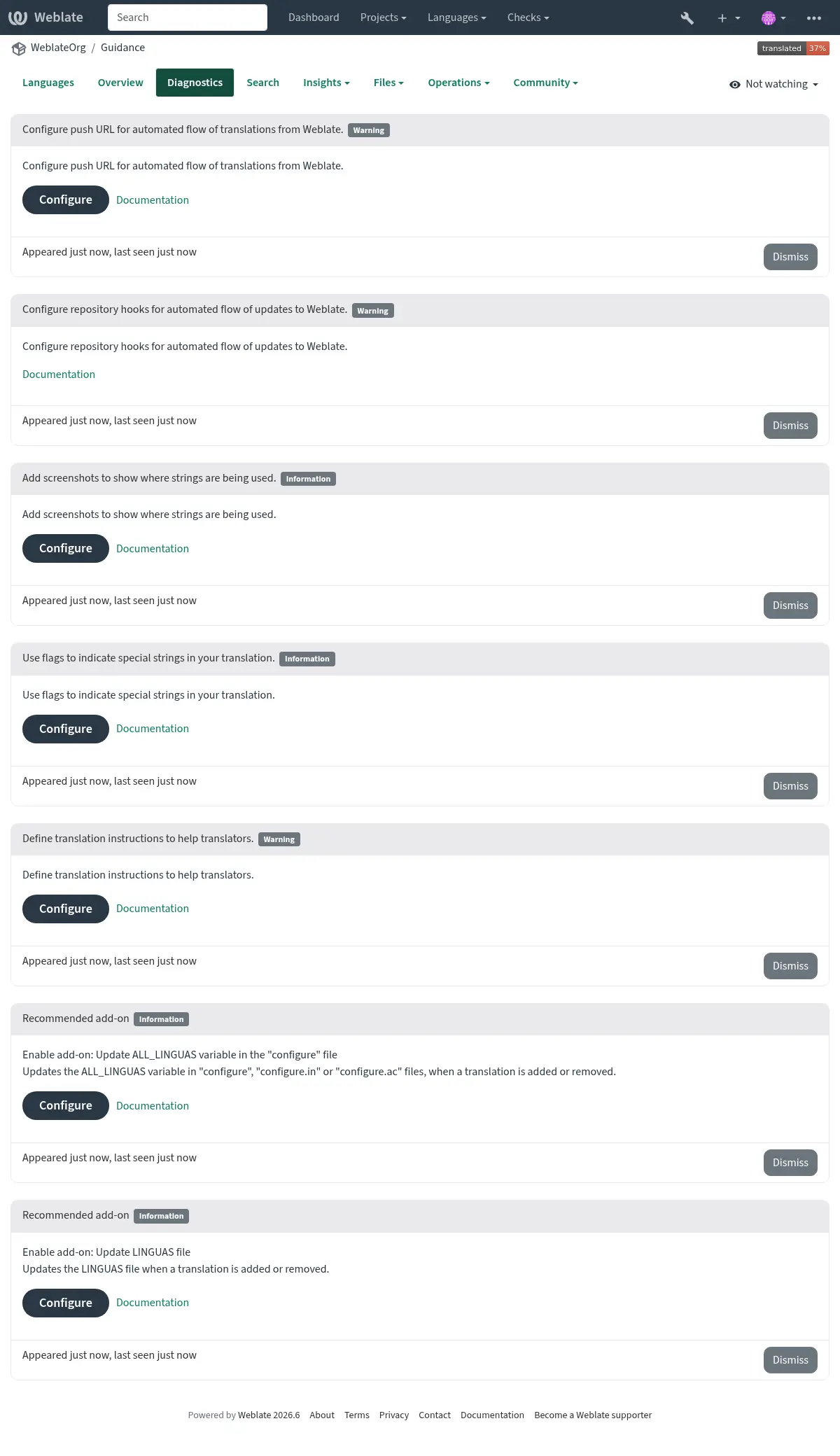
Diagnostics cannot tell whether your instructions are clear or questions get answered. Regularly try the contribution process with a translator account and ask newcomers where they got stuck.
Terminology management
Provide a Fjalorth for recurring terms, with explanations where a word has a project-specific meaning. Agree on terminology with each language team and keep it consistent across components. Record decisions so new contributors do not need to repeat earlier discussions.
Existing Kujtesë Përkthimesh can help reuse past translations. Review matches in their new context: identical source wording does not always have the same meaning.
Përkthim nga makina
Explain whether machine translation is allowed and how contributors should review its output. Choose services suited to the languages and subject matter of your project, and evaluate their output with the language teams. Do not assume that fluent wording preserves the source meaning or your terminology.
Weblate supports both service suggestions and automatic translation with human review. Choose a Machine translation and LLM workflows configuration that matches your quality expectations and available reviewers.
Review translations
When possible, have another speaker review translations for meaning, tone, and consistency. Explain how to become a reviewer and who handles pending suggestions. Respond constructively and explain corrections so contributors can learn from them.
Provide Screenshots and visual context, Shpjegim, and access to a preview or test release so people can check translations in context. A translation that reads well in isolation can still be wrong for a button or too long for its layout. See Starting with internationalization for writing source strings that work across languages.
Structured feedback
Weblate’s Checks and fixups help identify technical mistakes while translating. Explain how to resolve recurring failures, and investigate false positives instead of encouraging translators to ignore checks indiscriminately.
Translators also find problems in source strings. Monitor Komente and your advertised contact channel, answer questions, and report back when a problem is fixed. Configure Shfletues depoje so contributors can find the source code, and Adresë njoftimi të metash në vargje burim for reporting source problems. See Shqyrtim vargjesh burim for reviewing source strings in Weblate.
Avoid unnecessary source-string changes that create repeated translation work. Communicate changes to the workflow and let teams know when a component is no longer maintained. For broader developer practices, see Starting with internationalization.