用語集
Each project can include one or more glossaries for storing terms and their preferred translations. Glossaries help keep translations consistent by showing matching terms in the translation editor.
Glossaries are regular translation components with special behavior. The source language stores the terms Weblate searches for in source strings. Each glossary translation stores the preferred term, forbidden term, or untranslatable entry for one target language.
Terms from the glossary containing words from the currently translated source string are displayed in the sidebar of the translation editor.
ヒント
有効にしない限り、用語集の用語は品質検査には使われません。詳しくは、用語集に従っていない を参照してください。
How glossary matching works
When you translate a regular component, Weblate searches the source string for terms from the source language of the project glossaries. When a term matches, Weblate looks up the corresponding glossary entry for the language currently being translated and shows it in the editor.
This means glossary entries need to exist in the target glossary language to be shown while translating that target language. A source-language-only glossary can still store definitions and context, but it will not provide target-language matches for languages that do not have glossary entries.
If you want a term to be present in every glossary language, mark the source entry as プロジェクト固有の用語. If the term should stay unchanged in every language, use 翻訳禁止の用語; combine it with terminology only when you want Weblate to create and maintain entries for all glossary languages.
用語集の管理
バージョン 4.5 で変更: 用語集は、通常の翻訳コンポーネントになり、Weblate のすべての機能を使用できるように変更されました(コメント、リモート リポジトリへの保存、説明の追加など)。
用語集として使用 を有効にすることで、どのコンポーネントでも用語集として使用できます。1 つのプロジェクトに複数の用語集を作成できます。
プロジェクトの作成時に、プロジェクトには空の用語集が自動的に作成されます。用語集は同じプロジェクトのすべてのコンポーネントで共有します。必要に応じて、それぞれの用語集コンポーネントから プロジェクトで共有 を使用すると、別のプロジェクトと共有します。
用語集コンポーネントは、Weblate の他のコンポーネントと同じように見えますが、カラーラベルが追加されています:
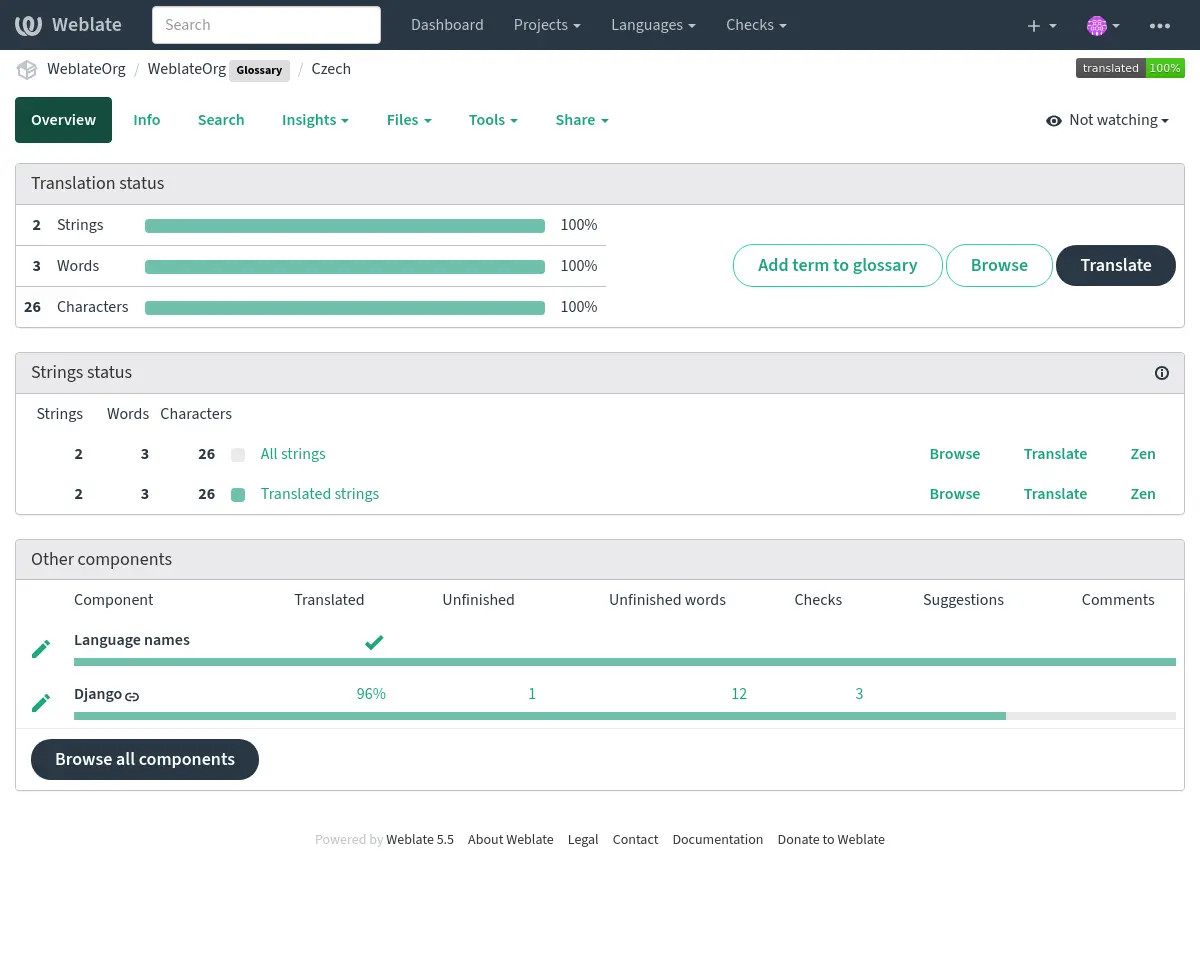
用語集のすべての用語を一覧できます。
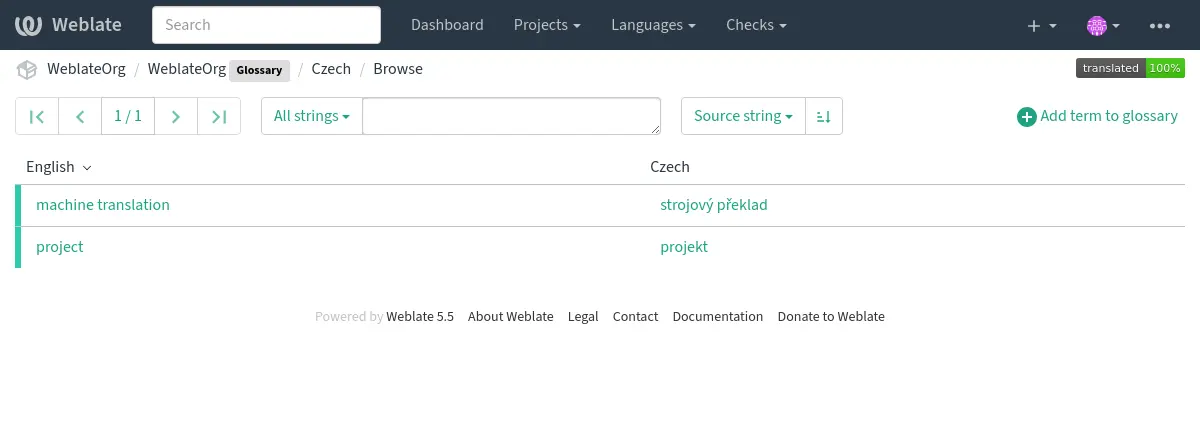
または、翻訳として編集します。
用語集の用語
用語集の用語は、通常の翻訳と同じ方法で翻訳します。各用語に対して ツール メニューから追加の機能を切り替えられます。
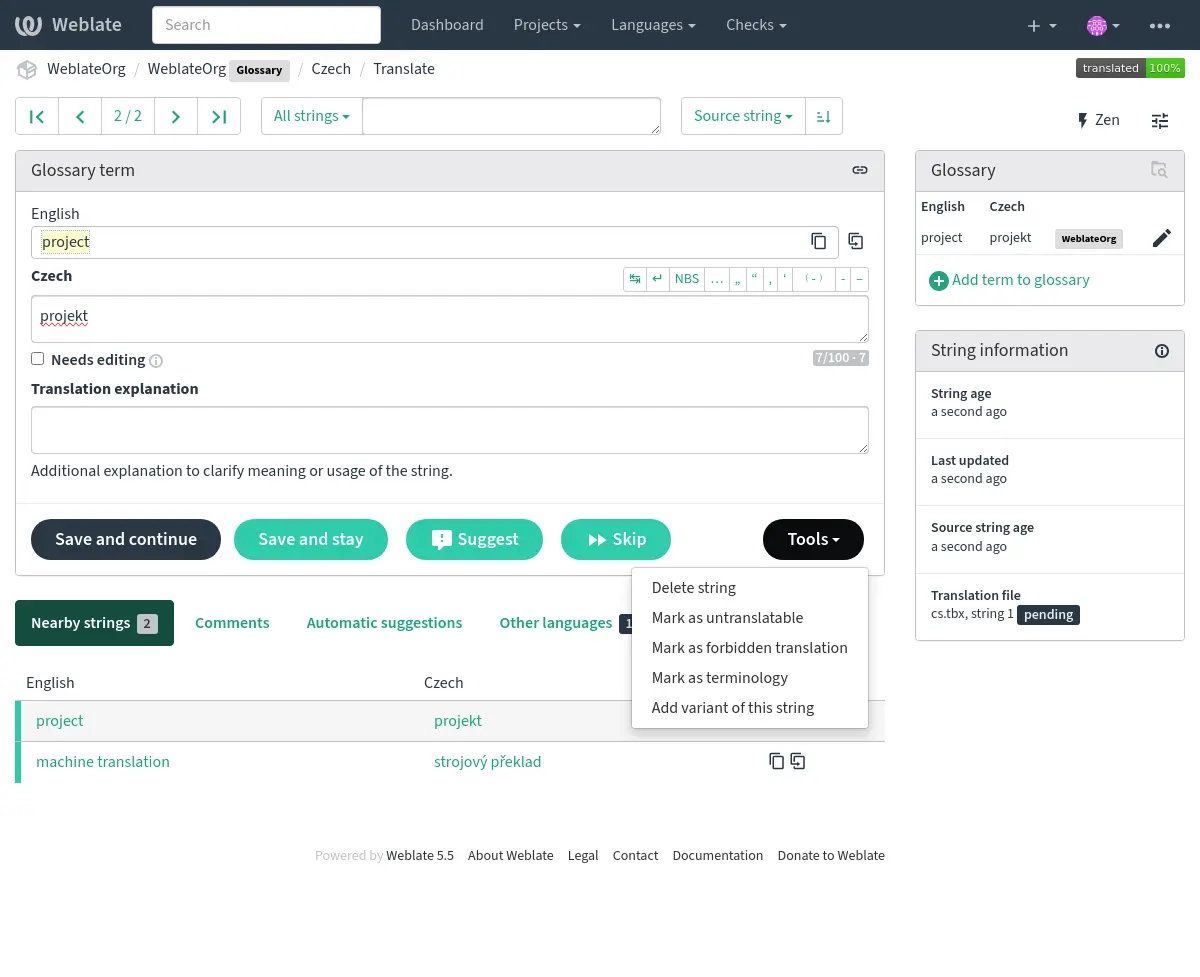
参考
種類 |
Purpose |
|---|---|
Regular glossary term |
Preferred translation or explanation for a term in one or more languages. |
Source term Weblate keeps present in every glossary language so missing translations can be tracked and filled. |
|
Term that should stay unchanged or should not be translated. |
|
Translation that should not be used for the source term. |
|
Alternative wording, abbreviation, or shorter form grouped with another glossary term. |
Choosing glossary terms
Choose glossary terms for meaning and audience, not only for literal word shape. If a source term is ambiguous, add an explanation so translators know which meaning applies in the project.
Glossary entries are especially useful for brand names, acronyms, product features, technical terms, and newly coined or transliterated words. Use variants for abbreviations or shorter wording, mark important cross-language terms as プロジェクト固有の用語, mark terms that should stay unchanged as 翻訳禁止の用語, and mark misleading translations as 使用を禁止する訳語.
翻訳禁止の用語
Added in version 4.5.
Flagging certain glossary term translations read-only by bulk-editing,
typing in the flag, or by using Tools ↓
Mark this translation as untranslatable means they cannot be translated. Use this
for brand names, product names, domains, technology names, or other terms that
should not be changed in other languages. Such terms are visually highlighted
in the glossary sidebar.
To keep a term unchanged in every language, use Mark as untranslatable for all languages. If the current translation is already untranslatable, Make untranslatable apply to all languages moves that flag to the source. Forbidden translations are language-specific; terminology remains source-wide.
The read-only flag is enough when the glossary entry already exists in the
languages where it should be shown. Add the プロジェクト固有の用語 flag as
well only when Weblate should create and maintain the untranslatable entry in
every glossary language.
使用を禁止する訳語
Added in version 4.5.
一括編集、フラグの入力、または ツール ↓ 使用禁止の訳語に設定 を使用して、特定の用語の翻訳に forbidden フラグを立てると、使用を 禁止する という意味です。あいまいな単語、または意図しない意味を含む翻訳を明確にするときに使用します。
Use forbidden entries for translations that should be avoided. Use regular glossary entries for preferred translations.
プロジェクト固有の用語
Added in version 4.5.
Flagging certain source-language glossary terms as terminology by
bulk-editing, typing in the flag, or by using Tools ↓
Mark as terminology for all languages adds entries for them to all languages in the
glossary. Use this for important terms that should be well thought out, and
retain a consistent meaning across all languages.
Enable 文字列の管理 on the glossary component to synchronize terminology. When it is disabled, Weblate does not create missing language entries, even for terms marked as terminology.
Weblate shows a dismissible diagnostic when string management is disabled for a glossary with no remote repository, or for another glossary that contains terminology. Enable string management to add terms directly in Weblate and synchronize terminology, or dismiss the warning if you maintain the glossary files separately.
The terminology flag is ongoing state, not just a one-time action. While the flag remains on the source term, Weblate treats it as terminology and keeps an entry for it in every glossary language. If a language entry is removed, the next glossary synchronization creates it again.
Removing the terminology flag stops this automatic maintenance, but it does
not remove or otherwise revert entries that were already created. They remain
regular glossary entries.
A regular glossary term can also have translations in every language. The difference is that Weblate does not recreate missing language entries for a regular term after they are removed.
別表記
別表記とは、文字列をグループ化するための基本的な方法です。すべての用語の別表記は、翻訳時に用語集のサイドバーに一覧表示されます。
ヒント
これを使用して、用語の略語または短い表現を追加できます。
参考
用語集のインポート
通常の翻訳コンポーネントと同様に、既存の用語集を Weblate にアップロードできます。CSV ファイル や TermBase eXchange 形式 などの形式に対応しており、アップロード可能です。参照: 翻訳のアップロード。
TBX files can include explanations, read-only metadata, and glossary flags; see TermBase eXchange 形式 for the exact metadata mapping.
Even though TBX can contain multiple languages, Weblate still maps component files to languages using the component file mask and language settings. For a TBX glossary component, keep the component source language as the source term language and name translation files for the target language they represent. Avoid naming a translation file with the same language as the component source language, because the source language already exists in Weblate and this can lead to duplicate language detection.
Language files and synchronization
Glossary components follow the languages used by the regular components in the same project. When a language is added to a regular component, Weblate adds the missing glossary language as well so glossary matches can be shown for that language.
This automatic language synchronization is intentional. Filtering glossary language files with 言語フィルター can reduce the number of managed files, but it also means Weblate has no glossary entries to show for filtered-out target languages.
Terminology entries are also synchronized. When a source glossary term is marked as terminology, Weblate creates missing entries in all glossary languages and recreates them if they are removed while the flag is still set.
Weblate can clean up stale glossary translations only for Weblate-managed glossaries, only when no regular component in the project still uses that language, and only when the stale glossary translation has no translated terms. If the stale glossary language still contains terms, Weblate keeps it and reports it as an unused glossary language.
Common setup patterns
- English-only explanatory glossary
Add source-language glossary terms with explanations. This works as a maintained term list, but it will not show target-language glossary matches unless you also create entries in the target glossary languages.
- Required terminology
Add terms in the source glossary language, mark them as プロジェクト固有の用語, and let translators fill the created entries in each target language. Use explanations to document the intended meaning.
- Non-translatable terms
Mark terms as 翻訳禁止の用語 when they should stay unchanged. Add プロジェクト固有の用語 only when the term should be present in every glossary language for matching and review.
- 使用を禁止する訳語
Add the misleading translation as a 使用を禁止する訳語 entry. Add the preferred wording as a separate regular glossary entry when translators should use a specific translation instead.
自動提案における用語集
Added in version 5.3.
一部の自動提案サービスは、翻訳時に用語集を利用します。対応状況については、自動提案 にある各サービスのドキュメントを参照してください。
用語集はサービスに渡される前に処理されます。
Duplicate source entries are skipped for services that require unique source terms. LLM-based services can receive duplicates with explanations to disambiguate them.
制御文字や前後の空白文字は取り除かれます。
使用を禁止する訳語 はスキップされます。
注釈
多くのサービスは用語集をサーバーサイドに保存し、保存する用語の数に制限を設けています。Weblateは、容量が不足した場合、必ず最も古い用語を削除します。