Glossar
Each project can include one or more glossaries for storing terms and their preferred translations. Glossaries help keep translations consistent by showing matching terms in the translation editor.
Glossaries are regular translation components with special behavior. The source language stores the terms Weblate searches for in source strings. Each glossary translation stores the preferred term, forbidden term, or untranslatable entry for one target language.
Terms from the glossary containing words from the currently translated source string are displayed in the sidebar of the translation editor.
Hinweis
Die Glossarbegriffe werden nicht in Qualitätsprüfungen verwendet, es sei denn, Sie aktivieren dies, siehe Folgt nicht dem Glossar für weitere Informationen.
So funktioniert der Glossarabgleich
When you translate a regular component, Weblate searches the source string for terms from the source language of the project glossaries. When a term matches, Weblate looks up the corresponding glossary entry for the language currently being translated and shows it in the editor.
This means glossary entries need to exist in the target glossary language to be shown while translating that target language. A source-language-only glossary can still store definitions and context, but it will not provide target-language matches for languages that do not have glossary entries.
If you want a term to be present in every glossary language, mark the source entry as Terminologie. If the term should stay unchanged in every language, use Nicht übersetzbare Begriffe; combine it with terminology only when you want Weblate to create and maintain entries for all glossary languages.
Glossare verwalten
Geändert in Version 4.5: Glossare sind jetzt reguläre Übersetzungskomponenten, für die Sie alle Weblate-Funktionen nutzen können – Kommentieren, Speichern in einem Remote-Repository oder Hinzufügen von Erklärungen.
Verwenden Sie jede Komponente als Glossar, indem Sie Als Glossar verwenden aktivieren. Sie können mehrere Glossare für ein Projekt erstellen.
Mit dem Projekt wird automatisch ein leeres Glossar erstellt. Glossare werden von allen Komponenten desselben Projekts gemeinsam genutzt, optional auch von anderen Projekten unter Verwendung von In Projekten teilen der jeweiligen Glossarkomponente.
Die Glossarkomponente sieht aus wie jede andere Komponente in Weblate, nur mit einem zusätzlichen farbigen Label:
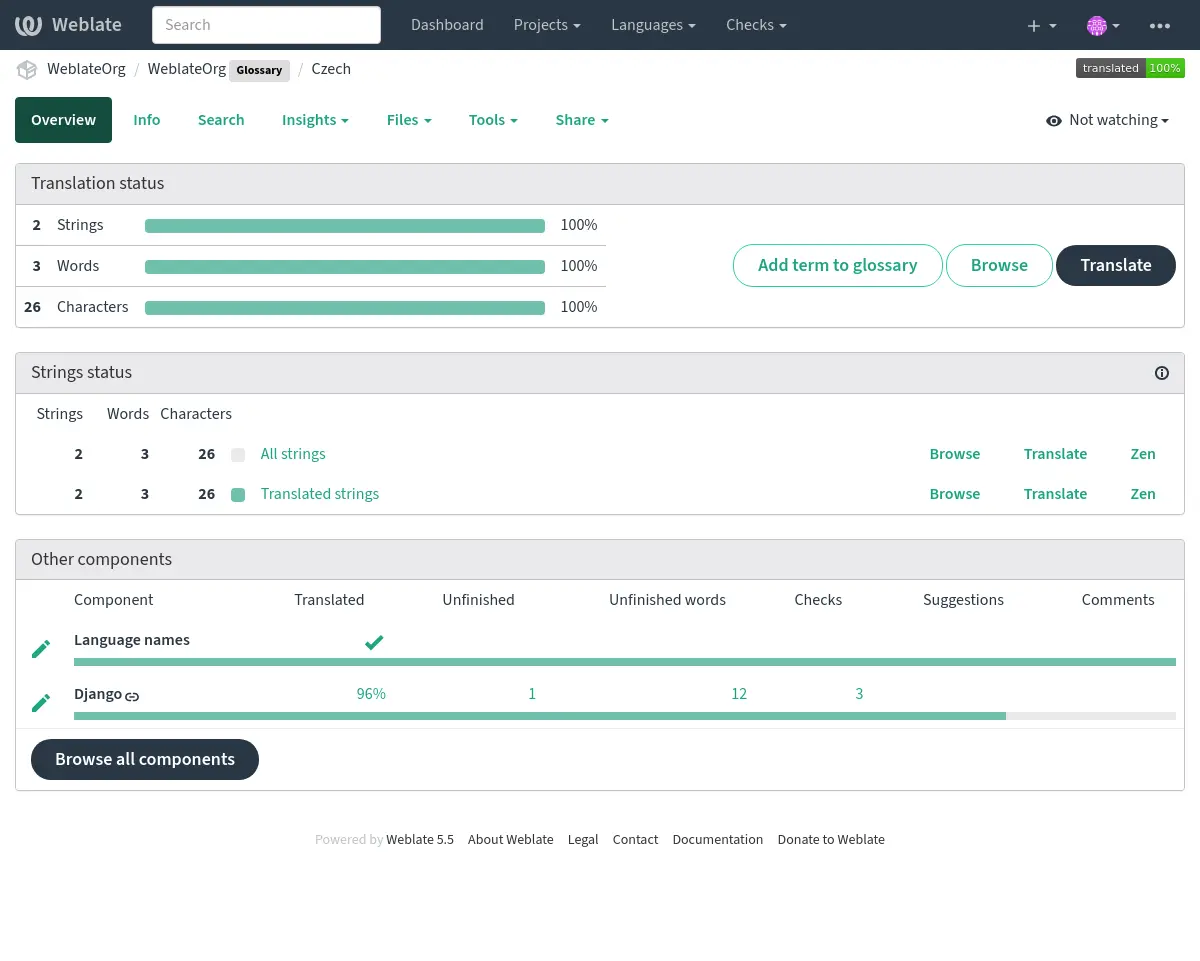
Sie können alle Begriffe des Glossars durchsuchen:
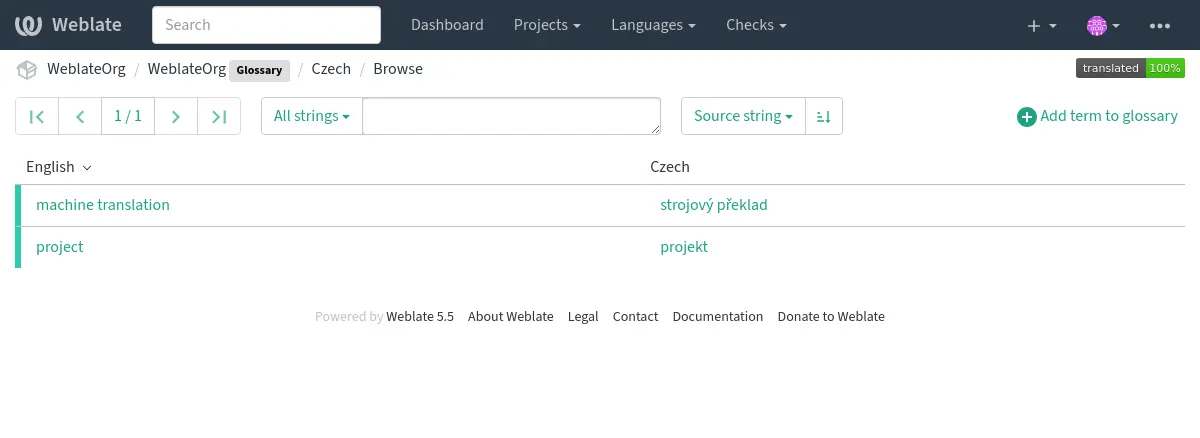
oder sie als beliebige Übersetzungen bearbeiten.
Glossarbegriffe
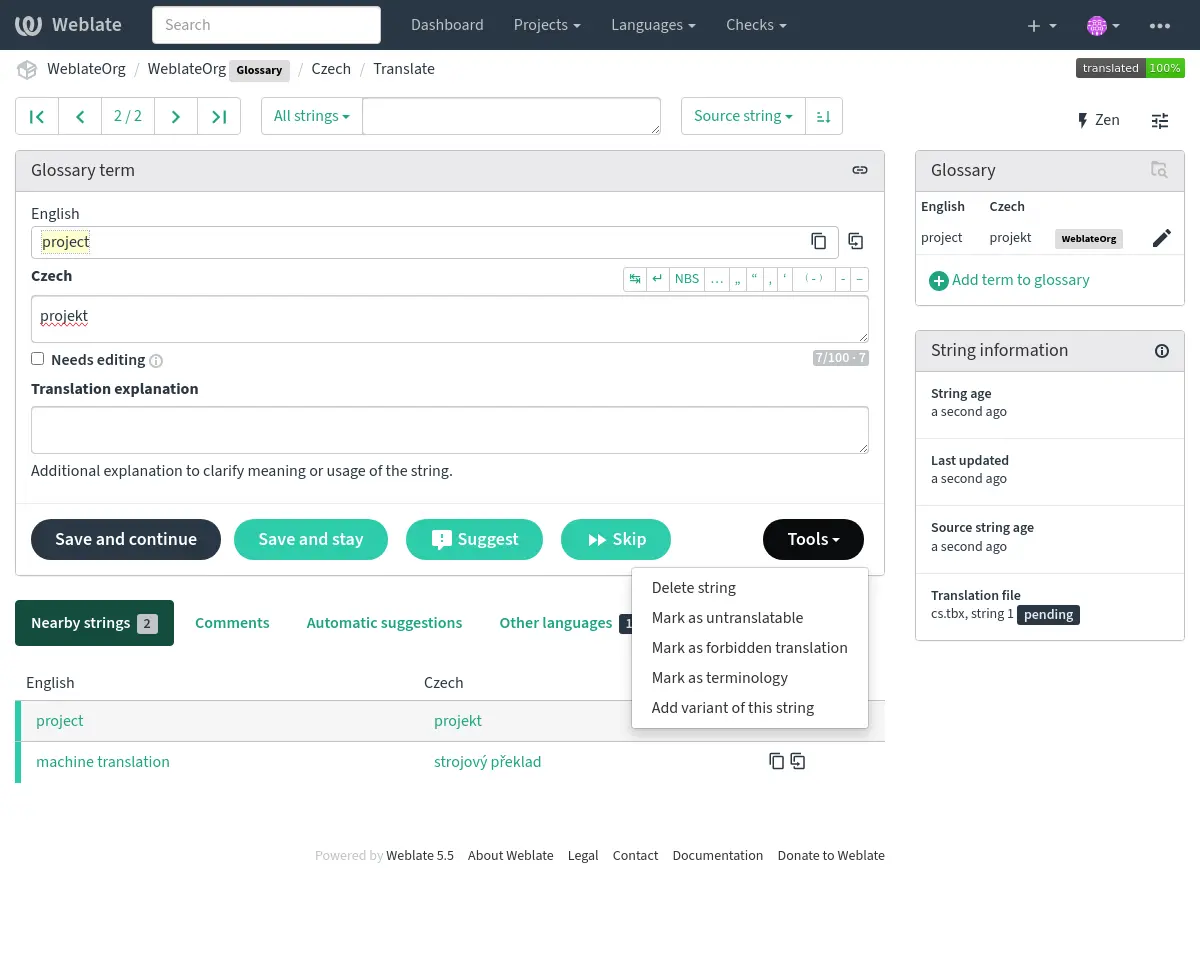
Glossarbegriffe werden auf die gleiche Weise übersetzt wie normale Zeichenketten. Sie können zusätzliche Funktionen über das Menü Werkzeuge für jeden Begriff einschalten.
Siehe auch
Typ |
Zweck |
|---|---|
Regulärer Glossarbegriff |
Bevorzugte Übersetzung oder Erklärung eines Begriffs in einer oder mehreren Sprachen. |
Weblate speichert den Ausgangsbegriff in jeder Glossarsprache, sodass fehlende Übersetzungen nachverfolgt und ergänzt werden können. |
|
Begriff, der unverändert bleiben oder nicht übersetzt werden sollte. |
|
Übersetzung, die für den Ausgangsbegriff nicht verwendet werden sollte. |
|
Alternative Bezeichnung, Abkürzung oder Kurzform, die mit einem anderen Glossarbegriff zusammengefasst ist. |
Glossarbegriffe auswählen
Wählen Sie Glossarbegriffe nach ihrer Bedeutung und der Zielgruppe aus, nicht nur nach der wörtlichen Form. Ist ein Ausgangsbegriff mehrdeutig, fügen Sie eine Erklärung hinzu, damit die Übersetzer wissen, welche Bedeutung im jeweiligen Projekt gilt.
Glossary entries are especially useful for brand names, acronyms, product features, technical terms, and newly coined or transliterated words. Use variants for abbreviations or shorter wording, mark important cross-language terms as Terminologie, mark terms that should stay unchanged as Nicht übersetzbare Begriffe, and mark misleading translations as Unzulässige Übersetzungen.
Nicht übersetzbare Begriffe
Added in version 4.5.
Flagging certain glossary term translations read-only by bulk-editing,
typing in the flag, or by using Tools ↓
Mark this translation as untranslatable means they cannot be translated. Use this
for brand names, product names, domains, technology names, or other terms that
should not be changed in other languages. Such terms are visually highlighted
in the glossary sidebar.
To keep a term unchanged in every language, use Mark as untranslatable for all languages. If the current translation is already untranslatable, Make untranslatable apply to all languages moves that flag to the source. Forbidden translations are language-specific; terminology remains source-wide.
The read-only flag is enough when the glossary entry already exists in the
languages where it should be shown. Add the Terminologie flag as
well only when Weblate should create and maintain the untranslatable entry in
every glossary language.
Siehe auch
Unzulässige Übersetzungen
Added in version 4.5.
Das Markieren bestimmter Übersetzungen von Glossarbegriffen als Unzulässige Übersetzung durch Massenbearbeitung, Eingabe der Markierung oder durch Verwendung von Werkzeuge ↓ Als unzulässige Übersetzung markieren bedeutet, dass sie nicht verwendet werden dürfen. Verwenden Sie dies, um die Übersetzung klarzustellen, wenn einige Wörter zweideutig sind oder unerwartete Bedeutungen haben könnten.
Use forbidden entries for translations that should be avoided. Use regular glossary entries for preferred translations.
Siehe auch
Terminologie
Added in version 4.5.
Flagging certain source-language glossary terms as terminology by
bulk-editing, typing in the flag, or by using Tools ↓
Mark as terminology for all languages adds entries for them to all languages in the
glossary. Use this for important terms that should be well thought out, and
retain a consistent meaning across all languages.
Enable Zeichenketten verwalten on the glossary component to synchronize terminology. When it is disabled, Weblate does not create missing language entries, even for terms marked as terminology.
Weblate shows a dismissible diagnostic when string management is disabled for a glossary with no remote repository, or for another glossary that contains terminology. Enable string management to add terms directly in Weblate and synchronize terminology, or dismiss the warning if you maintain the glossary files separately.
The terminology flag is ongoing state, not just a one-time action. While the flag remains on the source term, Weblate treats it as terminology and keeps an entry for it in every glossary language. If a language entry is removed, the next glossary synchronization creates it again.
Removing the terminology flag stops this automatic maintenance, but it does
not remove or otherwise revert entries that were already created. They remain
regular glossary entries.
A regular glossary term can also have translations in every language. The difference is that Weblate does not recreate missing language entries for a regular term after they are removed.
Siehe auch
Varianten
Varianten sind eine allgemeine Möglichkeit, Zeichenketten zusammenzufassen. Alle Begriffsvarianten werden beim Übersetzen in der Seitenleiste des Glossars aufgeführt.
Hinweis
Damit können Sie Abkürzungen oder kürzere Ausdrücke für einen Begriff hinzufügen.
Siehe auch
Glossarimport
Ähnlich wie bei regulären Übersetzungskomponenten können Sie vorhandene Glossare in Weblate hochladen. Formate wie CSV-Dateien oder TermBase-eXchange-Format werden unterstützt und können hochgeladen werden, siehe Übersetzungen hochladen.
TBX files can include explanations, read-only metadata, and glossary flags; see TermBase-eXchange-Format for the exact metadata mapping.
Even though TBX can contain multiple languages, Weblate still maps component files to languages using the component file mask and language settings. For a TBX glossary component, keep the component source language as the source term language and name translation files for the target language they represent. Avoid naming a translation file with the same language as the component source language, because the source language already exists in Weblate and this can lead to duplicate language detection.
Siehe auch
Sprachdateien und Synchronisierung
Glossary components follow the languages used by the regular components in the same project. When a language is added to a regular component, Weblate adds the missing glossary language as well so glossary matches can be shown for that language.
This automatic language synchronization is intentional. Filtering glossary language files with Sprachfilter can reduce the number of managed files, but it also means Weblate has no glossary entries to show for filtered-out target languages.
Terminology entries are also synchronized. When a source glossary term is marked as terminology, Weblate creates missing entries in all glossary languages and recreates them if they are removed while the flag is still set.
Weblate can clean up stale glossary translations only for Weblate-managed glossaries, only when no regular component in the project still uses that language, and only when the stale glossary translation has no translated terms. If the stale glossary language still contains terms, Weblate keeps it and reports it as an unused glossary language.
Gängige Konfigurationsmuster
- Erklärendes Glossar nur in englischer Sprache
Add source-language glossary terms with explanations. This works as a maintained term list, but it will not show target-language glossary matches unless you also create entries in the target glossary languages.
- Erforderliche Terminologie
Add terms in the source glossary language, mark them as Terminologie, and let translators fill the created entries in each target language. Use explanations to document the intended meaning.
- Nicht übersetzbare Begriffe
Mark terms as Nicht übersetzbare Begriffe when they should stay unchanged. Add Terminologie only when the term should be present in every glossary language for matching and review.
- Unzulässige Übersetzungen
Add the misleading translation as a Unzulässige Übersetzungen entry. Add the preferred wording as a separate regular glossary entry when translators should use a specific translation instead.
Glossare in automatischen Vorschlägen
Added in version 5.3.
Einige automatische Vorschlagsdienste verwenden während der Übersetzung Glossare. Bitte berücksichtigen Sie deren Dokumentation unter Automatische Vorschläge, um die Unterstützung zu überprüfen.
Das Glossar wird verarbeitet, bevor es dem Dienst zur Verfügung gestellt wird:
Duplicate source entries are skipped for services that require unique source terms. LLM-based services can receive duplicates with explanations to disambiguate them.
Alle Steuerzeichen sowie führende und nachgestellte Leerzeichen werden entfernt.
Unzulässige Übersetzungen werden übersprungen.
Bemerkung
Viele Dienste speichern Glossare serverseitig und begrenzen die Anzahl der gespeicherten Glossare. Weblate löscht immer das älteste Glossar, wenn der Speicherplatz nicht mehr ausreicht.